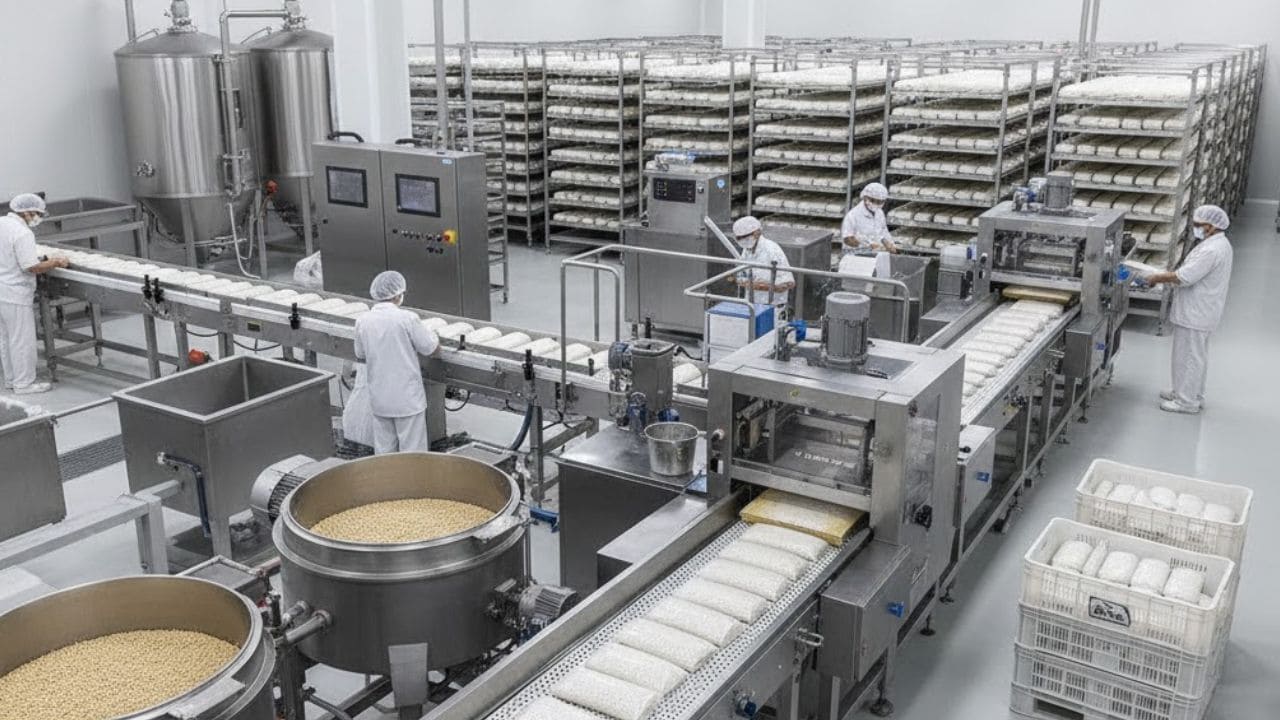
The plant-based protein market continues its explosive growth, with tempeh emerging as a nutritional powerhouse for health-conscious consumers. For food manufacturers entering this space, the difference between consistent, high-quality tempeh and inconsistent batches comes down to one critical factor: precise fermentation control. While traditional Indonesian methods rely on banana leaves and ambient temperatures, commercial tempeh production equipment for plant-based brands demands engineered solutions that deliver repeatable results at scale.
This comprehensive guide examines the specialized incubation systems, temperature control technologies, and post-fermentation processing equipment that enable consistent commercial tempeh production. Whether you're a startup plant-based brand scaling from farmers markets or an established food manufacturer diversifying your protein portfolio, understanding these systems is essential for market success.
Table of Contents
Navigate directly to the section you need. Click any link below to jump to detailed information about tempeh production equipment and commercial fermentation systems.
1. Understanding Commercial Tempeh Fermentation Requirements
Tempeh fermentation relies on Rhizopus oligosporus, a filamentous fungus that binds cooked soybeans into a dense, sliceable cake through mycelial growth. This seemingly simple transformation requires exacting environmental conditions to achieve the white, velvety mycelium consumers expect while preventing off-flavors, excessive sporulation, or contamination.
The critical temperature window for Rhizopus oligosporus activity spans 30-32°C (86-90°F). Within this narrow range, the fungus produces optimal mycelial growth without triggering premature sporulation (the black spore formation that indicates over-fermentation). However, commercial producers face a significant challenge: fermentation is highly exothermic. A properly inoculated batch generates substantial metabolic heat, potentially raising internal temperatures to 36-38°C within 12-16 hours if not actively managed.
Standard fermentation timelines run 20-24 hours from inoculation to harvest. During the first 8-12 hours, visible mycelium begins binding individual beans. The critical growth phase occurs between hours 12-20, when the mycelial mat achieves full density and develops tempeh's characteristic nutty aroma. Beyond 24 hours, most batches enter sporulation, producing the ammonia-like odors and bitter flavors that reduce product quality.
Moisture management proves equally critical. Properly fermented tempeh requires adequate oxygen penetration for aerobic growth, yet excess surface moisture promotes bacterial contamination, particularly Bacillus species. Commercial incubators must facilitate airflow around individual packages while maintaining the 85-90% relative humidity that prevents surface drying during fermentation.
Understanding these biological requirements informs every equipment decision in commercial tempeh production. The systems detailed below represent solutions to these fundamental challenges.
2. Types of Commercial Tempeh Incubators
Waterbath Incubator Systems
Waterbath incubators represent the gold standard for medium to large-scale commercial tempeh production. These systems utilize stainless steel trays suspended in temperature-controlled water baths, providing exceptional thermal stability and dual-purpose functionality.
A typical commercial waterbath system accommodates 14-28 perforated trays arranged in racks within an insulated stainless steel tank. Circulating water maintains precise temperature control (±0.5°C variance), while the thermal mass of water prevents the temperature spikes common in air-based systems. Tray dimensions commonly measure 60 x 40 cm with 3-5 cm depth, allowing 2-3 kg of inoculated substrate per tray. A 28-tray system produces approximately 70 kg finished tempeh per 24-hour cycle.
The dual-purpose capability of waterbath systems provides significant ROI advantages. The same equipment that maintains 30-32°C for fermentation can heat to 80°C for post-fermentation pasteurization, eliminating the need for separate blanching equipment. This 15-minute pasteurization step inactivates enzymes and surface bacteria, extending refrigerated shelf life from 5-7 days to 10-14 days before vacuum packaging.
Construction quality matters significantly. Food-grade AISI 304 or 316 stainless steel prevents corrosion and facilitates sanitation. Integrated heating elements (typically 3-6 kW for commercial units) and circulation pumps ensure temperature uniformity throughout the bath. Advanced systems include programmable controllers that automatically transition from fermentation to pasteurization cycles.
Cabinet-Style Incubators
Cabinet incubators offer an accessible entry point for small to medium-scale producers. These insulated chambers use thermostat-controlled heating elements or arrays of incandescent bulbs to maintain fermentation temperatures. Units typically feature adjustable shelving that accommodates various package sizes and production volumes.
Temperature control in cabinet systems relies on air circulation rather than water, making them more susceptible to hot spots and temperature gradients. Quality units incorporate circulation fans and multiple heating zones to minimize these variations. Capacity ranges from 50-200 kg per batch depending on cabinet dimensions and shelving configuration.
The primary advantage of cabinet incubators lies in their lower capital cost and operational simplicity. Units designed for pharmaceutical or laboratory applications can be adapted for tempeh production, though food-grade construction and sanitation features should be verified. Limitations include slower heat distribution, greater temperature variation (±1-2°C), and the need for separate pasteurization equipment.
Automated Incubation Systems
Emerging automated systems integrate multiple process steps into compact, countertop-scale units. Systems like the TempehSure combine controlled inoculation, precise temperature management, and programmed fermentation cycles in units suitable for small commercial kitchens or R&D applications.
These systems excel at producing 5-15 kg batches with minimal manual intervention. Digital controllers maintain temperature profiles, while integrated timers and alarms ensure consistent results. Though production capacity limits their application to specialty or small-batch operations, they provide valuable quality control for product development and testing new formulations.
3. Critical Equipment Specifications
Selecting appropriate tempeh production equipment for plant-based brands requires evaluating specifications that directly impact product consistency, food safety, and operational efficiency.
Temperature Control Accuracy: Fermentation success depends on maintaining 30-32°C throughout the incubation cycle. Quality systems provide ±0.5°C accuracy with PID (proportional-integral-derivative) controllers. Less expensive thermostatic controls often exhibit ±2°C swings that compromise mycelial development. Digital controllers with data logging capabilities enable HACCP documentation and process optimization.
Construction Materials: All product-contact surfaces must use food-grade stainless steel (AISI 304 minimum, AISI 316 preferred for acidified products). Insulation should be closed-cell foam or mineral wool to prevent moisture absorption and microbial growth. Avoid aluminum, which corrodes under the acidic conditions sometimes used in tempeh production.
Airflow Management: Rhizopus requires oxygen for aerobic metabolism, demanding perforated trays or mesh-bottom containers that facilitate air circulation. Incubator designs should allow 15-20% open area in horizontal surfaces. Some systems incorporate gentle forced-air circulation (0.1-0.3 m/s velocity) to distribute heat and provide oxygen without desiccating the product surface.
Humidity Control: Target relative humidity of 85-90% prevents surface drying while avoiding condensation that promotes bacterial growth. Passive humidity management relies on the moisture released during fermentation, while active systems may include humidification or controlled ventilation. Over-humidification risks contamination; under-humidification causes incomplete mycelial coverage at package edges.
Sanitation Features: Daily cleaning between batches prevents cross-contamination and Aspergillus introduction. Incubators should feature removable components, smooth surfaces without crevices, and drainage systems that facilitate CIP (clean-in-place) procedures. NSF/ANSI 51 certification for food equipment sanitation provides third-party verification of cleanability.
Monitoring and Safety Systems: Commercial operations require over-temperature alarms, power failure notifications, and continuous temperature recording. Systems with remote monitoring capabilities enable 24-hour oversight without on-site personnel during fermentation cycles. Emergency cooling protocols prevent total batch loss from equipment failures.
4. Inoculation Equipment and Process Control
Successful fermentation begins with proper inoculation of Rhizopus oligosporus spores onto prepared substrate. Commercial tempeh production equipment for plant-based brands must ensure uniform spore distribution at appropriate rates while maintaining sanitary conditions.
Starter Culture Handling: Rhizopus oligosporus cultures are available as spore powders, typically packaged in 100-500 g quantities. Storage at 4°C maintains viability for 6-12 months. Some producers cultivate their own starter cultures on rice or soybean substrates, though this requires dedicated facilities to prevent cross-contamination with wild Aspergillus or other molds.
Inoculation Rates and Distribution: Standard inoculation rates range from 0.1-0.3% by weight (1-3 g per kg substrate). Under-inoculation extends fermentation time and risks contamination; over-inoculation can cause excessive heat generation. For uniform distribution, spore powder is often diluted in sterile water or mixed with a small portion of cooled substrate before blending with the full batch.
Mechanical mixing equipment should provide gentle tumbling action that distributes inoculant without damaging cooked beans. Ribbon blenders or drum mixers work well for batches exceeding 50 kg. Smaller operations may use manual mixing in food-grade containers, though consistency suffers.
Pre-Fermentation Acidification: Many commercial protocols incorporate acidification with food-grade lactic acid (1% addition) or vinegar to lower substrate pH to 4.5-5.0. This selective pH favors Rhizopus growth while inhibiting bacterial competitors, particularly Bacillus cereus. Acidification equipment ranges from simple dosing pumps to automated pH-controlled systems for large batches.
Substrate Preparation Integration: Tempeh incubators function as one component in a complete production line. Upstream equipment includes soybean soaking tanks, pressure cookers or continuous cookers for substrate preparation, and cooling systems that reduce cooked beans to 35°C before inoculation. Downstream integration with packaging and pasteurization equipment creates efficient production flow.
Quality Control Parameters: Before inoculation, verify substrate moisture content (beans should appear dry on the surface but not desiccated), temperature (30-35°C at inoculation), and pH if acidification is used. During fermentation, monitor incubator temperature at multiple locations and check batches at 12, 18, and 24 hours for mycelial development and off-odors.
5. Post-Fermentation Processing Equipment
Raw tempeh harvested from incubators requires additional processing to ensure food safety, extend shelf life, and meet consumer expectations for ready-to-cook products.
Pasteurization Systems: Heat treatment to 80°C core temperature for 15 minutes inactivates enzymes and reduces surface microorganisms without significantly affecting texture. Waterbath systems with programmable controllers excel at this dual fermentation/pasteurization function. Facilities using cabinet incubators require separate blanching equipment-typically steam chambers or submersion tanks with temperature monitoring.
Cooling Requirements: Rapid cooling to below 10°C following pasteurization prevents spore germination and extends shelf life. Tunnel coolers or blast chillers reduce tempeh to refrigeration temperature within 60-90 minutes. Slower cooling in walk-in coolers extends to 4-6 hours and may allow some bacterial regrowth.
Cutting and Portioning Equipment: Consumer packages typically contain 200-400 g portions, requiring slicing or dicing. Band saws, ultrasonic cutters, or wire cutting frames provide clean cuts without compressing the tempeh structure. Automated portioning systems with weight verification ensure package consistency for retail distribution.
Pre-Marination Systems: Value-added tempeh products increasingly incorporate marinades or seasonings. Vacuum tumbling equipment infuses flavors deep into the porous tempeh structure. Continuous coating systems apply dry seasonings or glazes before packaging. These secondary processing steps command premium pricing and differentiate brands in competitive markets.
6. Vacuum Packaging Systems for Tempeh
Oxygen exposure drives rapid quality deterioration in tempeh through continued oxidation and eventual spoilage. Vacuum packaging extends refrigerated shelf life from 7-10 days to 21-28 days while maintaining organoleptic quality and preventing package purge.
Chamber Vacuum Sealers: Entry-level commercial operations utilize chamber vacuum sealers that evacuate air from both the chamber and the package simultaneously. Single-chamber units process 2-4 packages per minute (depending on vacuum cycle time), suitable for operations producing 50-150 kg daily. Dual-chamber systems alternate between chambers, nearly doubling throughput while maintaining continuous operation.
Chamber vacuum levels should reach 98-99.5% evacuation (5-10 mbar absolute pressure) to remove sufficient oxygen for effective preservation. Seal bars must achieve 3-5 mm seal width at 140-160°C to create hermetic closures in multi-layer barrier films. Quality units include gas flush capabilities for modified atmosphere packaging if desired.
Thermoforming Rollstock Systems: High-volume producers (500+ kg daily) justify thermoforming packaging equipment that creates packages from rollstock film. These inline systems form the bottom package, fill with product, create vacuum, seal the top film, and cut individual packages in continuous operation. Throughput reaches 20-40 packages per minute depending on package size.
Initial capital investment for thermoforming equipment ranges from $50,000-$200,000, but per-package costs drop significantly at volume. These systems also enable custom package shapes and sizes that differentiate products on retail shelves.
Barrier Film Requirements: Tempeh packaging demands high oxygen barrier films to prevent oxidative rancidity and off-flavor development. Multi-layer structures incorporating EVOH (ethylene vinyl alcohol) or metallized layers achieve oxygen transmission rates below 5 cc/m²/24hrs at 23°C, 0% RH. Nylon or polyester outer layers provide puncture resistance for the relatively rigid tempeh blocks.
Film thickness typically ranges from 75-100 microns (3-4 mil) for adequate protection. Transparent films showcase the white mycelium, an important visual quality cue, though some brands use printed films with viewing windows.
Timing and Food Safety: Vacuum packaging should occur immediately following pasteurization and cooling to minimize oxygen exposure and bacterial recontamination. The critical food safety consideration involves preventing Bacillus cereus spore germination and growth, which can occur in improperly pasteurized tempeh held at room temperature. Some operations include refrigeration time before packaging to verify absence of spoilage indicators.
Modified atmosphere packaging (MAP) using CO2/N2 blends offers an alternative to high-vacuum packaging, though equipment complexity and gas costs generally favor vacuum systems for tempeh applications.
7. Scaling Production: Equipment Sizing Guide
Matching equipment capacity to production goals and market demand prevents both overcapitalization and operational bottlenecks.
Small-Scale Operations (10-50 lbs/day): Startup brands and farmers market vendors typically begin with cabinet-style incubators holding 15-30 kg per batch. A single 24-hour cycle produces sufficient volume for weekly market sales. Equipment investment ranges from $2,000-$8,000 for incubator, basic inoculation supplies, and chamber vacuum sealer. Manual processes dominate at this scale, with labor representing the primary variable cost.
Medium-Scale Production (100-300 lbs/day): Regional distribution to natural food stores and co-ops demands consistent daily production. Multi-tray waterbath incubators (14-20 trays) enable 50-80 kg per cycle with superior quality control. Two-shift operation or staggered batch starts provide daily throughput. Equipment costs escalate to $15,000-$40,000 including incubation, pasteurization, and packaging systems. At this scale, dedicated production space and some automation become cost-effective.
Large-Scale Production (500+ lbs/day): National distribution requires industrial equipment and continuous production scheduling. Multiple incubation systems operated in parallel, automated substrate preparation, thermoforming packaging lines, and integrated cold storage characterize these facilities. Capital investment exceeds $150,000-$500,000 for complete production lines. Per-unit costs drop significantly through economies of scale, enabling competitive pricing for mainstream retail distribution.
ROI Calculations: Equipment amortization, utilities, labor, and raw materials determine production costs. Small-scale operations typically achieve $4-6 per pound wholesale pricing with 40-50% gross margins. Medium-scale producers reduce costs to $2.50-4.00 per pound through improved efficiency. Large-scale manufacturers approach $1.50-2.50 per pound, competing directly with established brands while maintaining profitability.
Throughput optimization requires matching incubation capacity with upstream substrate preparation and downstream packaging capabilities. Bottlenecks at any process step limit overall production regardless of individual equipment capacity.
8. Sanitation and Food Safety Compliance
Tempeh production environments harbor numerous microbial contamination risks that demand rigorous sanitation protocols and HACCP implementation.
Daily Cleaning Protocols: All product-contact surfaces require cleaning between batches. Waterbath systems should be drained, surfaces scrubbed with alkaline detergent, rinsed thoroughly, and sanitized with food-grade quaternary ammonium or peracetic acid solutions. Removable trays and racks should undergo separate washing in commercial dishwashers or three-compartment sinks. Cabinet incubators require similar treatment, with particular attention to corners, fans, and heating elements where organic matter accumulates.
HACCP Critical Control Points: Temperature and time during fermentation represent the primary CCPs. Continuous temperature logging with alarm systems provides verification. Post-fermentation pasteurization temperature and duration require monitoring and documentation. Packaging integrity (seal quality and barrier performance) prevents recontamination and extends shelf life.
Preventing Contamination: The primary tempeh spoilage organisms include Aspergillus species (producing yellow-orange discoloration and mycotoxins), Bacillus cereus (causing ropiness and potential foodborne illness), and various bacterial contaminants. Prevention strategies include:
- Dedicated production areas isolated from other food operations
- Positive air pressure systems with HEPA filtration
- Personnel hygiene protocols (handwashing, clean garments, restricted access)
- Regular environmental monitoring and swab testing
- Proper starter culture storage and handling
- Acidification protocols when appropriate
Regulatory Compliance: Tempeh production in the United States falls under FDA jurisdiction. Facilities must comply with Current Good Manufacturing Practices (CGMPs) and develop HACCP plans addressing identified hazards. State and local health departments may impose additional requirements. Organic certification requires NON-GMO soybeans, organic-compliant processing aids, and approved cleaning chemicals.
Proper documentation systems tracking raw material sourcing, batch records, temperature logs, cleaning verification, and finished product testing provide the foundation for regulatory compliance and quality assurance.
9. Conclusion
Scaling tempeh production from artisanal batches to consistent commercial output demands purpose-built fermentation equipment that controls the critical parameters of temperature, time, moisture, and sanitation. For plant-based brands entering this rapidly growing market, equipment investment priorities should emphasize temperature control precision, food safety features, and scalability that matches business growth trajectories.
The tempeh production equipment for plant-based brands detailed in this guide-from waterbath incubators providing dual fermentation and pasteurization capabilities to vacuum packaging systems extending shelf life-represents proven solutions that deliver the consistency consumers expect. Quality control throughout the process, from Rhizopus inoculation through final packaging, drives consumer acceptance and repeat purchases in an increasingly competitive market.
As plant-based protein consumption continues accelerating, manufacturers who master fermentation technology and invest in appropriate production systems will capture market share and command premium positioning. The future of tempeh production lies not just in scaling volume, but in maintaining the artisanal quality characteristics that distinguish this ancient fermented food in modern plant-based portfolios.
Scaling tempeh production for plant-based brands?
This premium domain is perfect for launching your tempeh production platform, alternative protein fermentation guide, or plant-based equipment resource site. FermenterPro.com attracts food entrepreneurs, plant-based manufacturers, and fermentation specialists seeking authoritative content on tempeh production equipment, sanitation protocols, and commercial scaling strategies.