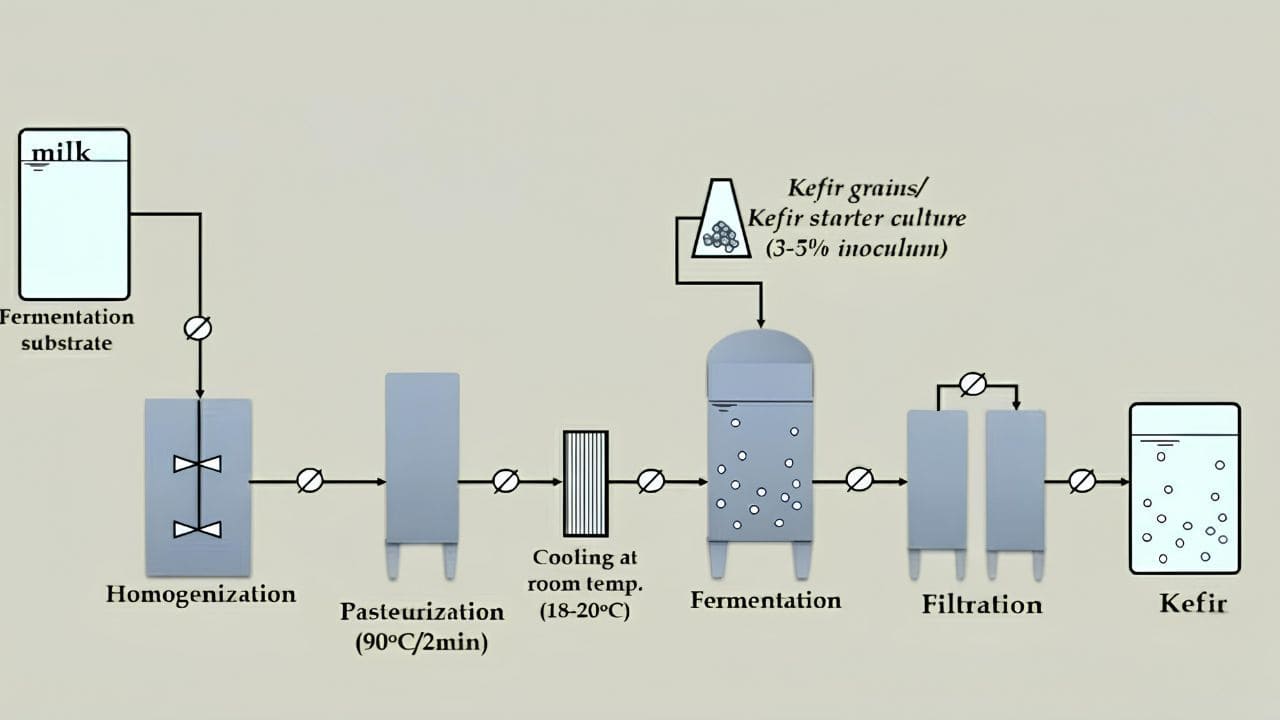
Kefir production represents one of the fastest-growing opportunities in the fermented dairy sector, with the global market valued at $2.85 billion in 2023 and projected to grow at 6.3% annually through 2032. Unlike yogurt operations facing saturated markets and commodity pricing pressure, kefir producers benefit from premium positioning ($4-$8 per quart retail), health-conscious consumer demand for probiotic foods, and manageable shelf life of 21 days enabling regional distribution without extensive cold chain infrastructure.
Small dairy startups choose kefir for compelling economics: 40-60% gross margins on retail sales, minimal specialized equipment beyond standard dairy processing, and production cycles of just 18-24 hours enabling rapid inventory turnover. A modest 200-liter fermentation system producing 800 bottles weekly can generate $40,000-$60,000 annually with startup equipment investment of $8,000-$15,000.
The critical decision facing dairy entrepreneurs involves production methodology: traditional kefir grains offering complex flavor profiles and living culture propagation, versus standardized powder cultures (DVS - Direct Vat Set) providing batch consistency and scalability. This choice fundamentally impacts equipment selection, quality control protocols, and long-term operational costs.
But here's the operational reality: scaling beyond 100 bottles weekly requires systematic approach. That 5-gallon home fermentation vessel you tested recipes with? Commercial production demands temperature-controlled jacketed tanks, automated pH monitoring, and rigorous sanitation protocols meeting Grade A dairy standards. The difference between artisanal home production and licensed commercial operation isn't just volume-it's comprehensive quality control, regulatory compliance (FDA PMO requirements), and equipment investments justifying $8,000-$50,000 depending on target production capacity.
By the end of this guide, you'll understand the five primary kefir production system architectures (small-batch jacketed tanks through continuous flow systems), how to calculate true cost-per-bottle including culture, labor, and regulatory compliance, which equipment justifies premium investment versus where commodity options suffice, and the specific operational challenges that only appear at commercial scale. Whether you're a dairy farmer diversifying revenue streams, an artisanal producer scaling from farmers markets to wholesale, or an entrepreneur launching a regional probiotic beverage brand, this is your technical roadmap.
This guide evaluates five commercial kefir production systems ranging from $2,500 to $35,000, analyzes the economic and operational tradeoffs between grain-based and powder culture fermentation, explains pasteurization requirements protecting both product safety and probiotic viability, and provides the production workflows and shelf life management strategies necessary for building sustainable kefir operations from dairy startup to regional distribution.
Table of Contents
Navigate directly to the section you need. Click any link below to jump to detailed information about kefir production systems, cultures, regulations, and profitability.
1. Kefir Production Fundamentals for Commercial Scale
Kefir fermentation involves complex symbiotic culture of bacteria and yeasts (SCOBY) converting lactose into lactic acid, ethanol, and carbon dioxide. Traditional kefir grains contain 40-60 distinct probiotic strains including Lactobacillus species, Streptococcus thermophilus, and various yeasts, creating the tangy, slightly effervescent beverage. Powder cultures typically provide 7-12 strains selected for consistency and regulatory compliance.
Fermentation requires precise temperature control between 68-78°F (20-25°C). Below 65°F fermentation slows dramatically extending production time to 36-48 hours and increasing contamination risk. Above 80°F beneficial bacteria populations decline while undesirable thermophilic organisms proliferate, producing off-flavors and compromising safety. Commercial operations target 72-75°F for optimal 18-24 hour fermentation cycles.
Inoculation rates vary by culture type: kefir grains require 2-5% by weight (20-50 grams grains per liter milk), while powder cultures use manufacturer-specified rates typically 0.02-0.05% (0.2-0.5 grams per liter). Higher inoculation accelerates fermentation but may produce excessive acidity; lower rates extend fermentation time but risk contamination during prolonged incubation.
Pre-fermentation pasteurization represents non-negotiable food safety requirement for commercial dairy. Milk must be heated to 161°F (72°C) for 15 seconds (HTST pasteurization) or 145°F (63°C) for 30 minutes (batch pasteurization) to eliminate pathogens and competing bacteria. All major kefir brands including Lifeway Foods pasteurize before fermentation, then add probiotic cultures, ensuring finished product contains only beneficial live cultures.
Post-fermentation pasteurization extends shelf life to 45-60 days but kills probiotic organisms, preventing "live cultures" labeling and eliminating the primary value proposition consumers seek. This practice remains rare among premium kefir brands focused on probiotic content.
The standard 21-day refrigerated shelf life results from continued slow fermentation even at 35-40°F storage temperature. During refrigeration, pH gradually decreases from initial 4.4-4.5 to 4.0-4.2, increasing tartness while maintaining safety. Proper cold chain management (never exceeding 40°F from production through retail display) ensures consistent quality throughout shelf life. Many commercial kefir products remain consumable 7-10 days beyond printed dates when continuously refrigerated.
Critical Success Factors for Commercial Kefir:
- Precise temperature control (72-75°F) throughout 18-24 hour fermentation
- pH monitoring and endpoint determination (target 4.4-4.5)
- Culture management: grain health maintenance or powder culture lot tracking
- Pasteurization compliance (161°F/15s HTST or 145°F/30m batch)
- Cold chain integrity (never exceed 40°F from production to retail)
- Batch documentation for regulatory compliance and quality tracking
At commercial scale, consistency isn't perfectionism-it's the difference between wholesale accounts and rejected batches.
2. Kefir Production Systems: 5 Equipment Options
1. Small-Batch Jacketed Fermentation Tanks (20-50L)
Technical Specifications:
Stainless steel 304 vessels with glycol-jacketed temperature control enable precise fermentation management for recipe development and small-scale production.
Cost Breakdown:
- Tank: $1,800-$4,500 (depending on capacity and automation level)
- Glycol chiller: $600-$1,200
- Temperature controller (if not included): $200-$400
- Additional fittings and hoses: $100-$200
Total system investment: $2,700-$6,300
Operating costs: $10-$20 monthly (electricity for chiller)
Production Capacity:
20L System
160-270
bottles/week (2-3 batches)
50L System
400-675
bottles/week (2-3 batches)
Labor: ~1.5 hours per batch for setup, inoculation, pH monitoring, and harvesting.
Footprint: Compact 2' x 2' floor space, 24-30" height. Weight fully loaded: 100-220 lbs depending on capacity. Fits standard dairy processing areas or commercial kitchens. Requires standard 110V outlet and water source for glycol system circulation.
Skill Level: Intermediate. Requires understanding of temperature control systems, glycol circulation, pH monitoring, proper inoculation rates, and sanitation protocols. First-time kefir producers benefit from supplier training or dairy extension services.
Pros:
- Precise temperature control (±1°F) ensures batch consistency
- Professional stainless construction provides 15-20 year lifespan
- Compact footprint fits existing dairy processing spaces
- Scalable-purchase multiple units for capacity expansion
- Excellent for developing recipes before scaling up
- Compatible with both kefir grains and powder cultures
- CIP spray balls simplify sanitization between batches
Cons:
- Requires glycol chiller infrastructure and electrical service
- Manual batch harvesting labor-intensive for high volumes
- CIP cleaning demands disassembly for thorough sanitation
- Higher capital cost per liter compared to simpler vessels
- Glycol system adds complexity and potential failure points
Best For: Dairy startups testing market demand with 100-300 bottles weekly, operations developing multiple kefir flavors requiring separate fermentation vessels, cheesemakers adding kefir as complementary product line, farms with existing dairy processing infrastructure.
Expected Outcomes: Batch-to-batch pH variation under 0.15 units, fermentation time consistency ±2 hours, yield 19-20 liters from 20L batch (95% efficiency). Produces competition-quality kefir suitable for premium retail positioning.
2. Mid-Scale Batch Fermenters (100-300L)
Technical Specifications:
Purpose-built commercial fermenters designed for dairy processing scale, featuring automated temperature control, optional agitation systems, and sophisticated monitoring.
Cost Breakdown:
- 100L system: $6,000-$10,000
- 200L system: $10,000-$15,000
- 300L system: $13,000-$20,000
- Electrical installation: $500-$1,500
- Plumbing for CIP system: $300-$800
- Validation and commissioning: $500-$1,000
Total installed cost (200L system): $11,300-$17,300
Production Capacity:
100L System
2,000-2,700
bottles/week (5-6 batches)
200L System
4,000-5,400
bottles/week (5-6 batches)
300L System
6,000-8,100
bottles/week (5-6 batches)
Note: Most startups operate 2-3 batches weekly initially (1,600-2,700 bottles for 200L system).
Footprint: 36-48 inches diameter, 48-60 inches height. Requires dedicated production space with ceiling clearance for cleaning access. Weight empty: 150-350 lbs. Requires 220V/30A electrical service (may necessitate facility electrical upgrades).
Skill Level: Advanced. Requires understanding of automated fermentation control, PLC systems, CIP protocols, HACCP documentation, pH endpoint determination, and regulatory compliance. Operator training essential-2-3 days typical commissioning period.
Pros:
- Automated temperature profiling optimizes fermentation kinetics
- Integrated documentation aids regulatory compliance (HACCP records)
- CIP systems reduce cleaning labor from 45 minutes to 15 minutes
- Jacketed design enables heating for pasteurization and cooling for fermentation in single vessel
- Production capacity supports wholesale distribution beyond direct retail
- Programmable profiles ensure batch-to-batch consistency
- Sample ports enable in-process quality testing without contamination risk
Cons:
- Significant capital investment requires 6-12 month ROI timeline
- Electrical infrastructure (220V/30A typical) may require facility upgrades
- Footprint demands dedicated production space
- Complexity necessitates operator training for proper use and maintenance
- Powder cultures strongly recommended (grain harvesting impractical at this scale)
Best For: Dairies producing 500-2,000 bottles weekly for wholesale and retail distribution, operations transitioning from startup to established regional brand, facilities with existing Grade A dairy license and processing space, producers targeting grocery chains requiring consistent supply and quality.
Expected Outcomes: pH variance under 0.1 units batch-to-batch with powder cultures, fermentation time consistency ±1 hour, yield 95-97% efficiency. Capable of meeting wholesale quality specifications for major retailers.
3. Continuous Flow Fermentation Systems (200-500L)
Technical Specifications:
Advanced continuous processing where fresh pasteurized milk feeds constantly while finished kefir harvests continuously. Maintains steady-state fermentation with 18-24 hour residence time.
Cost Breakdown:
- 200L continuous system: $18,000-$28,000
- 500L continuous system: $28,000-$40,000
- Automated culture dosing pump: $1,500-$3,000
- Inline pH monitoring: $2,000-$4,000
- PLC programming and commissioning: $3,000-$5,000
- Backup batch fermentation capacity: $5,000-$8,000
Total turnkey installation (200L): $29,500-$50,000
Production Capacity:
200L System
5,600
bottles/week (800/day)
500L System
14,000
bottles/week (2,000/day)
Labor: 3-4 hours daily for milk prep, culture management, quality testing, and CIP cycles. Output consistency exceptional once steady state achieved.
Footprint: Single large vessel configuration: 200L requires 36"×60" floor space, 500L requires 48"×72" floor space. Height: 60-84 inches. Additional space needed for pumps, control panels, culture dosing systems. Weight empty: 250-650 lbs.
Skill Level: Expert. Powder cultures mandatory-kefir grains incompatible with continuous flow systems. Continuous operations use frozen DVS cultures with automated reconstitution and dosing. Complexity demands trained operators and maintenance technicians. Requires understanding of steady-state fermentation kinetics, PLC troubleshooting, and process optimization.
Pros:
- Highest throughput per square foot of production space
- Labor efficiency exceeds batch systems by 40-60% at scale
- Consistent steady-state fermentation produces minimal batch variation
- Continuous availability supports just-in-time delivery for major retail accounts
- Equipment amortization favorable when running 6-7 days weekly
- Culture costs higher but labor savings offset expense at high volumes
- Once steady state achieved, requires minimal intervention
Cons:
- Massive capital investment requires established market and financing
- Startup period (2-4 weeks to achieve steady state) produces inconsistent product
- System failures disrupt entire production-no backup means zero product
- Minimum viable scale 1,500+ bottles weekly to justify investment
- Inflexible for recipe variation or seasonal flavors
- Culture costs higher ($0.30-$0.45 per bottle vs $0.15-$0.25 batch systems)
Best For: Established kefir brands with proven market serving 2,000+ bottles weekly, dairies adding kefir to existing high-volume yogurt or milk processing, regional distributors seeking economies of scale, operations with 24/6 or 24/7 production schedules amortizing capital rapidly.
Expected Outcomes: Output consistency exceptional-once steady state achieved, product quality remains stable for weeks. Labor costs reduced to $0.22 per bottle vs $0.50 for batch operations. pH variance typically ±0.03 units with automated monitoring.
4. Hybrid Batch-Continuous Fermentation Systems (150-400L)
Technical Specifications:
Modular designs combining batch fermentation flexibility with continuous harvesting efficiency. Multi-vessel configuration with staggered schedules creating continuous product availability.
Cost Breakdown:
- Three-vessel 75L hybrid system: $12,000-$18,000
- Four-vessel 100L configuration: $18,000-$28,000
- Centralized PLC controller: included
- Automated valving matrix: included
- Shared pasteurization/cooling equipment: included
- Electrical and plumbing installation: $3,000-$4,000
Total installed cost: $15,000-$32,000
Production Capacity:
3-Vessel 75L System
2,700-3,150
bottles/week (staggered)
4-Vessel 100L System
4,800-5,600
bottles/week (staggered)
Scalability: Capacity scales linearly by adding vessels-modular design enables incremental expansion as market grows.
Footprint: Three-vessel system requires approximately 6×8 ft floor space, four-vessel requires 8×10 ft. Height: 48-60 inches per vessel. Interconnecting piping and shared equipment add complexity. Combined weight empty: 400-900 lbs depending on configuration.
Skill Level: Advanced to Expert. Flexible-can accommodate grain or powder methodology. Grain-based production works well with 2-3 vessel configuration allowing time for grain harvesting and transfer. Powder cultures enable full automation with 4+ vessel systems. Requires understanding of staggered batch scheduling, multi-vessel coordination, and automated valving control.
Pros:
- Modular expansion spreads capital investment over time matching revenue growth
- Batch methodology enables recipe experimentation and seasonal flavors
- Redundancy protects against complete production loss if one vessel fails
- Labor requirements scale gradually vs dramatic jump from batch to continuous
- Suitable for operations uncertain about long-term volume commitment
- Maintains production flow while allowing flexibility
- Can mix grain cultures (artisanal) with powder cultures (consistency) in different vessels
Cons:
- Higher per-liter capital cost than dedicated continuous systems at equivalent volumes
- Complexity of multi-vessel coordination demands sophisticated control systems
- Floor space requirements exceed single large vessel
- Cleaning labor higher than single vessel batch systems
- Interconnecting piping increases maintenance complexity
Best For: Growing dairies uncertain about 12-24 month demand trajectory, operations requiring flexibility for seasonal flavors or co-packing arrangements, facilities with spatial constraints preventing installation of large single vessels, producers wanting scalability without massive upfront investment.
Expected Outcomes: Continuous product availability despite batch methodology. Flexibility to run different recipes simultaneously. Production redundancy-if one vessel fails, others continue operating. Labor efficiency improves as vessels added to system.
5. Complete Turnkey Starter Kits (Small Dairy)
Technical Specifications:
Bundled systems integrating all essential equipment for kefir production launch. Complete solution eliminating research burden with 15-25% cost savings versus individual purchases.
Cost Breakdown:
- Basic 50L kit: $5,000-$8,000
- Standard 75L kit: $8,000-$12,000
- Premium 100L kit with bottling automation: $12,000-$18,000
- Includes 6-12 months consumable supplies (cultures, cleaning chemicals, initial packaging)
Kit range: $5,000-$18,000
Ongoing costs per bottle: Cultures $0.20-$0.35, Packaging $0.80-$1.20, Utilities $0.10-$0.15
Production Capacity:
50L Kit
400-675
bottles/week (2-3 batches)
100L Kit
800-1,350
bottles/week (2-3 batches)
Typical ramp-up: Most buyers start 1-2 batches weekly (200-450 bottles) during market development, scaling to full capacity within 6-12 months.
Footprint: Compact integrated design. 50L kit requires approximately 4×6 ft space, 100L kit requires 5×8 ft. All components designed for coordinated placement. Typical height 48-60 inches. Weight varies by configuration: 150-400 lbs total equipment.
Skill Level: Beginner to Intermediate. Most kits supply powder cultures-typically 50-100 doses of freeze-dried DVS from Chr. Hansen, Danisco, or similar suppliers. Includes instructions for culture handling, storage, and reconstitution. Grain cultures available as kit upgrades ($100-$200 additional) providing 50-100 grams starter grains and grain propagation guide. Included training resources accelerate learning curve for first-time kefir producers.
Pros:
- Single-supplier sourcing simplifies procurement and ensures component compatibility
- Bulk pricing saves 15-25% versus individual equipment purchases
- Included training resources accelerate learning curve for first-time producers
- Technical support from kit supplier provides troubleshooting assistance during startup
- Turnkey nature enables production launch within 30-45 days vs 90-120 days for custom assembly
- All components guaranteed compatible-no integration headaches
- Predictable costs with consumables bundled
Cons:
- Limited customization-locked into supplier's equipment choices and specifications
- Some kit components may be lower quality than preferred brands if price-optimized
- Expansion beyond kit capacity requires separate equipment purchases
- Bottle and packaging style predetermined limiting brand differentiation
- May include features you don't need while missing others you want
Best For: First-time kefir producers without dairy processing experience seeking guidance, farms with existing dairy license wanting to diversify product mix rapidly, operations valuing convenience and support over equipment customization, startups with limited capital requiring affordable entry point and predictable costs.
Expected Outcomes: Production launch within 30-45 days of kit delivery. Lower initial learning curve with included training. Consistent results following kit protocols. Expansion path through purchasing additional identical fermenters that integrate with existing kit infrastructure.
3. Equipment Comparison Table
| System Type | Capacity | Investment | Bottles/Week | Labor/Batch | Grain/Powder | Best For |
|---|---|---|---|---|---|---|
| Small Jacketed Tanks | 20-50L | $2,700-$6,300 | 160-675 | 1.5 hours | Both | Recipe development, multi-flavor |
| Mid-Scale Fermenters | 100-300L | $11,300-$17,300 | 1,600-5,400 | 2 hours | Powder recommended | Wholesale distribution |
| Continuous Flow | 200-500L | $29,500-$50,000 | 5,600-14,000 | 3-4 hours/day | Powder only | High-volume established |
| Hybrid Batch-Continuous | 150-400L | $15,000-$32,000 | 2,700-5,600 | 2.5 hours | Both | Growing operations |
| Complete Starter Kits | 50-100L | $5,000-$18,000 | 400-1,350 | 2 hours | Powder included | First-time producers |
4. Grains vs Powder Cultures: Commercial Decision Analysis
The choice between traditional kefir grains and standardized powder cultures fundamentally impacts operational workflow, product consistency, cost structure, and scalability potential.
Kefir Grains - Living Culture Propagation
Kefir grains contain 40-60 distinct probiotic strains creating complex flavor profiles consumers describe as "authentic" or "artisanal." The grains self-propagate-growing 10-15% each fermentation cycle when properly maintained. A 100-gram grain starter ($50-$150 initial purchase) can theoretically produce indefinitely with proper care, representing zero ongoing culture costs.
However, grain maintenance demands daily attention even during non-production periods. Grains require feeding with fresh milk every 24-48 hours, straining, rinsing, and storage at 35-40°F between production runs. Neglected grains die within 5-7 days at room temperature, necessitating complete culture replacement.
Flavor consistency varies 10-20% batch-to-batch with grain fermentation due to natural culture population shifts, temperature fluctuations, and grain health variations. Wholesale accounts-especially grocery chains with standardized product specifications-frequently reject grain-fermented kefir due to this variability.
Labor requirements for grain harvesting scale poorly. Processing 20L requires 15-20 minutes straining; 200L demands 90-120 minutes intensive physical labor with industrial strainers. At volumes exceeding 100L per batch, grain harvesting labor costs ($18-$25 per hour) often exceed powder culture costs.
Regulatory compliance complications arise with living grain cultures. FDA and state dairy inspectors scrutinize ongoing grain culture management, requiring documentation of grain health monitoring, contamination prevention protocols, and traceability systems. Many small producers face inspection warnings for inadequate grain management documentation.
Best for: Artisanal operations under 500 bottles weekly emphasizing traditional methods and complex flavor, direct-to-consumer sales where batch variation adds character rather than detracting, producers comfortable with daily grain maintenance and culture management expertise.
Powder Cultures (DVS) - Standardized Production
Direct Vat Set powder cultures contain 7-12 strains selected for regulatory approval, shelf stability, and predictable performance. Freeze-dried cultures store 12-18 months frozen, enabling bulk purchasing and inventory management. Single-use packets eliminate cross-contamination risks and provide perfect traceability-each batch correlates to specific culture lot number.
Cost per batch ranges $15-$40 depending on volume and supplier, typically $0.20-$0.35 per bottle produced. While seemingly expensive compared to "free" grain propagation, powder cultures deliver 5-10× labor savings by eliminating straining, rinsing, and daily maintenance. At 500+ bottles weekly, powder culture workflow efficiency typically generates $300-$600 monthly labor savings offsetting culture costs.
Batch consistency achieves ±0.1 pH variation when using powder cultures with proper temperature control-critical for wholesale accounts with quality specifications. Major retailers like Whole Foods and regional grocery chains often require powder culture documentation as prerequisite for kefir approval.
Scalability proves straightforward with powder cultures. Doubling production simply requires doubling culture quantity-no time-consuming grain propagation or culture health monitoring. Many dairies successfully scale from 500 to 5,000 bottles weekly using powder cultures while grain-based operations struggle to maintain culture health beyond 2,000 bottles weekly.
Supplier relationships provide technical support. Chr. Hansen, Danisco, and other commercial culture houses offer fermentation troubleshooting, recipe optimization consulting, and product development assistance-services unavailable to grain-based producers.
Best for: Commercial operations targeting 500+ bottles weekly, wholesale distribution requiring consistency and traceability, dairies prioritizing operational efficiency and labor cost control, producers planning rapid scaling, operations subject to rigorous regulatory scrutiny.
12-Month Cost Comparison
Culture Cost Analysis (500 bottles/week production):
- Grain-based: Culture $150 initial + $0 ongoing + $1,200 harvesting labor = $1,350 total
- Powder-based: Culture $0 initial + $5,200 annual + $400 labor = $5,600 total
- Break-even point: At 1,000 bottles/weekly, grain labor costs exceed powder culture + labor combined
Decision factors: Grains favor small artisanal operations valuing traditional methods; powder cultures optimize for wholesale consistency and operational scaling.
5. Pasteurization Requirements & Shelf Life Management
Pre-fermentation pasteurization represents non-negotiable requirement for all commercial kefir production under FDA Pasteurized Milk Ordinance (PMO) and state dairy regulations. Raw milk fermentation remains illegal for commercial sale in most jurisdictions and creates severe food safety liability.
Batch Pasteurization (LTLT - Low Temperature Long Time)
Heat milk to 145°F (63°C) maintaining temperature for minimum 30 minutes. Requires insulated vat with heating element, accurate thermometer, and timer. Batch pasteurizers cost $1,500-$4,000 for 50-200L capacity. Advantages: gentle heating preserves milk proteins improving texture, lower equipment cost, suitable for small batches. Disadvantages: 60-90 minute cycle time including heating and cooling limits daily throughput, labor-intensive requiring constant monitoring.
HTST Pasteurization (High Temperature Short Time)
Heat milk to 161°F (72°C) for minimum 15 seconds using plate heat exchanger. Milk flows continuously through thin channels between heated plates achieving rapid heating and cooling. Systems cost $3,000-$8,000 for 50-200L hourly capacity. Advantages: rapid processing (200L in 60 minutes vs 3 hours batch), automated operation requires minimal supervision, precise temperature control ensures consistent pasteurization. Disadvantages: higher capital investment, requires 220V electrical service, plate cleaning labor-intensive.
After pasteurization, rapid cooling to 72-75°F prevents thermophilic bacteria growth and prepares milk for culture inoculation. Immersion chillers using ice water or glycol systems achieve target temperature in 20-40 minutes depending on volume.
Post-Fermentation Pasteurization (Rare)
Some producers pasteurize finished kefir at 165°F for 15 seconds extending shelf life to 45-60 days. This practice kills all probiotic cultures, eliminating the primary consumer value proposition. Products labeled "kefir-style cultured dairy drink" typically use post-pasteurization and cannot claim probiotic benefits. Market research indicates 78% of kefir consumers specifically seek live probiotics-post-pasteurization alienates core customer base while competing against commodity yogurt drinks.
21-Day Shelf Life Management
Standard refrigerated kefir shelf life of 21 days results from multiple factors: pH stabilization around 4.2-4.5 prevents pathogenic bacteria growth but permits continued slow fermentation, live probiotic cultures remain active producing additional acidity over time, lactose content decreases while tartness increases, and proper refrigeration (35-40°F) slows but doesn't halt biological activity.
Quality control requires testing every batch for pH (target 4.4-4.5 at packaging, 4.0-4.2 at expiration), probiotic count (minimum 10^9 CFU per serving at expiration), and sensory evaluation (aroma, taste, texture). Many producers conduct accelerated shelf life testing-store samples at 45°F and 55°F checking quality at 7-day intervals to predict product stability under suboptimal retail conditions.
Cold chain management proves critical. Temperature excursions above 45°F accelerate fermentation and reduce shelf life by 30-50%. Insulated delivery vehicles, refrigerated display cases, and consumer education about immediate refrigeration all contribute to maintaining 21-day quality window.
6. Production Workflow & Quality Control
Day 1 - Milk Reception & Pre-Pasteurization (2-3 hours)
Receive fresh Grade A milk from dairy supplier or farm production. Filter through 100-micron strainer removing particulate matter. Test for antibiotics using commercial test strips (Charm test or similar-$3-$5 per test). Check temperature (must receive at 38°F or below), measure pH (6.6-6.8 for fresh milk), and sample for bacterial count baseline. Transfer to pasteurizer vessel or HTST system.
Execute pasteurization cycle-batch LTLT 145°F for 30 minutes or HTST 161°F for 15 seconds. Immediately cool to 72-75°F using immersion chiller or heat exchanger. Cooling time: 25-40 minutes for 100-200L volumes. Hot milk (above 85°F) added to cultures causes thermal death killing probiotic strains.
Day 1 - Inoculation & Fermentation Start (30 minutes)
Transfer cooled milk to sanitized fermentation vessel. Add culture: kefir grains at 2-5% by weight (2-5 kg per 100L) or reconstituted powder culture per manufacturer instructions (typically 0.2-0.5 grams per liter). Mix gently for 2-3 minutes ensuring culture distribution. Cover vessel with breathable cloth or install airlock preventing contamination while allowing CO2 release. Set temperature controller to 72-75°F. Record batch number, culture type/lot, inoculation time, and initial pH.
Day 1-2 - Active Fermentation (18-24 hours)
Monitor temperature every 4-6 hours ensuring stability within ±2°F. Active fermentation begins 4-8 hours post-inoculation evidenced by slight thickening and mild tangy aroma. Sample at 12 hours checking pH (should decline to 4.8-5.2) and taste (mild acidity developing). Continue fermentation until pH reaches 4.4-4.5 and desired tartness achieved-typically 18-24 hours at 72-75°F, potentially 14-16 hours at 78°F or 26-30 hours at 68°F.
Day 2 - Harvest & Cold Shock (2-4 hours)
Verify final pH 4.4-4.5 using calibrated pH meter. Taste test comparing to standard reference sample. If using grains, strain through food-grade mesh or perforated harvest screen collecting grains for next batch. Rinse grains with cool filtered water, store in fresh milk at 35-40°F until next production run. Powder culture fermentation requires no straining-entire batch proceeds to packaging.
Rapidly cool finished kefir to 35-38°F using immersion cooling or jacket cooling over 30-60 minutes. Cold shock halts fermentation preventing over-acidification during packaging and storage. Some producers gently stir during cooling to break up excessive coagulation and improve pourability-avoid vigorous agitation which damages probiotic cultures.
Day 2 - Bottling & Labeling (2-3 hours)
Transfer kefir to clean sanitized bottles using gravity fill, pump fill, or automated bottling equipment. Leave 1/2 inch headspace preventing overflow during secondary fermentation (slight continued CO2 production occurs even refrigerated). Apply caps and labels including production date, best-by date (21 days post-production), batch number, nutrition facts, ingredients, and required dairy statements.
Pack bottles in refrigerated storage at 35-40°F minimum 6-8 hours before distribution allowing flavors to mellow and texture to stabilize. Some producers "rest" kefir 24-48 hours before sale improving palatability.
Quality Control Checkpoints
Test every batch for pH (4.4-4.5 required), viscosity (should coat spoon and pour smoothly), probiotic count (laboratory test every 10-20 batches confirming >10^9 CFU per serving), and sensory evaluation (aroma clean and lightly yeasty, taste pleasantly tart without sharp acidity, texture smooth without excessive separation). Document all results in batch log with corrective actions for out-of-specification results.
Common Issues & Solutions
Troubleshooting Common Kefir Production Problems:
Over-acidification (pH below 4.2):
Reduce fermentation time by 2-4 hours next batch, decrease inoculation rate 25%, verify temperature not exceeding 75°F.
Excessive separation (watery whey layer):
Reduce agitation during fermentation, decrease incubation temperature to 70-72°F, add 1-2% dry milk powder to milk before fermentation.
Yeasty off-flavors:
Ensure adequate aeration during mixing, verify culture viability, reduce fermentation temperature to 70-72°F which favors lactic acid bacteria over yeasts.
7. Scaling Economics & Revenue Projections
Understanding the financial reality of kefir production at different scales helps producers match equipment investment to realistic revenue expectations. These projections assume standard pricing, operational efficiency, and typical market penetration rates.
Small-Scale Operations: 200 Bottles Weekly
Target Market: Farmers markets, farm stores, local co-ops, direct-to-consumer sales
Equipment Setup: 50L jacketed fermentation tank with temperature control ($8,000 total investment)
Cost Structure Per Bottle:
• Milk: $0.60
• Powder culture: $0.25
• Packaging (bottle, cap, label): $0.80
• Total ingredient cost: $1.65 per bottle
Monthly Operating Costs:
• Ingredients for 800 bottles: $1,485
• Labor (6 hours weekly at $20/hour): $120
• Utilities: $40
• Total monthly costs: $1,645
Revenue & Profitability:
Selling 800 bottles monthly at $6 retail generates $4,800 revenue. After subtracting $1,645 in costs, gross profit reaches $3,155 monthly (66% margin). At this profit rate, the $8,000 equipment investment recovers in 2.5 months. Annual performance: $57,600 revenue, $37,860 gross profit.
Mid-Scale Operations: 800 Bottles Weekly
Target Market: Regional grocery chains, health food stores, café wholesale, farmers markets
Equipment Setup: 200L automated fermenter with pasteurizer ($20,000 total investment)
Cost Structure: $1.70 per bottle (ingredients, packaging, proportional labor)
Monthly Operating Costs:
• Ingredients and packaging for 3,200 bottles: $5,440
• Labor (12 hours weekly): $240
• Utilities: $120
• Total monthly costs: $5,800
Revenue & Profitability:
Mixed channel sales-60% wholesale at $4.50 per bottle, 40% retail at $6.00-average $5.10 per unit. Monthly revenue: 3,200 bottles × $5.10 = $16,320. Gross profit: $10,520 monthly (64% margin). Equipment investment recovers in 1.9 months. Annual performance: $195,840 revenue, $126,240 gross profit.
High-Volume Operations: 2,000 Bottles Weekly
Target Market: Regional distribution, multiple grocery chains, food service wholesale
Equipment Setup: 500L continuous flow system with automation ($45,000 total investment)
Cost Structure: $1.65 per bottle (culture costs higher but labor efficiency significantly improved)
Monthly Operating Costs:
• Ingredients and packaging for 8,000 bottles: $13,200
• Labor (20 hours weekly): $400
• Utilities: $280
• Total monthly costs: $13,880
Revenue & Profitability:
Primarily wholesale distribution at $4.50 per bottle. Monthly revenue: 8,000 bottles × $4.50 = $36,000. Gross profit: $22,120 monthly (61% margin). Equipment investment recovers in 2.0 months. Annual performance: $432,000 revenue, $265,440 gross profit.
Understanding Margin Reality
The 61-66% gross margins shown above represent revenue minus direct production costs: ingredients, packaging, and direct labor. These figures don't account for substantial indirect expenses that reduce actual take-home profit.
Typical Indirect Costs Reducing Net Profit:
• Facility rent or mortgage allocation
• Business insurance ($2,000-$5,000 annually)
• Regulatory permits and licensing fees
• Marketing and website expenses
• Vehicle costs for delivery
• Administrative labor (bookkeeping, customer service)
• Equipment depreciation and maintenance
• Product liability insurance
• Waste and quality control testing
After accounting for these indirect costs, net profit margins typically fall to 12-18% for small-to-mid-scale kefir producers. On $200,000 annual revenue, realistic net profit expectation: $24,000-$36,000.
Key Financial Metrics Summary:
61-66%
Gross Margin
12-18%
Net Profit Margin
2-3 months
Equipment ROI
Success requires balancing fermentation craft with business discipline: master culture management, control costs precisely, build customer relationships, and scale methodically as market validates demand.
8. Regulatory Compliance & Dairy Licensing
Commercial kefir production requires Grade A dairy processing license from state department of agriculture. Application involves facility inspection (three-compartment sink, hot water heater, refrigeration, sanitary surfaces), plan review (production workflow, HACCP plan, sanitation procedures), and operator training (dairy processing fundamentals, food safety). License fees range $500-$5,000 annually depending on state and production volume.
FDA Pasteurized Milk Ordinance (PMO) compliance mandates pasteurization equipment meeting specific design standards, recording thermometers documenting time-temperature exposure, daily equipment inspection logs, and monthly bacterial testing. Violations result in license suspension and product recalls.
HACCP (Hazard Analysis Critical Control Points) plans identify critical control points in production: pasteurization temperature, fermentation pH, cold storage temperature, and packaging sanitation. Document monitoring procedures, corrective actions for deviations, and verification testing. State inspectors review HACCP compliance during semi-annual inspections.
Liability insurance for commercial dairy typically requires $2-3 million coverage at premiums of $2,000-$5,000 annually for small producers. Coverage protects against product liability claims, foodborne illness allegations, and facility accidents.
9. Resources & Next Steps
Equipment Suppliers: Glacier Tanks (small fermenters $2,000-$8,000), Stainless Steel Tanks (mid-scale $8,000-$20,000), Paul Mueller Company (commercial dairy equipment), Cherry Burrell (HTST pasteurizers).
Culture Suppliers: Chr. Hansen (MY-16, ABY-3 cultures), Danisco (ABT-5), Lallemand (dairy cultures), Cultures for Health (starter grains).
Industry Associations: American Cheese Society, Dairy Business Association, local dairy cooperatives offering new producer support.
Action Timeline
Week 1-2: Market Research and Planning
Research state dairy licensing requirements, evaluate market demand through competitor analysis and consumer surveys. Identify target customers, pricing expectations, and distribution channels. Connect with existing producers for mentorship.
Weeks 3-4: Business Planning
Develop comprehensive business plan including equipment selection, projected volumes, and financial pro formas. Calculate startup capital requirements, operating costs, and break-even timelines. Secure preliminary funding commitments.
Weeks 5-8: Equipment Procurement and Facility Preparation
Secure funding, order equipment with 4-8 week lead times, begin facility preparation. Ensure electrical service adequate (220V for mid-scale systems), plumbing for CIP, refrigeration capacity, and three-compartment sink installation.
Weeks 9-12: Installation and Testing
Install equipment with supplier technical support, complete dairy license application with plan review, conduct test batches refining fermentation protocols. Document procedures for HACCP plan.
Week 13+: Launch and Growth
Launch production with soft opening to close contacts, establish distribution relationships, iterate on recipes based on customer feedback. Monitor quality metrics closely during first 20 batches.
First-Year Milestones
- Month 3: Achieve consistent pH control and flavor profile across 5+ batches, complete regulatory inspections
- Month 6: Establish 3-5 wholesale accounts and regular farmers market presence, reach 200-400 bottles weekly
- Month 9: Reach 500+ bottles weekly production, positive cash flow covering operating expenses
- Month 12: Evaluate scaling to next equipment tier or maintain current volume while improving margins through efficiency gains
Realistic First-Year Revenue Expectations: Part-time operations (200-400 bottles weekly): $25,000-$60,000 annual revenue. Full-time focused producers targeting wholesale distribution (800-1,500 bottles weekly): $80,000-$180,000 annual revenue. Second year with established accounts and refined processes: 50-100% growth typical.
Success requires balancing fermentation craft with business operations-master culture management, understand costs precisely, build customer relationships with wholesale accounts and direct consumers, maintain rigorous quality control and regulatory compliance, and scale methodically as market validates demand rather than over-investing in capacity before revenue materializes.
Ready to launch your commercial kefir operation?
This premium domain is perfect for launching your fermentation equipment business, commercial kefir production resources, or food fermentation education platform focused on dairy startups and probiotic products.