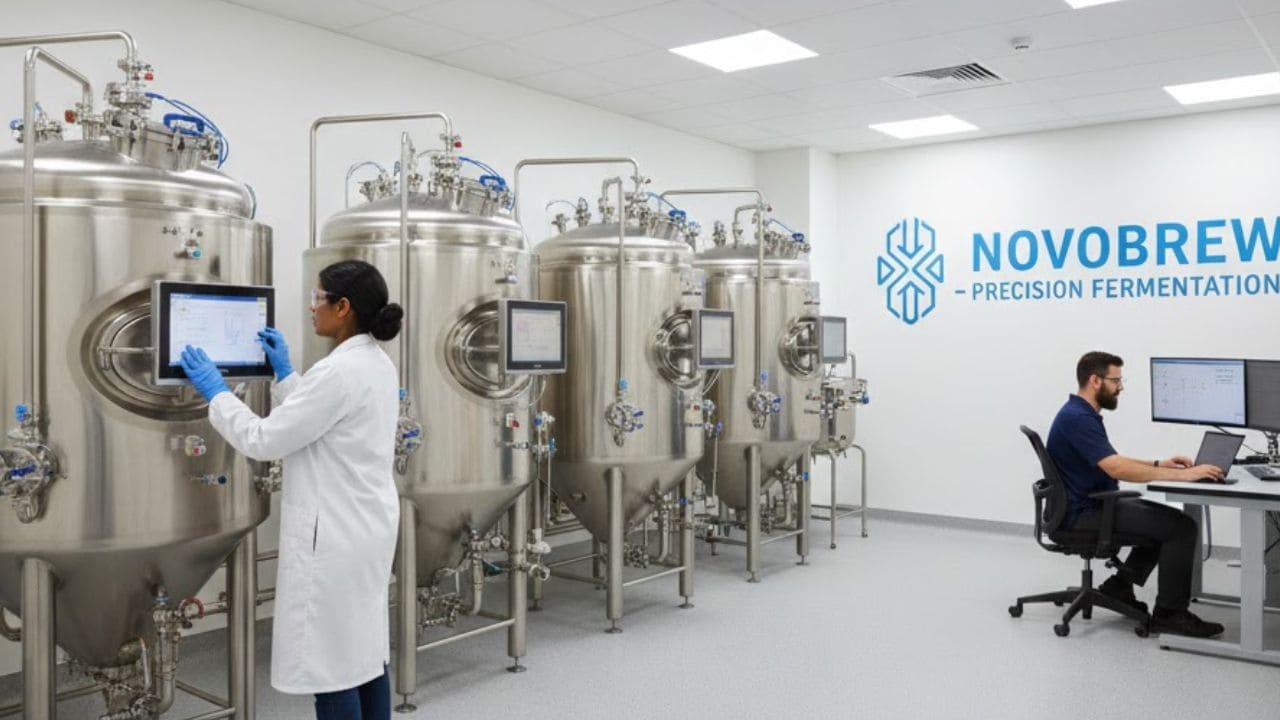
The precision fermentation industry is projected to expand from $5.82 billion in 2024 to $151 billion by 2034, driven by alternative protein companies producing animal-free whey, collagen, heme proteins, and recombinant enzymes. For startups entering this space, selecting the right bioreactor system represents the single most critical equipment decision-one that will determine your path to commercial viability and ultimately dictate whether your protein production process scales economically.
Unlike traditional biomass fermentation, precision fermentation bioreactors must support high-cell-density cultivation while optimizing for the target protein being secreted or expressed intracellularly. Whether you're engineering Pichia pastoris to produce milk proteins or E. coli for collagen precursors, your bioreactor selection must align with your specific host organism requirements and downstream processing strategy from day one.
Table of Contents
Navigate directly to the section you need. Click any link below to jump to detailed information about precision fermentation bioreactor selection.
1. Understanding Precision Fermentation Bioreactor Requirements for Protein Production
Precision fermentation for recombinant proteins demands different specifications than brewing or pharmaceutical production-specifications that directly impact your ability to achieve commercial-scale protein titers and process economics. Your system must achieve terminal cell densities exceeding 100 g/L dry cell weight while maintaining tight control over dissolved oxygen, pH, and temperature throughout multi-day fed-batch runs. These aren't aspirational targets but minimum requirements for economic viability in the alternative protein market.
The three most common host organisms-Pichia pastoris, Escherichia coli, and Saccharomyces cerevisiae-each impose distinct requirements. Pichia systems demand exceptional oxygen transfer rates and can achieve cell densities of 150-200 g/L DCW. E. coli fermentations grow faster but require careful monitoring to prevent acetate accumulation. S. cerevisiae offers GRAS status but complicates oxygen management.
Critical control parameters include dissolved oxygen maintenance within ±3% of setpoint (20-30% saturation), pH control to ±0.02 units, and temperature stability within ±0.2°C. A pH drift of just 0.1 units in a Pichia fermentation can reduce protein titer by 15-20%. With target production costs of $5-10 per kilogram for alternative proteins, you need systems capable of 3-5 g/L/h productivity in fed-batch mode.
2. Essential Bioreactor Features for Startup-Scale Protein Production
Stirred-tank bioreactors remain the industry standard for precision fermentation due to their proven scalability and flexibility-what works in your 50L pilot reactor will translate directly to 5,000L commercial vessels using established scale-up principles. Your STR system must balance sophisticated control capabilities with reasonable capital investment while maintaining a clear path to commercial scale. Cutting corners here guarantees expensive failures and delays your path to market by 12-18 months.
Agitation and Mixing: Most systems employ multiple Rushton turbine impellers for high oxygen transfer efficiency. Your impeller tip speed should reach 2-3 m/s to achieve oxygen transfer coefficients (kLa) of 200-400 h⁻¹ necessary for high-cell-density Pichia cultivation. Calculate your specific power input requirement at 2-5 kW/m³ for adequate mixing.
Oxygen Transfer: Innovative designs now employ super atmospheric pressure operation at 0.05-0.10 MPa, which can eliminate pure oxygen requirements and reduce operational costs by 15-20%. Your aeration system must deliver at least 1-2 vvm with the ability to blend air and oxygen dynamically.
Automated Control: Modern bioreactors require industrial-grade control systems with PID loops managing pH, temperature, DO, and feeding profiles simultaneously. Look for cascade control where DO setpoint adjustments automatically modulate agitation and aeration. Your control system should log all parameters at 1-minute intervals.
Material Specifications: All product-contact surfaces must be 316L stainless steel with electropolished finish (Ra <0.8 μm). Ensure your vessel includes multiple ports for sensors, sampling, feeding lines, and antifoam addition. Budget for redundant critical sensors-a failed DO probe mid-batch can destroy weeks of work.
Scalability: Maintain power per unit volume (P/V), impeller tip speed, and volumetric oxygen transfer coefficients constant during scale-up. A 50L pilot bioreactor should have identical aspect ratio (height:diameter of 2:1 to 3:1) as your planned 5,000L production vessel.
3. Top 5 Bioreactor Systems for Precision Fermentation Startups
System 1: 50-100L Pilot-Scale STR Bioreactors
Representative Systems: Eppendorf BioFlo 320, Sartorius BIOSTAT C, TECNIC eLAB series
For early-stage startups, 50-100L working volume bioreactors represent the optimal entry point at $80,000-150,000 fully configured. These systems provide industrial-scale capabilities while consuming manageable quantities of expensive raw materials during optimization. You'll harvest 4-8 kg of cell mass per batch for downstream process development, enough for meaningful protein recovery and characterization work without burning through Series A capital.
Critical specifications: kLa capability exceeding 300 h⁻¹, jacketed vessel with 30L/min cooling capacity, and minimum three automatic feeding pumps. Ensure foam detection with automated antifoam addition-Pichia fermentations foam intensely during methanol induction.
Best for: Companies with 1-3 years of runway focusing on strain engineering optimization and generating material for market testing.
System 2: 300-500L Demonstration-Scale Systems
Representative Systems: Applikon MiniBio 500, GEA Axenic 500
The 300-500L scale bridges laboratory development and commercial production, allowing you to validate process economics and produce 50-100 kg protein per batch for customer trials. Investment typically ranges $200,000-400,000 including controls and installation. This represents your proof-of-concept scale where investors and partners can see you're serious about manufacturing.
At this scale, geometric similarity with commercial equipment becomes non-negotiable. A 500L bioreactor running weekly batches can produce 2-4 tonnes of protein annually, sufficient for pilot commercial sales. Ensure adequate utilities: 15-20 L/min cooling water at 10-15°C, compressed air at 40-50 SCFM, and 480V three-phase power.
Best for: Startups transitioning to scale-up validation and companies raising Series A/B seeking to demonstrate manufacturing readiness.
System 3: Modular Systems with Advanced Methanol Control
Representative Systems: Custom configurations with Bronkhorst mass flow controllers
For Pichia pastoris fermentation, methanol feeding control represents the difference between success and failure. The AOX1 promoter requires maintaining methanol at 3-5 g/L; above 5 g/L becomes toxic while below 2 g/L reduces protein expression. Simple manual additions or timer-based pumps leave you guessing and losing 40-60% of potential protein yield.
A well-designed system includes dedicated mass flow controllers (0.1-10 mL/min range, ±1% accuracy), exhaust gas analyzers for O₂ and CO₂, and software calculating respiratory quotient (RQ) to adjust methanol flow every 30-60 seconds. Investment adds $30,000-60,000 to base bioreactor cost but can increase protein titers by 40-60%.
Best for: Any startup using Pichia pastoris for protein production, particularly targeting secreted proteins where maximizing extracellular titer reduces downstream processing costs.
System 4: High-Pressure Aeration Systems
Representative Systems: Pierre Guerin, Zeta BioPharma elevated pressure bioreactors
High-pressure aeration systems operate at 0.05-0.10 MPa gauge pressure, increasing dissolved oxygen saturation by 50-100% according to Henry's Law. This eliminates pure oxygen consumption, which can exceed $0.50 per kilogram of biomass at commercial scale. For a 5,000L reactor producing 150 kg/batch, that's $75 saved per run or $3,900 annually at weekly batches.
The technology trades higher capital cost (30-40% increase) for substantially reduced OPEX. Techno-economic analyses show breakeven at approximately 1,000 m³ annual fermentation volume, making this attractive for startups planning rapid scale-up.
Best for: Startups with Series B+ funding planning commercial-scale operations within 18-24 months and companies producing oxygen-demanding proteins.
System 5: Semi-Continuous Cultivation Platforms
Representative Systems: Applikon Perfusion, Repligen XCell ATF
Semi-continuous cultivation (SCC) and perfusion systems couple bioreactors with cell retention devices allowing continuous medium replacement while retaining cells. Conventional fed-batch requires 24-48 hours turnaround between runs, representing 17-25% lost productivity. SCC systems operate continuously for 20-30 days, increasing annual productivity by 30-50% from the same physical footprint.
For secreted proteins, continuous product removal prevents prolonged protease exposure and reduces degradation. Recombinant proteins often show 20-30% higher active fraction when harvested continuously. Capital investment increases 2-3x ($300,000-600,000 for a 100L perfusion reactor), but volumetric productivity improvements of 3-5x can justify the cost.
Best for: Companies with established products transitioning to commercial manufacturing and startups with capacity constraints seeking to maximize output.
4. Host Organism-Specific Bioreactor Considerations
Pichia pastoris / Komagataella phaffii Systems
Pichia dominates alternative protein production for secreted products including whey proteins and certain collagen variants-over 60% of precision fermentation startups use this workhorse organism. The methylotrophic yeast utilizes methanol as both carbon source and protein expression inducer, achieving protein titers of 5-15 g/L with optimized strains reaching 20+ g/L. These numbers directly determine your manufacturing costs and competitive position.
Critical fermentation parameters:
- Temperature: 28-30°C (±0.2°C control)
- pH: 5.0-6.0 (typically pH 5.5 for growth, pH 6.0 for production)
- DO setpoint: 20-30% during growth, 10-15% during methanol induction
- Methanol concentration: 3-5 g/L during induction phase
- Target cell density: 150-200 g/L DCW achievable
Your bioreactor must provide kLa values exceeding 300 h⁻¹. At 150 g/L cell density, oxygen consumption reaches 150-200 mmol/L/h requiring impeller tip speeds of 2.5-3.0 m/s and specific power input of 3-5 kW/m³. Effective methanol control systems represent 15-25% of total bioreactor investment but directly determine protein titers.
Escherichia coli Systems
E. coli offers faster growth kinetics (doubling time 20-30 minutes versus 2-4 hours for Pichia) and simpler nutritional requirements, making it attractive for rapid development cycles. However, acetate accumulation and predominantly intracellular protein accumulation create distinct challenges. You'll need excellent DO control and feeding strategies that maintain glucose just above zero to prevent overflow metabolism.
Critical fermentation parameters:
- Temperature: 30-37°C (often reduced to 25-28°C post-induction)
- pH: 6.8-7.2
- DO setpoint: 30-40% saturation
- Glucose concentration: <0.5 g/L during fed-batch
- Target cell density: 80-120 g/L DCW
Post-induction temperature reduction improves protein folding, requiring bioreactor cooling capacity of 25-30 kW per m³. Implement exponential feeding strategies maintaining glucose at 0.2-0.5 g/L to maximize growth while preventing overflow metabolism.
Saccharomyces cerevisiae Systems
S. cerevisiae offers GRAS regulatory status and superior protein glycosylation patterns-critical advantages for food applications where regulatory clearance determines time-to-market. The yeast's Crabtree-positive metabolism produces ethanol even under aerobic conditions at high glucose, requiring careful oxygen management.
Critical fermentation parameters:
- Temperature: 28-30°C
- pH: 4.5-5.5
- DO setpoint: 30-50% saturation
- Glucose concentration: <0.2 g/L to maintain respiratory growth
- Target cell density: 60-100 g/L DCW
Your bioreactor must balance adequate oxygenation (kLa 150-250 h⁻¹) with glucose limitation through exponentially decreasing feed rates matching the decreasing specific growth rate.
5. Downstream Processing Integration for Precision Fermentation
Downstream processing typically represents 45-92% of total manufacturing cost-often 10-20x more expensive than fermentation itself. Your bioreactor selection and operation must consider DSP implications from day one. Optimizing fermentation in isolation while ignoring how it affects purification is a recipe for commercial failure. Every fermentation decision ripples through your entire process economics.
Clarification and Cell Separation: For secreted proteins, fermentation broth requires clarification using disk-stack centrifuges ($150,000-300,000) achieving 99%+ cell removal or microfiltration systems (0.2-0.45 μm). For intracellular proteins, cell lysis via high-pressure homogenizers (1,000-1,500 bar) increases DSP costs by 2-4x versus secreted proteins.
Chromatography and Purification: Animal-free whey production may allow single-step capture chromatography achieving 95%+ purity. Collagen requires polishing steps achieving >98% purity via ion exchange followed by size exclusion chromatography. Heme protein purification presents unique challenges requiring 3-4 chromatography steps with 60-75% overall yields.
Chromatography resin costs $5,000-15,000 per liter. Your fermentation strategy must maximize titer to minimize the protein-to-impurity ratio. A 150 g/L cell density fermentation producing 10 g/L protein creates a 15:1 ratio. Increasing protein titer to 15 g/L reduces the ratio to 10:1, cutting clarification costs by 30-40%.
6. Cost Analysis and ROI for Startup Bioreactor Investment
Understanding the full financial picture prevents costly mistakes that can drain Series A funding in 6-9 months. These aren't one-time purchases but platforms determining your manufacturing economics for years.
Capital Investment by Scale:
- 50L pilot system: $80,000-150,000
- 100L demonstration system: $150,000-250,000
- 500L bridge scale: $300,000-500,000
- 2,000L commercial: $800,000-1,500,000
Production Capacity: A 500L bioreactor operating in fed-batch mode with 400L working volume, 150 g/L DCW, and 10 g/L protein titer produces 4 kg protein per batch. Running 50-60 batches annually yields 200-240 kg protein. With 70-85% DSP recovery, final purified protein reaches 140-200 kg/year.
Cost Structure: Upstream fermentation represents 8-55% of total manufacturing cost depending on protein complexity. For secreted proteins with simple purification (whey), fermentation might be 40-55% of costs. For complex intracellular proteins (certain collagens), fermentation drops to 8-15% of total cost.
This means expression optimization outweighs growth optimization by 3:1 in economic impact. Every 1 g/L increase in protein titer directly reduces DSP costs per kilogram product.
7. Conclusion
Selecting the right fermentation tanks requires aligning equipment capabilities with your protein target, host organism, and capital constraints-decisions that will echo through every aspect of your business for the next 3-5 years. For most startups, the optimal path involves 50-100L pilot systems for 12-18 months, transition to 300-500L demonstration scale for validation, then rapid scaling to 2,000-5,000L commercial vessels. Skip steps and you'll face expensive rework; move too slowly and competitors will capture market share.
Technical requirements are non-negotiable: kLa >300 h⁻¹ for Pichia systems, pH control to ±0.02 units, temperature stability within ±0.2°C, and sophisticated feeding control. Plan downstream processing integration from the beginning. Target metrics should balance cell density with protein titer, aiming for >10 g/L secreted protein or >15 g/L intracellular protein to achieve economically viable manufacturing costs.
Ready to launch your precision fermentation platform?
This premium domain is perfect for building an alternative protein production resource, biotech equipment marketplace, or precision fermentation consulting platform focused on commercial-scale protein manufacturing.