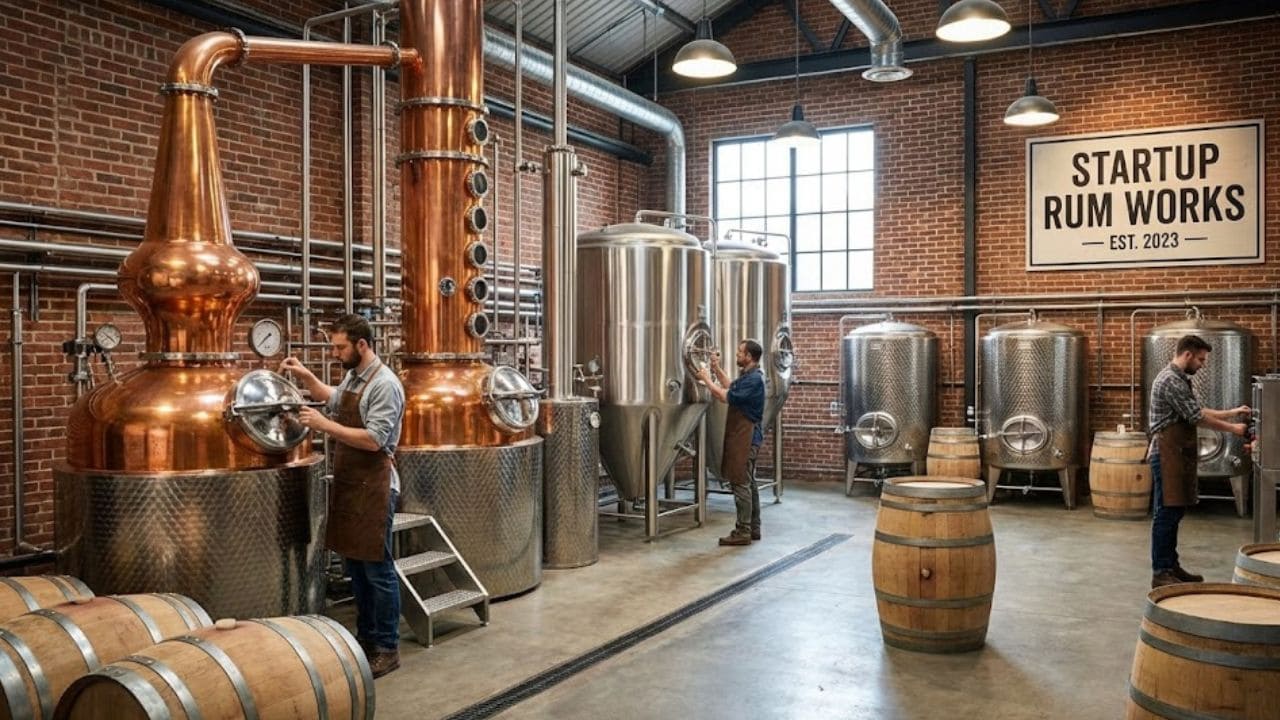
Starting a rum distillery requires more than passion for spirits-it demands understanding the intricate relationship between your raw materials, fermentation processes, and distillation equipment. Whether you're launching a craft distillery or scaling from homebrewing to commercial production, the choices you make about molasses selection, fermentation methods, and still configuration will define your product quality, production efficiency, and ultimately your profitability. This comprehensive guide breaks down the technical details of molasses-based rum production, comparing blackstrap versus fancy molasses, exploring traditional dunder pit fermentation, and evaluating pot versus column still systems. You'll walk away with specific equipment recommendations, cost projections, and process parameters that eliminate guesswork from your startup planning.
Table of Contents
Navigate directly to the section you need. Click any link below to jump to detailed information about rum production equipment and startup distillery planning.
1. Understanding Molasses Types for Rum Production Equipment
The foundation of quality rum starts with molasses selection, and this choice directly impacts your fermentation vessel specifications, processing time, and final flavor profile. Molasses comes in three primary grades: fancy (first molasses), cooking grade (second molasses), and blackstrap (third molasses). For distillers, the debate centers on fancy versus blackstrap molasses.
Blackstrap molasses represents the final extraction from sugarcane processing, containing approximately 45-55% fermentable sugars with higher mineral content, including iron, calcium, and magnesium. The total sugar content sits around 55g per 100g, but fermentable sugars are lower due to increased unfermentable compounds. This creates a robust, full-bodied wash with pronounced burnt sugar, bitter, and earthy notes. Blackstrap ferments more slowly due to higher mineral content and requires careful pH management, typically needing more acid addition to reach optimal fermentation pH of 4.8-5.2.
Fancy molasses (first extraction) contains 60-65% fermentable sugars with cleaner flavor characteristics. With approximately 65g total sugars per 100g, fancy molasses produces higher alcohol yields per batch-typically 8-10% ABV versus 6-8% ABV with blackstrap under identical conditions. The fermentation progresses more predictably, with less foaming and easier temperature control. The resulting distillate carries sweeter caramel and vanilla notes rather than the aggressive funk of blackstrap.
For startup distilleries, the choice impacts equipment sizing. Blackstrap's lower sugar content requires 15-20% larger batch volumes to achieve equivalent alcohol output, directly affecting fermentation vessel capacity needs. However, blackstrap costs $0.80-$1.20 per kilogram compared to $1.50-$2.00 for fancy molasses, offering significant raw material savings at scale.
Many craft distillers blend both types-typically 60% fancy to 40% blackstrap-achieving flavor complexity while maintaining fermentation efficiency. This approach optimizes both production economics and flavor profile development.
2. Essential Fermentation Equipment for Startup Distilleries
Your fermentation infrastructure represents 20-30% of total equipment investment but determines your production capacity and product consistency. For startup rum distilleries, fermentation vessel selection must balance initial capital constraints with future scaling needs.
Fermentation vessels should be food-grade stainless steel (304 or 316 grade) with conical or flat-bottom designs. For startup operations, 200-1,000 liter (50-265 gallon) vessels provide optimal flexibility. Beginners often start with 2-4 vessels of 400L (105 gallons) capacity, allowing 800-1,600 liters total working volume. This supports weekly production of 80-160 liters of rum at 40% ABV after dilution. Expect investment of $3,000-$8,000 per 400L vessel with basic temperature control jackets.
Temperature control systems are non-negotiable for consistent fermentation. Rum fermentation generates substantial heat-molasses fermentations commonly reach 32-35°C (90-95°F) without cooling, stressing yeast and creating fusel alcohols. Glycol-jacketed vessels with digital temperature controllers maintain optimal ranges of 28-32°C (82-90°F) for clean fermentations or 32-35°C (90-95°F) for ester-heavy traditional styles. A glycol chiller system (1-2 ton capacity) costs $4,000-$12,000 depending on total vessel volume.
pH monitoring and adjustment equipment includes calibrated pH meters ($200-$800 for quality digital units) and dosing capabilities. Molasses washes typically start at pH 5.5-6.5 and require acidification to 4.8-5.2 using food-grade citric, sulfuric, or phosphoric acid. Commercial operations benefit from automated pH dosing systems ($2,000-$5,000) that maintain consistent conditions across batches.
Mixing and aeration equipment ensures homogeneous sugar distribution and adequate dissolved oxygen for yeast health. Commercial mixers with variable speed drives ($800-$2,500) prevent stratification in high-gravity molasses washes. Initial oxygenation using venturi injectors, air stones, or pure oxygen systems ($500-$3,000) improves yeast cell membrane synthesis and shortens lag phases.
Complete startup fermentation setup costs typically range from $15,000 for minimal 2-vessel systems to $50,000 for optimized 4-vessel configurations with full automation. Used equipment can reduce costs 40-60%, though warranty and sanitation concerns require careful evaluation.
3. Rum Fermentation Process Using Dunder Pits
Dunder represents one of rum production's most distinctive traditional techniques, creating the characteristic "high ester" profile of Jamaican-style rums. Understanding dunder implementation separates craft producers creating authentic traditional rums from those producing neutral spirits.
Dunder defined: Dunder is the spent wash remaining in the pot still after distillation, rich in dead yeast cells, organic acids, minerals, and residual sugars. Rather than discarding this material, traditional rum producers store it in open pits or tanks where complex microbial communities develop, generating flavor precursors that dramatically impact the next fermentation.
Traditional dunder pits are concrete or stone-lined pits holding 5,000-50,000 liters of aged stillage, exposed to open air and environmental microbes. The liquid develops thick surface layers ("muck") containing Lactobacillus, Clostridium, and various acid-producing bacteria. This microbial ecosystem creates butyric acid, propionic acid, and ester precursors. Dunder pits age for months to years, developing increasingly complex microbiology.
Modern dunder tank systems provide controlled alternatives using closed stainless steel tanks with controlled temperature and optional aeration. While losing some environmental microbial diversity, tanks offer consistency and sanitation benefits. Startup distilleries typically implement 500-2,000 liter dunder tanks ($2,000-$8,000) maintained at 30-35°C.
Dunder application rates range from 15-35% of total wash volume. Standard practice uses 20-25% dunder, 70-75% dilution water, and 5-10% fresh molasses solution. Higher dunder ratios (30-35%) create extremely high-ester rums (800-1,600 ppm esters) with intense funky, overripe fruit characteristics. Lower ratios (15-20%) provide moderate ester content (200-400 ppm) suitable for mixing or aged expressions.
Muck pit management requires careful monitoring. The muck layer-thick, viscous material floating on dunder-concentrates acid-producing bacteria. Traditional producers scrape muck from pits and add 2-5% directly to fermentation vessels, accelerating acid production and ester formation. The pH of dunder typically ranges from 3.0-4.5, requiring additional alkali addition when building washes.
Practical implementation for startups: Begin with a single 1,000L dunder tank. After your first distillation run, transfer pot still tails (everything after hearts cut) to the tank. Maintain at 30-33�C and allow to develop for 2-4 weeks before first use. Monitor pH weekly-ideal working dunder maintains pH 3.5-4.2. Add 20% dunder to subsequent fermentations, topping up the dunder tank with fresh stillage after each distillation. Within 3-4 months, your dunder develops characteristic microbiology.
Alternative approach: If traditional dunder seems too unpredictable for initial production, consider bacterial co-inoculation using commercially available Lactobacillus plantarum or L. fermentum cultures. Add these bacteria at 0.5-1% population levels alongside yeast, achieving controlled acid and ester production without maintaining separate dunder systems. This creates moderate ester profiles (150-300 ppm) with greater batch consistency.
4. Yeast Selection and Fermentation Parameters
Yeast strain selection and fermentation parameter control determine alcohol yield, flavor profile, and production timeline. Rum fermentation offers remarkable flexibility compared to beer or wine, tolerating wide parameter ranges that create distinct regional styles.
Yeast strain options for rum production include both distiller's yeasts and repurposed strains:
- Saccharomyces cerevisiae distiller's strains (Lallemand DistilaMax RM, Fermentis SafSpirit M-1): These specialized rum yeasts tolerate high alcohol (up to 18% ABV), produce moderate esters, and ferment efficiently at 28-35°C. They provide consistency and reliability, ideal for commercial operations. Cost: $40-$80 per 500g pack treating 1,000-2,000 liters.
- Baker's yeast (Saccharomyces cerevisiae): Traditional choice for many Caribbean distilleries, baker's yeast creates distinct flavor profiles with higher fusel alcohol production. Less alcohol-tolerant (12-14% ABV maximum) but extremely inexpensive. Requires higher pitching rates (3-5 g/L versus 0.5-1 g/L for distiller's strains).
- EC-1118 champagne yeast: Highly alcohol-tolerant (18% ABV), vigorous fermentation, but produces cleaner, more neutral spirits with lower ester content. Better suited for light rum styles or vodka production.
Pitching rates depend on strain selection and starting gravity. For commercial distiller's yeasts, pitch 0.5-1.0 g/L for starting gravities of 1.070-1.090 (17-22� Brix). For baker's yeast, increase to 3-5 g/L. Proper rehydration in 35-38�C water for 15-20 minutes before pitching improves cell viability.
Fermentation temperature ranges dramatically impact flavor:
- 28-30°C (82-86°F): Clean fermentation with moderate esters, good alcohol tolerance, 5-7 day fermentation duration. Optimal for light rums or aged expressions where wood character dominates.
- 30-33°C (86-91°F): Increased ester production, more fruity character, faster fermentation (4-6 days). Standard temperature for most craft rum production.
- 33-35°C (91-95°F): High ester production, increased fusel alcohols, potential yeast stress if not managed. Used for traditional high-ester Jamaican styles, requires robust yeast strains and careful nutrient management.
pH management begins with must preparation. Molasses washes typically start at pH 5.5-6.5, too high for optimal yeast performance and bacterial contamination prevention. Acidify to pH 4.8-5.2 using:
- Food-grade citric acid: 2-4 g/L typically required, adds slight citrus notes
- Sulfuric acid: More economical for large operations, flavor-neutral
- Phosphoric acid: Provides phosphorus nutrient, flavor-neutral
Nutrient additions improve fermentation speed and completion. Molasses contains minerals but often lacks sufficient nitrogen for vigorous fermentations. Add:
- Diammonium phosphate (DAP): 0.5-1.0 g/L provides assimilable nitrogen
- Yeast hulls: 0.2-0.5 g/L improves alcohol tolerance
- Complete yeast nutrient blends: Follow manufacturer recommendations, typically 0.5-1.5 g/L
Fermentation duration and monitoring: Standard rum fermentations complete in 4-7 days at optimal temperatures. Monitor specific gravity daily-target final gravity of 1.005-1.010 (complete attenuation to 0.990-1.000 creates thin flavor profiles). Traditional high-ester fermentations using dunder may extend to 10-21 days, with intentional bacterial activity creating acid and ester precursors throughout the extended timeline.
Target parameters summary:
- Starting gravity: 1.070-1.100 (17-24° Brix)
- Final gravity: 1.005-1.016
- Starting pH: 4.8-5.2
- Fermentation temperature: 28-35°C depending on style
- Expected ABV: 6-10% in wash
- Duration: 4-21 days depending on style and temperature
5. Pot Still vs Column Still: Equipment Selection for Rum
Your still selection represents the single largest equipment investment and defines your rum's character, production capacity, and operational flexibility. Understanding the technical and economic differences between pot stills, column stills, and hybrid systems guides informed capital allocation.
Pot still characteristics: Pot stills operate as batch systems, heating the entire wash to vaporize alcohol, then condensing vapors for collection. Traditional copper pot stills create "heavy" rums with pronounced congener content (flavor compounds, esters, fusel alcohols).
Pot stills provide:
- Flavor retention: Carries forward molasses character, fermentation esters, and fermentation-derived congeners into the distillate
- Manual control: Operator makes real-time decisions about cut points (heads, hearts, tails separation)
- Batch operation: Each fermentation requires separate distillation run of 6-12 hours
- Lower capital cost: Basic 200-500L copper pot stills cost $50,000-$150,000 depending on configuration
- Lower proof output: Typically produces 60-70% ABV spirits in a single pass, requiring second distillation for higher proof
- Copper contact: Natural sulfur compound reduction and catalytic ester formation enhance flavor smoothness
Pot stills suit craft distilleries prioritizing flavor complexity over production volume, particularly for aged rums where barrel aging integrates bold base spirit characteristics.
Column still characteristics: Column (continuous) stills operate continuously, feeding wash into a tall column containing multiple plates or packing material. Steam strips alcohol as wash descends, creating high-proof, cleaner spirits.
Column stills provide:
- Continuous operation: Feed wash continuously during operation, no batch limitations
- Higher efficiency: Single-pass distillation to 85-96% ABV, significantly higher alcohol recovery per liter of wash
- Cleaner spirits: Fewer congeners and flavor compounds, creating "light" rum styles
- Higher production capacity: Process 100-1,000+ liters per hour depending on column sizing
- Higher capital cost: Industrial column stills cost $100,000-$400,000+ for craft-scale units
- Automation potential: Temperature and flow controls reduce operator involvement
- Flexibility: Adjustable reflux ratios allow some flavor control
Column stills suit operations prioritizing production volume, consistency, and light rum styles. They're essential for white/silver rum or neutral base spirits for spiced rum production.
Hybrid still systems: Many craft distilleries install pot-column hybrid configurations, combining pot still character with column efficiency. Typical designs feature a pot still base with a small rectification column (4-8 plates) mounted above. This configuration allows:
- Pot still mode: Bypass or minimize column reflux for flavorful, heavy distillates
- Column mode: Engage full column reflux for cleaner, higher-proof spirits
- Mid-range flexibility: Adjust reflux ratios to find sweet spots between heavy and light styles
Hybrid systems cost $80,000-$250,000 depending on capacity and automation level, representing excellent value for diversified product lines.
Flavor profile differences: Pot still rums exhibit pronounced molasses, brown sugar, baked fruit, and funky ester notes with full mouthfeel. Column still rums present cleaner, sweeter profiles with subtle molasses hints and lighter body. Aged expressions from pot stills showcase intense wood-spirit integration, while column-distilled aged rums emphasize barrel characteristics with subtler base spirit influence.
Production capacity considerations: A 500L pot still processes one 400L fermentation per 8-10 hour shift, yielding approximately 40-50 liters of 70% ABV spirit (28-35 liters at bottling strength after aging and dilution). Annual capacity at 5 days/week operation: approximately 7,000-9,000 liters bottled product. A comparably-sized column still operating 8 hours daily processes 3-5 fermentations, yielding 120-150 liters of 90% ABV spirit (90-115 liters bottled), supporting 22,000-28,000 liters annual production.
Equipment selection framework:
- Heavy/funky aged rum focus: Copper pot still, 500-1,000L capacity, budget $80,000-$180,000
- Light/white rum or high volume: Column still, 100-200 L/hour capacity, budget $150,000-$400,000
- Diversified product line: Hybrid system, 500L pot with 6-plate column, budget $120,000-$250,000
- Multi-spirit distillery: Hybrid system with maximum flexibility for rum, vodka, gin production
Consider used equipment-reputable dealers offer refurbished stills at 40-60% discounts with warranties. European and Australian markets frequently have available craft-scale systems due to distillery consolidation.
6. Rum Production Equipment Costs and ROI for Startup Distilleries
Converting rum production aspirations into functional businesses requires realistic capital planning and profitability modeling. Based on current market conditions, here's a comprehensive breakdown of startup costs and return on investment projections.
Fermentation equipment costs:
- Fermentation vessels (4 � 400L with jackets): $12,000-$32,000
- Glycol chiller system (2-ton): $4,000-$12,000
- pH meters and monitoring: $500-$1,500
- Mixing and aeration: $2,000-$5,000
- Pumps and transfer equipment: $2,000-$4,000
- Subtotal: $20,500-$54,500
Distillation equipment costs:
- Pot still system (500L): $80,000-$150,000
- Column still system (200 L/hour): $150,000-$350,000
- Hybrid system (500L): $120,000-$220,000
- Condenser and cooling: Often included, or $5,000-$15,000
- Spirit safe and proof monitoring: $2,000-$5,000
- Subtotal: $82,000-$370,000
Aging and finishing equipment:
- Used bourbon barrels (200L): $100-$200 each, 20 barrels: $2,000-$4,000
- New oak barrels: $400-$800 each if preferred
- Barrel racks and storage: $3,000-$8,000
- Bottling line (semi-automatic): $8,000-$25,000
- Label applicator: $2,000-$6,000
- Subtotal: $15,000-$43,000
Facility and utilities:
- Facility build-out/renovation: $30,000-$150,000
- HVAC and ventilation: $10,000-$30,000
- Water treatment system: $5,000-$15,000
- Wastewater management: $5,000-$20,000
- Safety equipment (fire suppression): $8,000-$20,000
- Subtotal: $58,000-$235,000
Regulatory and legal:
- Federal DSP application and setup: $2,000-$5,000
- State licenses and permits: $1,000-$10,000
- Local permits and inspections: $2,000-$8,000
- TTB bonds and insurance: $5,000-$15,000 annually
- Legal and consulting fees: $5,000-$15,000
- Subtotal: $15,000-$53,000
Raw materials (first 6 months):
- Molasses (12 tons at $800/ton): $9,600
- Yeast and nutrients: $1,500
- Acids and processing chemicals: $800
- Barrels for aging: Included above
- Bottles, labels, packaging: $8,000-$15,000
- Subtotal: $19,900-$27,900
Total startup capital requirements: $210,400-$783,400
Most micro-distilleries launching with pot still systems fall into the $250,000-$400,000 range. Column still operations requiring higher capacity typically need $400,000-$650,000.
Revenue modeling (pot still example, 8,000L annual production at 40% ABV):
- Production: 8,000 liters = 10,667 750ml bottles annually
- Wholesale price: $20-$30 per bottle
- Gross revenue: $213,340-$320,000 annually
- Retail direct sales (30% of volume at $35-$45): Additional $112,000-$144,000
- Total revenue potential: $325,000-$464,000 annually at full production
Operating costs:
- Raw materials: $18,000-$24,000 annually
- Labor (2 FTE): $80,000-$120,000
- Facility costs (rent, utilities): $30,000-$60,000
- Insurance and compliance: $12,000-$20,000
- Marketing and sales: $20,000-$40,000
- Excise taxes (varies by state): $25,000-$40,000
- Total operating costs: $185,000-$304,000 annually
Profitability timeline: Most craft rum distilleries reach positive cash flow in years 3-4, accounting for aging inventory investment. Year 1-2 focus on building aged inventory while selling white/unaged expressions. Break-even typically occurs at 60-75% of designed capacity with mixed product portfolio (30% white rum immediate release, 70% aged expressions on 2-3 year cycles).
Return on investment: With $300,000 initial investment and stabilized operations generating $140,000-$160,000 annual net profit (years 3-5), expect 47-53% annual ROI, recovering initial capital in 2-3 years post-stabilization.
Critical success factors: Distillery profitability depends on distribution access, brand development, and production efficiency. Successful operations typically achieve: 85%+ distillation yield efficiency, 40%+ direct-to-consumer sales (tasting room, online), and diversified product portfolios capturing multiple price points.
7. Conclusion
Building a successful rum distillery requires strategic equipment decisions aligned with your product vision, market positioning, and financial resources. The choice between blackstrap and fancy molasses affects both your flavor profile and production economics, while dunder pit implementation separates authentic traditional rums from standard distillates. Your still selection-pot, column, or hybrid-fundamentally determines product character and production capacity.
Most startup distilleries succeed by beginning with focused equipment investments: a quality fermentation setup supporting consistent wash production, a versatile hybrid still system enabling product diversification, and adequate aging infrastructure for portfolio development. Resist the temptation to over-capitalize initially-successful craft distilleries often begin with $250,000-$400,000 in core equipment, then expand systematically as market demand validates specific product categories.
The rum market rewards quality, authenticity, and compelling brand stories. Your equipment choices should enable the flavor profiles and production volumes that bring your brand vision to life while maintaining the financial sustainability that keeps your distillery operating through the challenging early years. Invest in quality fermentation and distillation systems, develop your skills with traditional techniques like dunder fermentation, and focus relentlessly on creating distinctive, well-crafted spirits that justify premium positioning in an increasingly competitive market.
Launching a rum distillery startup?
This premium domain is perfect for launching your rum production platform, molasses fermentation guide, or craft spirits equipment review site. FermenterPro.com attracts distillery entrepreneurs, equipment buyers, and spirits enthusiasts looking for authoritative content on rum production techniques and startup strategies.