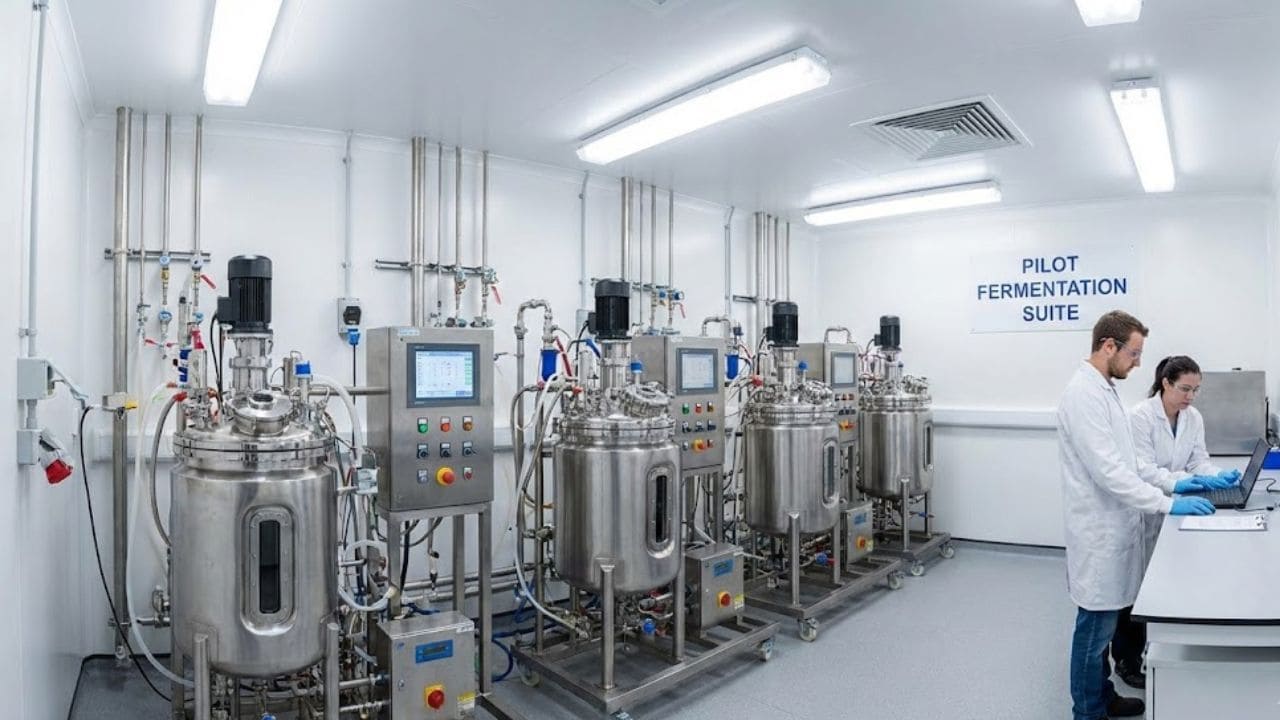
Transitioning antibiotic production from laboratory flasks to pilot-scale fermenters represents one of the most critical phases in pharmaceutical development. For small pharma companies, contract manufacturers, and biotech startups, mastering pilot-scale fermentation can mean the difference between a viable product and a failed scale-up. This guide focuses on producing penicillin and streptomycin using fed-batch fermentation strategies, sterile sampling protocols, and analytical methods that ensure consistent, high-titer production.
Table of Contents
Navigate directly to the section you need. Click any link below to jump to detailed information about pilot-scale antibiotic fermentation, equipment selection, and process optimization.
1. Understanding Pilot-Scale Antibiotic Fermentation Systems
Pilot-scale fermentation typically involves vessels ranging from 50 liters to 500 liters, with the 100-300L range representing the sweet spot for most small pharma operations. These systems bridge the gap between benchtop research (1-20L) and full commercial production (5,000L+), allowing you to validate bioprocesses, optimize economics, and generate material for clinical trials.
Unlike laboratory fermenters, pilot-scale systems require robust sterilization-in-place (SIP) capabilities, sophisticated control systems, and the ability to maintain aseptic conditions for extended periods. Your fermenter should be constructed from 316L stainless steel with electropolished interiors (Ra <0.8 μm) to minimize contamination risks and facilitate cleaning validation.
Modern pilot-scale antibiotic production fermenters for small pharma must include automated control of dissolved oxygen (DO), pH, temperature, agitation, and substrate feeding. These parameters directly impact antibiotic titer, and manual control becomes impractical during multi-day fermentation runs. Expect to invest $80,000-$250,000 for a fully equipped 200L system with appropriate monitoring and control infrastructure.
Critical features include multiple sampling ports, optical density probes, dedicated feed lines with peristaltic or diaphragm pumps, and redundant sensors for key parameters. The control system should log data at minimum 1-minute intervals to enable process characterization for regulatory submissions.
2. Selecting the Right Antibiotic Production Fermenters for Small Pharma
When evaluating fermentation systems for antibiotic production, prioritize vessels that can withstand repeated steam sterilization cycles at 121°C (250°F) for 30-60 minutes. SIP capability is non-negotiable for pharmaceutical applications, as it eliminates the contamination risks associated with transferring media into the vessel.
Your fermenter should feature a minimum aspect ratio (height to diameter) of 2:1 to 3:1, which improves oxygen transfer efficiency-critical for aerobic antibiotic producers like Penicillium chrysogenum and Streptomyces griseus. The agitation system typically employs Rushton turbine impellers or marine-style impellers, with power input capabilities of 2-5 watts per liter.
Port configuration matters significantly. You'll need dedicated ports for:
- Sterile sampling (with 0.2 μm hydrophobic filters)
- Inoculation (with steam-sterilizable connections)
- Substrate feeding (minimum two independent feed lines)
- Antifoam addition
- Acid/base addition for pH control
- Exhaust gas analysis (O₂ and CO₂ sensors)
- Harvest line with aseptic valve assembly
Temperature control should maintain ±0.5°C stability, typically achieved through jacketed vessels connected to heating/cooling systems with proportional-integral-derivative (PID) controllers. For antibiotic fermentation, heat removal becomes the limiting factor as microbial metabolism generates substantial heat-ensure your system can remove 150-250 watts per liter.
Budget for analytical integration. Modern systems should support real-time data acquisition, with the ability to correlate process parameters with offline analytical results from HPLC, spectrophotometry, or bioassays.
3. Fed-Batch Fermentation Strategy for Penicillin Production
Fed-batch operation remains the industrial standard for penicillin production because it addresses Penicillium chrysogenum's sensitivity to substrate (glucose or lactose) concentration while maximizing volumetric productivity. Unlike simple batch fermentation, fed-batch allows you to control substrate availability, preventing both carbon catabolite repression and substrate depletion.
The fermentation proceeds through three distinct phases:
Growth Phase (24-48 hours): Initial batch phase with 20-30 g/L glucose or lactose. Temperature maintained at 25°C, pH controlled at 6.5 using ammonia solution (which also serves as nitrogen source), and dissolved oxygen held above 30% saturation through cascade control of agitation (150-300 rpm) and aeration (0.5-1.0 vvm). Biomass doubles every 6-8 hours during this phase.
Transition Phase (48-72 hours): As glucose depletes to 5-10 g/L, initiate exponential feeding to maintain substrate concentration at 10-15 g/L. This concentration prevents overflow metabolism while ensuring sufficient carbon for both growth and penicillin biosynthesis. The precursor phenylacetic acid or phenoxyacetic acid is added continuously at 0.1-0.2 g/L/hour starting at 48 hours.
Production Phase (72-180 hours): Linear feeding replaces exponential feeding, with rates adjusted based on oxygen uptake rate (OUR) measurements. Maintain glucose at 10-15 g/L, DO at 20-40%, pH at 6.8-7.0, and temperature at 25°C. Modern high-yielding strains produce 70-90 g/L penicillin G over this 5-7 day fermentation.
Feed composition typically contains 500-600 g/L glucose or lactose, along with balanced concentrations of nitrogen, phosphorus, sulfur, and trace elements. Calculate feed rates using the formula:
F = (μ × X × V) / (Sf × Y)
Where F = feed rate (L/h), μ = specific growth rate (h⁻¹), X = biomass concentration (g/L), V = culture volume (L), Sf = substrate concentration in feed (g/L), and Y = yield coefficient (g biomass/g substrate).
Monitor viscosity throughout the fermentation. P. chrysogenum forms pellets or filamentous morphology depending on strain and conditions, with apparent viscosity reaching 200-500 cP during peak production. This affects oxygen transfer and may require agitation adjustments.
4. Streptomycin Fermentation Protocol at Pilot Scale
Streptomyces griseus fermentation for streptomycin production follows different kinetics than penicillin, requiring longer fermentation times (7-10 days) and distinct medium composition. Streptomycetes are obligate aerobes with high oxygen demands, making oxygen transfer the critical engineering challenge at pilot scale.
Medium Composition: Use Hockenhull medium or modifications containing glucose (10-15 g/L), soybean meal (15-25 g/L), sodium chloride (5 g/L), calcium carbonate (3-5 g/L), and trace elements. The soybean meal provides complex nitrogen, which streptomycetes utilize more efficiently than simple nitrogen sources.
Fermentation Phases:
Phase 1 - Growth (0-48 hours): Rapid biomass accumulation with glucose as primary carbon source. Temperature: 28°C, pH: 7.0-7.2 (calcium carbonate buffers naturally), DO: >40% saturation, agitation: 200-300 rpm, aeration: 0.8-1.2 vvm. The mycelium develops characteristic branching morphology.
Phase 2 - Transition (48-96 hours): As primary metabolism slows, secondary metabolism initiates. Glucose concentration drops to <5 g/L, triggering streptomycin biosynthesis pathway activation. Begin fed-batch glucose addition to maintain 5-8 g/L. Streptomycin appears in broth at low titers (100-300 units/mL).
Phase 3 - Production (96-240 hours): Streptomycin accumulates linearly if oxygen supply remains adequate. Maintain DO >30%, pH 7.2-7.5 (adjust with NaOH or H₂SO₄), temperature 27-28°C. Modern industrial strains yield 2,500-4,000 units/mL (approximately 2-3 g/L).
Oxygen transfer coefficient (kLa) must exceed 150-200 h⁻¹ during production phase. Calculate kLa using the dynamic gassing-out method or sodium sulfite oxidation. If kLa falls below critical values, increase agitation incrementally to 350 rpm or increase aeration to 1.5 vvm, monitoring foam generation closely.
5. Sterile Sampling Techniques for Antibiotic Fermentation
Contamination during multi-day fermentation runs can destroy entire batches, making sterile sampling technique paramount. Pilot-scale antibiotic production fermenters for small pharma should incorporate dedicated sterile sampling systems that maintain vessel sterility while allowing frequent sample withdrawal.
Sampling Port Design: Install steam-sterilizable sampling valves with 0.2 μm hydrophobic membrane filters positioned upstream of the sampling point. Before each sample, steam the sampling line for 10-15 minutes, then cool with sterile air or nitrogen for 5 minutes. The first 10-20 mL drawn should be discarded as it represents liquid in the dead volume.
Frequency and Volume: Sample every 8-12 hours during growth phase and every 4-6 hours during production phase. Extract 30-50 mL per sample-enough for cell density measurement, pH/DO verification, substrate analysis, and antibiotic titer determination, while minimizing volume loss over the fermentation (total ~500 mL from a 200L batch = 0.25% volume loss).
Aseptic Technique: Always sample into sterile containers pre-warmed to fermentation temperature to prevent temperature shock artifacts. Immediately place samples on ice if processing will be delayed >30 minutes. For antibiotic assays, freeze samples at -20°C if analysis cannot occur within 2 hours.
Contamination Monitoring: Perform microscopic examination of every sample, comparing morphology to pure culture controls. For penicillin fermentation, watch for bacterial rods, cocci, or wild yeast. For streptomycin, look for contaminating molds or non-sporulating bacteria. Plate samples on nutrient agar every 24 hours as confirmatory sterility checks.
Consider installing online sampling systems with automated sample conditioning (dilution, filtration) that connect directly to analytical instruments, reducing contamination risk and labor while improving data frequency.
6. Critical Process Parameters and Control
Successful antibiotic fermentation at pilot scale demands precise control of multiple interdependent parameters. Small deviations compound over multi-day runs, reducing titers by 20-50% or causing complete batch failures.
Temperature Control: Maintain 25-26°C for penicillin, 27-28°C for streptomycin, with stability of ±0.3°C. Temperature excursions above 30°C can irreversibly damage antibiotic biosynthesis enzymes. Use PID controllers with jacket temperature setpoints 2-3°C different from culture temperature to enable rapid heat transfer without overshoot.
pH Management: For penicillin, control pH at 6.5-7.0 using ammonia solution (provides nitrogen) and phosphoric acid (provides phosphorus). For streptomycin, maintain 7.2-7.5 using 2M NaOH and 2M H₂SO₄. Install redundant pH probes and calibrate against buffer standards every 48 hours. Sensor drift of 0.3 pH units can reduce final titers by 15-30%.
Dissolved Oxygen (DO): The most critical parameter for aerobic antibiotic producers. Cascade control strategies adjust agitation first (150-350 rpm range), then aeration (0.5-1.5 vvm), and finally gas composition (air to oxygen-enriched air). Never allow DO to drop below 20% saturation for penicillin or 30% for streptomycin during production phases.
Calculate oxygen uptake rate (OUR) from exhaust gas analysis:
OUR = (Qin × YO₂,in - Qout × YO₂,out) / V
Where Q = volumetric flow rate, Y = mole fraction of O₂, V = culture volume. OUR increases from 5-10 mmol/L/h during growth to 15-30 mmol/L/h during peak production.
Foam Control: Antibiotic fermentation generates substantial foam due to protein secretion and gas sparging. Use silicone-based antifoams (Antifoam 204, Dow Corning) at 0.1-0.3 mL/L as needed. Install automated foam sensors that trigger antifoam pumps, preventing foam-out events that compromise sterility.
Carbon Dioxide Accumulation: At high cell densities (>30 g/L dry weight), CO₂ production can reach 20-40 mmol/L/h, raising dissolved CO₂ above inhibitory levels (>100 mM). Monitor exhaust CO₂ and increase aeration or reduce working volume if necessary.
7. Analytics for Monitoring Antibiotic Production
Accurate, timely analytical data drives process decisions and ensures batch consistency. Establish robust analytical methods before initiating pilot-scale campaigns.
HPLC Methods: High-performance liquid chromatography provides the gold standard for antibiotic quantification. For penicillin G, use reverse-phase HPLC with C18 column (4.6 × 250 mm, 5 μm particle size), mobile phase of acetonitrile:phosphate buffer (30:70 v/v), flow rate 1.0 mL/min, UV detection at 214 nm. Retention time approximately 6-8 minutes with detection limit of 0.1 mg/L.
For streptomycin, employ ion-pairing reverse-phase HPLC or normal-phase HPLC with refractive index detection. Sample preparation requires dilution in mobile phase and filtration through 0.45 μm membranes. Standard curves from 10-1,000 μg/mL provide quantification range.
Sample Preparation: Dilute fermentation broth 10-100 fold in buffer or mobile phase to bring antibiotic concentration within linear range. For mycelial fermentations, centrifuge at 10,000 × g for 10 minutes, then filter supernatant through 0.22 μm syringe filters before injection. Proper sample preparation eliminates column fouling and improves reproducibility.
Bioassays: Classical agar diffusion assays (cylinder-plate method) remain valuable for rapid screening, though less precise than HPLC. For penicillin, use Bacillus subtilis or Staphylococcus aureus as test organisms. For streptomycin, use Bacillus subtilis or Klebsiella pneumoniae. Correlate zone diameters to standard curves prepared from reference standards.
Online Monitoring: Integrate optical density (600 nm), pH, DO, and exhaust gas analysis (O₂, CO₂) for real-time process understanding. Modern systems use soft sensors-mathematical models that estimate difficult-to-measure variables (biomass, product concentration) from easily measured parameters using multivariate regression or neural networks.
Offline Measurements: Every sample should be analyzed for:
- Cell density (OD₆₀₀ or dry weight)
- Residual substrate (glucose/lactose via enzymatic assay or HPLC)
- Antibiotic titer (HPLC primary, bioassay confirmation)
- By-products (organic acids by HPLC)
- Microscopic examination for morphology and contamination
Document all analytical results in batch records compliant with Good Manufacturing Practice (GMP) requirements if producing material for clinical trials.
8. Scaling Considerations and Common Pitfalls
Successfully scaling antibiotic fermentation from lab to pilot scale requires understanding how physical and chemical parameters change with vessel geometry.
Oxygen Transfer: The volumetric mass transfer coefficient (kLa) typically decreases with scale due to reduced mixing efficiency. Match kLa between scales using the correlation:
kLa ∝ (P/V)⁰‧⁴ × (vs)⁰‧⁵
Where P/V = power per unit volume (W/L) and vs = superficial gas velocity (cm/s). If lab-scale kLa = 200 h⁻¹, maintain similar (P/V) and aeration rate at pilot scale.
Mixing Time: Increases with scale, potentially creating concentration gradients. In a 200L fermenter with single impeller, mixing time reaches 20-40 seconds versus 5-10 seconds in 5L vessels. Add substrate feeds below liquid surface near the impeller to minimize concentration extremes.
Shear Stress: Increases with agitation intensity, potentially damaging shear-sensitive organisms. Filamentous fungi like Penicillium tolerate moderate shear, but excessive agitation fragments mycelia, reducing productivity. Monitor morphology and adjust impeller design (multiple smaller impellers) rather than simply increasing rpm.
Heat Transfer: Surface area-to-volume ratio decreases with scale, making heat removal more challenging. At pilot scale, metabolic heat generation can exceed 200 W/L during peak production. Ensure jacket cooling capacity, heat exchanger sizing, and refrigeration systems are adequate for maximum anticipated heat load plus 25% safety factor.
Common Failures:
- Premature oxygen limitation from underestimating kLa requirements (reduces titers 40-60%)
- pH sensor fouling causing control errors (10-20% titer reduction)
- Contamination from inadequate sterilization of feed lines (total batch loss)
- Foam-outs compromising sterility (total batch loss)
- Scale-up based on agitation speed rather than power per volume (poor correlation)
Conduct at least three replicate pilot batches before declaring a process "validated." Biological variation and process drift mean single-batch results are unreliable for commercial projections.
9. Conclusion
Pilot-scale antibiotic fermentation bridges the crucial gap between laboratory promise and commercial reality for small pharma operations. Success requires careful selection of antibiotic production fermenters with appropriate sterilization, control, and sampling capabilities, mastery of fed-batch strategies that optimize substrate availability, implementation of robust sterile techniques, and establishment of analytical methods that provide timely process data.
For penicillin production, expect fermentation times of 6-7 days with titers reaching 70-90 g/L using modern strains and optimized feeding protocols. Streptomycin fermentation extends to 8-10 days with titers of 2,500-4,000 units/mL, demanding rigorous oxygen transfer management. Both processes require meticulous attention to sterility, as contamination remains the primary cause of batch failure at pilot scale.
Small pharma companies should plan for 6-12 months of process development at pilot scale before committing to full commercial production. This timeline allows for media optimization, strain improvement evaluation, analytical method validation, and operator training-all essential for consistent, high-quality antibiotic production that meets regulatory requirements.
Building a pilot-scale pharmaceutical fermentation facility?
This premium domain is perfect for launching your biotech platform, pharmaceutical manufacturing insights, or fermentation technology resources focused on antibiotic production and GMP compliance.