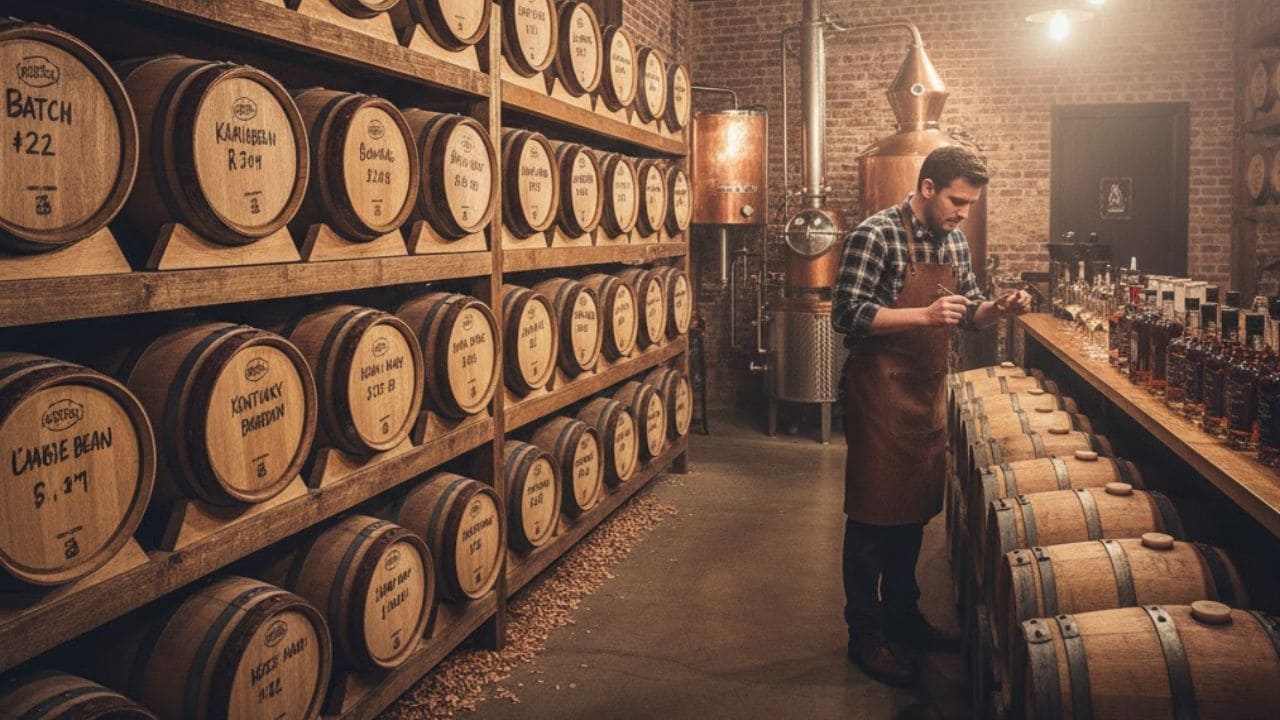
For craft distillers and serious homebrewers, small oak barrels represent a revolutionary approach to spirit maturation. While traditional distilleries wait years for their products to develop complex flavors in 53-gallon barrels, small barrel aging in 1-5 gallon vessels can achieve comparable results in weeks or months. This accelerated timeline stems from dramatically increased surface area-to-volume ratios, allowing craft producers to experiment rapidly, refine recipes, and bring products to market faster. This guide covers the technical fundamentals of small barrel aging, from char level selection to managing angel's share, providing craft spirits producers with actionable protocols for consistent, high-quality results.
Table of Contents
Navigate directly to the section you need. Click any link below to jump to detailed information about small barrel aging techniques and craft spirits maturation.
1. Understanding Small Barrel Aging Science
The accelerated maturation in small barrels isn't magic-it's pure physics and chemistry. A 1-liter barrel offers approximately 10 times more oak surface area per volume of spirit compared to a standard 53-gallon barrel. This means chemical extraction and interaction happen at a proportionally faster rate.
During aging, three primary chemical processes occur. Hemicellulose in the oak breaks down into wood sugars, contributing sweetness and caramel notes. Lignin degrades into vanillin and other aromatic compounds, providing vanilla, spice, and smoky characteristics. Meanwhile, tannins extract from the oak, adding structure, astringency, and mouthfeel. The char layer acts as a filtration medium, removing sulfur compounds and harsh flavors while contributing additional smoky, toasted notes.
The accelerated timeline means a 2-liter barrel can achieve in 6-8 weeks what might take 2-3 years in a large barrel. However, this isn't a perfect 1:1 comparison. Small barrels produce slightly different flavor profiles due to oxygen exposure patterns and temperature fluctuations affecting smaller liquid volumes more dramatically. Craft producers should view small barrel aging as its own distinct process rather than simply a time-compressed version of traditional aging.
Understanding these fundamentals allows producers to make informed decisions about barrel size, aging duration, and when to terminate maturation before over-oaking occurs.
2. Selecting the Right Small Barrel Size for Craft Spirits
Barrel size selection directly impacts both aging timeline and batch economics. Each size category serves different production goals and business models.
1-Liter Barrels
These micro-barrels age spirits in 2-6 weeks and are ideal for experimentation, recipe development, and barrel-aged cocktail programs. The extreme surface-to-volume ratio requires careful monitoring, with tasting every 3-5 days essential to prevent over-extraction. Best suited for home distillers and bars creating limited-batch cocktails rather than commercial spirit production due to low throughput.
2-3 Liter Barrels
The sweet spot for many craft producers, these barrels deliver optimal aging in 4-12 weeks. They provide sufficient volume for meaningful production runs while maintaining accelerated aging characteristics. A 3-liter barrel produces roughly 100 ounces of finished spirit per batch, making them economically viable for nano-distilleries and premium limited releases. Tasting intervals of 5-7 days allow for precise control over final flavor profiles.
5-Gallon Barrels
Approaching small commercial scale, 5-gallon barrels require 2-6 months for full maturation. These barrels strike a balance between accelerated aging and production volume, yielding approximately 640 ounces (20 liters) per batch. The slower aging timeline compared to 1-2 liter barrels allows for more nuanced flavor development and reduces the risk of over-oaking. Many craft distilleries use 5-gallon barrels as a stepping stone between experimentation and full commercial production.
3. Char Levels and Flavor Profile Development
Oak barrel char level represents one of the most critical flavor determinants in aged spirits. Cooperages typically offer four standardized char levels, each producing distinct chemical transformations in the wood.
Char Level 1 (Light Char)
Applied for approximately 15 seconds, this light char creates minimal caramelization of wood sugars while preserving delicate oak tannins. Expect subtle vanilla notes, light honey sweetness, and pronounced wood tannin structure. Ideal for delicate spirits like white whiskey or light rum where oak character should complement rather than dominate the base spirit. The lighter char provides less filtration, meaning harsher congeners remain more prominent.
Char Level 2 (Medium Char)
A 30-second char develops moderate caramelization, producing enhanced butterscotch and toffee notes alongside vanilla. This level offers a balanced approach for most whiskey and rum applications, providing noticeable oak influence without overwhelming the spirit. The char layer begins acting as an effective carbon filter while contributing sweet, toasted grain characteristics.
Char Level 3 (Medium Plus)
The industry standard for bourbon production, this 35-second char creates the classic "alligator" texture and delivers robust caramel, vanilla, and toasted coconut flavors. The heavier char layer provides excellent filtration of sulfur compounds and fusel alcohols while extracting deeper into the oak's red layer, where concentrated tannins and flavor compounds reside. Recommended for bourbon-style whiskeys, dark rums, and any spirit where bold oak character is desired. Approximately 70% of craft distillers select this char level for whiskey production.
Char Level 4 (Heavy Char)
A 55-second char produces intense smoky, espresso, and dark chocolate notes with assertive charred wood character. Best reserved for specific flavor profiles such as heavily peated whiskey or rum with pronounced molasses character. The heavy char can overwhelm lighter base spirits and requires extended aging times to integrate properly. Some craft producers use Level 4 barrels for second-use aging to add complexity without excessive extraction.
Matching char level to your base spirit and desired outcome is essential. Neutral grain spirits benefit from Level 2-3 chars, while robust pot-distilled whiskeys can handle Level 3-4. Document your results across different char levels to develop your signature house style.
4. Barrel Preparation and Curing Process
New oak barrels require proper curing before first use-skip this step and you'll experience excessive leaking and inconsistent flavor extraction. The curing process swells the wood staves, creating watertight seals while removing excess tannins and harsh wood compounds.
Begin by filling the barrel completely with hot water (65-75°C / 150-170°F). The heat accelerates wood expansion while beginning tannin extraction. Place the barrel bung-side up in a basin or tray to catch inevitable leakage. Rotate the barrel every 6-8 hours, ensuring all interior surfaces contact the hot water. Replace the water daily, noting how the color progressively lightens from dark brown to amber-this visual indicator shows tannin removal.
For 1-2 liter barrels, curing requires 3-4 days. Three-liter barrels need 4-5 days, while 5-gallon barrels demand 5-7 days minimum. The curing is complete when water replacement shows light amber color and leakage reduces to occasional drips only. Small weeps from the head joints are normal and will seal completely once high-proof spirit fills the barrel.
After curing, drain completely and rinse with cool water. Fill immediately with your spirit-never allow a cured barrel to dry out, as the wood will contract and recreate leaking issues. If you must store an empty cured barrel, keep it filled with a sulfur dioxide solution (1 gram per liter water) and check monthly.
Between batches, rinse thoroughly with hot water only-never use soap or sanitizers that will penetrate the wood and taint future batches. Steam cleaning provides the most effective sanitization for commercial operations.
5. Managing Angel's Share in Small Barrels
Angel's share-the spirit lost to evaporation during aging-represents a significant economic consideration in small barrel production. While traditional 53-gallon barrels lose approximately 2-4% annually, small barrels experience dramatically higher evaporation rates of 10-20% annually due to their greater surface area relative to volume.
The evaporation rate depends heavily on storage environment. Humidity levels between 55-70% provide optimal conditions, with higher humidity slowing alcohol evaporation while lower humidity increases water loss. Temperature fluctuations accelerate evaporation, so maintaining stable conditions between 15-20°C (60-68°F) minimizes losses. Craft distillers using temperature-controlled aging rooms report evaporation rates 30-40% lower than uncontrolled environments.
For a 2-liter barrel aged 8 weeks, expect to lose 150-300ml depending on environmental conditions-7.5-15% of total volume. This loss intensifies the remaining spirit's flavor concentration, which factors into your aging timeline calculations. Some producers intentionally leverage higher evaporation rates to create concentrated, bold flavor profiles.
Monitor liquid levels weekly by checking through the bung hole. When levels drop 2-3cm below the bung, top up with additional spirit of the same batch to minimize headspace and oxidation. Never mix different distillate batches when topping up, as this compromises batch consistency and traceability.
For commercial operations, angel's share losses directly impact profitability. Calculate your break-even point by factoring evaporation losses into your cost per bottle. A 5-gallon barrel losing 15% over 3 months means 750ml of product loss valued at retail-often $30-60 depending on your market positioning.
6. Aging Timeline by Spirit Type
Different spirits extract oak character at varying rates based on proof, congener content, and inherent flavor profiles. These timelines assume properly cured barrels at room temperature (18-21°C / 65-70°F).
Whiskey and Bourbon
For 1-2 liter barrels, begin tasting at 2 weeks. Optimal aging typically occurs between 4-8 weeks, with high-proof bourbon (60% ABV / 120 proof) reaching peak complexity around 6 weeks. Three-liter barrels develop best flavor at 6-10 weeks, while 5-gallon barrels require 2-4 months. Over-oaking manifests as bitter tannins and excessive wood spice-once present, these characteristics cannot be removed. Many craft distillers blend over-oaked whiskey with un-aged spirit at ratios of 1:3 to salvage batches.
Rum
Rum's molasses-derived congeners integrate oak flavors more rapidly than grain-based spirits. In 1-2 liter barrels, light rum achieves golden color and vanilla notes in 3-4 weeks, while full-bodied pot still rum develops rich caramel complexity in 4-6 weeks. Three-liter barrels optimize at 6-10 weeks, and 5-gallon barrels at 2-3 months. Rum tolerates heavier oak character than whiskey, allowing slightly longer aging windows.
Tequila
Reposado-style tequila (lightly aged) requires only 1-2 weeks in 1-liter barrels, 2-4 weeks in 2-3 liter barrels, and 1-2 months in 5-gallon barrels. The goal is subtle oak enhancement preserving agave character rather than heavy wood influence. Añejo-style (heavily aged) tequila can extend to 4-6 weeks in small barrels, though traditional large barrel aging remains preferred for authentic añejo character.
Barrel-Aged Cocktails
Pre-batched cocktails like Negronis, Manhattans, and Old Fashioneds benefit from 1-3 weeks in 1-2 liter barrels. The oak integration mellows harsh spirits while adding complexity. Monitor closely-over-aged cocktails become astringent and unbalanced. Rotate cocktail barrels between different recipes, as residual flavors contribute interesting cross-pollination effects.
Establish a tasting protocol: sample 15ml every 3-5 days for 1-2L barrels, every 5-7 days for 3L barrels, and weekly for 5-gallon barrels. Evaluate color progression, nose development, and palate integration. When the spirit achieves desired balance, bottle immediately to halt oak extraction.
7. Optimizing Results for Commercial Production
Scaling small barrel aging from hobby to commercial operation requires systematic process control and economic optimization.
Temperature-controlled aging rooms maintain consistent 15-20°C with 60-65% humidity, dramatically improving batch consistency and reducing angel's share losses. Investment costs of $2,000-5,000 for a temperature-controlled space housing 20-30 small barrels typically pays back within 18 months through reduced product loss and higher quality consistency.
Implement a barrel rotation system with clear labeling: barrel number, fill date, spirit type, proof, and target bottle date. Photograph your spirit color progression weekly to build a visual reference library. This documentation proves invaluable when training new staff and maintaining quality standards across scaling production.
Track each barrel's usage history meticulously. First-use barrels extract most aggressively, second-use provides mellower character, and third-use yields subtle enhancement. Many distilleries use first-use for flagship products, second-use for experimental batches, and third-use for barrel-aged cocktails or finishing. Beyond three uses, small barrels contribute minimal flavor-at this point, char refreshing or retirement becomes necessary.
Calculate your real cost per bottle including barrel depreciation, angel's share loss, storage space, and labor. A $150 three-liter barrel producing four batches over two years costs $37.50 per batch. Add 12% angel's share loss and storage overhead, and your actual per-bottle barrel cost may reach $2.50-4.00 depending on retail price point. Understanding these economics helps price products appropriately while maintaining profitability.
For nano-distilleries, 10-15 small barrels in rotation can support monthly product releases while keeping overhead manageable. Scale gradually, adding barrels only as sales volume justifies expanded inventory.
8. Troubleshooting Common Small Barrel Issues
Even with proper protocols, small barrel aging presents occasional challenges requiring quick diagnosis and correction.
Over-oaking manifests as excessive bitterness, astringent tannins, and overwhelming wood character that masks base spirit qualities. Prevention is key-taste frequently and bottle at first sign of optimal balance. If over-oaking occurs, blend with un-aged spirit at 1:2 or 1:3 ratios to dilute wood influence. Some distillers successfully "finish" over-oaked spirit in stainless steel with toasted oak spirals for controlled flavor adjustment.
Mold growth during barrel storage indicates insufficient sulfur dioxide solution or incomplete water coverage. If mold appears on exterior surfaces, scrub with hot water and white vinegar, then re-sanitize with fresh sulfur solution. Interior mold requires barrel retirement, as the mycelium penetrates wood pores and will contaminate future batches.
Leaks developing after curing usually indicate the barrel dried out between uses or wasn't filled immediately after curing. Re-cure following the original protocol. Persistent leaks at head joints may require beeswax application externally-melt pure beeswax and apply with a brush to problem areas, then buff smooth.
Off-flavors resembling wet cardboard or mustiness suggest bacterial contamination or insufficient barrel cleaning between batches. Steam clean thoroughly, inspect for mold, and consider retiring the barrel if flavors persist after cleaning. Prevention through immediate filling after emptying and proper sanitization between uses eliminates most contamination issues.
Document every problem and resolution in your production logs. Pattern recognition across multiple barrels often reveals systematic issues like inadequate climate control or flawed curing protocols that can be corrected facility-wide.
9. Conclusion
Small barrel aging empowers craft distillers and serious homebrewers to produce complex, mature spirits in weeks rather than years. Success requires understanding the accelerated extraction dynamics, selecting appropriate barrel sizes and char levels, maintaining proper environmental conditions, and monitoring closely to avoid over-oaking. The higher angel's share and intensive management demands are offset by rapid product development, lower capital requirements compared to large barrel programs, and the ability to bring products to market quickly.
Start with 2-3 liter barrels for optimal balance between aging speed and batch volume. Document every variable-barrel size, char level, spirit type, proof, aging duration, temperature, and humidity. This systematic approach builds the knowledge base necessary to develop your signature house style and scale production confidently. The craft spirits market increasingly values transparency and innovation; small barrel aging provides both while delivering exceptional quality in compressed timeframes.
Scaling craft spirits with small barrel aging?
This premium domain is perfect for launching your barrel aging platform, craft spirits optimization guide, or spirits maturation resource site. FermenterPro.com attracts distillery entrepreneurs, craft spirits enthusiasts, and barrel aging specialists looking for authoritative content on accelerated maturation and small batch production techniques.