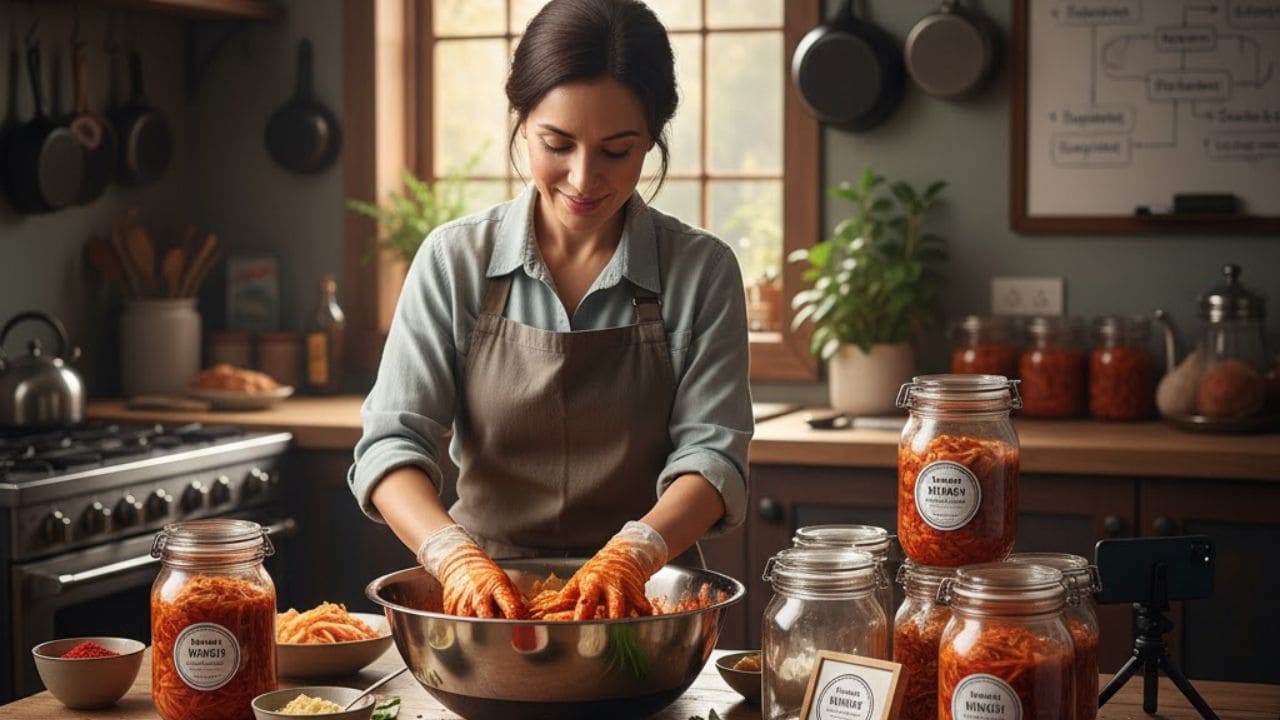
Starting a kimchi production business from your home kitchen represents one of the fastest-growing opportunities in the artisanal food sector. With the global kimchi market projected to reach $1.2 billion by 2030 and mainstream acceptance expanding beyond Korean-American communities, home-based producers can capture local market share with minimal startup capital and achieve profitability within months rather than years.
Unlike bakery or jam businesses facing intense competition, fermented vegetable producers occupy a specialized niche with fewer competitors-primarily because regulatory complexity deters casual entrepreneurs. This barrier to entry protects serious producers willing to master pH testing protocols and navigate cottage food regulations, creating a genuine opportunity for those who invest time understanding the landscape.
The business model offers compelling economics: startup costs of $800-$2,500, gross margins of 60-70% on retail sales, and realistic first-year revenue potential of $15,000-$60,000 depending on market density and time investment. Most successful home-based kimchi producers reach profitability within 3-4 months and scale to commercial kitchen operations within 18-24 months as demand outpaces cottage food production capacity.
This guide focuses on building a viable kimchi production business, covering regulatory compliance as the necessary foundation but emphasizing customer acquisition, production efficiency, pricing strategy, and sustainable growth pathways. You'll learn which states permit home-based fermented food sales, how to set up efficient production systems, strategies for building customer base, and precisely when and how to transition from cottage food to commercial operations.
Table of Contents
Navigate directly to the section you need. Click any link below to jump to detailed information about starting a kimchi production business.
1. Cottage Food Feasibility: State Regulations Overview
Before investing in equipment or developing recipes, determine if your state permits fermented vegetable sales under cottage food law. Approximately 15-20 states allow home-based kimchi production with proper pH testing and documentation, while 30-35 states prohibit fermented foods entirely under cottage food permits.
States Permitting Home-Based Kimchi Sales:
Texas ($150,000 annual cap), Alabama (unlimited revenue, pH ≤4.2), Iowa ($35,000 cap, added 2024), Montana ($75,000 cap), Colorado ($10,000 cap), Wyoming ($10,000 cap). These states require pH testing at or below 4.6 (federal standard) with batch documentation and cottage food labeling disclosures.
States Prohibiting Fermented Vegetables:
California, Florida, New York, Washington, Oregon, Arizona, Pennsylvania, New Jersey, Maryland, Michigan all exclude fermented products from cottage food programs. Producers in these states must use commercial kitchens ($300-$1,200 monthly) or co-packing services ($4-$8 per unit).
Critical Requirements in Permissive States:
All states allowing fermented vegetable sales mandate calibrated pH meter testing (equipment cost $80-$200), validated recipes demonstrating consistent pH achievement, batch record documentation retained 2+ years, and specific cottage food label disclosures like "This food is made in a home kitchen and is not inspected by the Department of State Health Services" (Texas wording).
Permit costs range from $0 (Texas, Iowa, Wyoming) to $50-$100 (Colorado, Alabama, Montana). Processing time typically 30-60 days. Some states permit wholesale sales to retail establishments (Texas, Iowa, Montana) while others restrict to direct-to-consumer only (Alabama, Colorado, Wyoming).
For detailed state-by-state comparison including revenue caps, pH requirements, wholesale permissions, and permit costs, consult your state's department of agriculture cottage food program. The Forrager Cottage Food Law database (forrager.com) maintains updated regulations with recent legislative changes.
If your state prohibits cottage food fermented vegetables, evaluate commercial kitchen alternatives before proceeding-the business model remains viable but requires different cost structure and higher revenue targets to achieve profitability.
2. Home Kitchen Production Setup & Equipment Investment
Efficient production systems maximize output per hour invested while ensuring regulatory compliance. Unlike hobby fermentation where equipment is discretionary, commercial home-based operations require specific tools for consistency and food safety.
Essential Equipment ($500-$900):
Calibrated pH Meter ($80-$200):
Non-negotiable for cottage food compliance. Apera PH60 ($120) or Milwaukee MW102 ($85) provide adequate accuracy. Include pH calibration buffers (4.0, 7.0 solutions, $15-$30) replaced every 3-6 months. Weekly calibration mandatory-uncalibrated meters produce unreliable readings risking batch rejection or food safety violations.
Fermentation Vessels ($100-$250):
Purchase 2-3 vessels enabling batch rotation. Ceramic crocks (3-5 gallon, $60-$120 each) offer temperature stability and traditional aesthetics. Food-grade HDPE buckets with lids ($25-$45 each) provide lighter weight and lower cost. Plan one vessel per 10-15 lbs cabbage capacity. Batch rotation maximizes kitchen efficiency-while batch A ferments days 1-7, prepare batch B ingredients; when A finishes, B begins fermenting.
Commercial-Grade Scale ($40-$100):
Digital scale accurate to 0.1g ensures recipe consistency. Salt percentage typically 2-3% of total vegetable weight-1g variation in 500g batch equals 0.2% salt difference affecting fermentation timing and final pH. Kitchen scales reading only to 1g lack adequate precision.
Glass Jars Bulk Purchase ($150-$300):
Initial inventory of 100-150 jars (mix of 8 oz and 16 oz). Bulk pricing through SKS Bottle, Fillmore Container, or Specialty Bottle: 8 oz jars $1.20-$1.50 each, 16 oz jars $1.60-$2.00 each. Purchase 20% excess for breakage reserves.
Additional Tools ($80-$150):
Fermentation weights ($20-$40), infrared thermometer ($25-$40), ingredient prep equipment (mandoline slicer $30-$50, large mixing bowls $15-$30), sanitizer and cleaning supplies ($20).
Ingredient Cost Structure (Per 10-Pound Batch):
- Napa cabbage: 10 lbs ($15-$20)
- Gochugaru: 1 lb ($8-$12)
- Garlic: 4 oz ($2-$3)
- Ginger: 4 oz ($2-$3)
- Fish sauce: 8 oz ($3-$4)
- Salt: 1 lb ($2)
- Optional additions: scallions, carrots, daikon ($3-$5)
Total: $35-$49. Yield: 28-32 jars at 8 oz size. Per-unit ingredient cost: $1.25-$1.55.
Space Configuration:
Dedicate 25-40 square feet organized into three zones: prep station (washing, cutting, mixing), fermentation storage (temperature-stable area 65-75°F for 5-7 days), and cold storage (refrigerator or chest freezer for finished product). Cottage food regulations typically prohibit pets in production areas and require separation from household living spaces during production.
Production Capacity Planning:
One person working 4-hour sessions can process 20-30 lbs cabbage (60-85 jars output). Plan two 4-hour production days weekly yielding 120-170 jars weekly = 480-680 jars monthly. At $8 average wholesale price or $9 retail, monthly revenue potential: $3,840-$6,120 wholesale, $4,320-$6,120 retail.
Total Startup Investment:
- Equipment: $800-$1,500
- Initial ingredient inventory: $100-$300
- Permits/registration: $100-$500
- Initial jar inventory: $100-$200
Total: $1,100-$2,500 before first sales.
3. Efficient Production Process & Quality Control
Streamlined production workflows maximize jar output per labor hour while maintaining pH compliance and consistent flavor profiles.
Day 1 (2 hours) - Salting:
Quarter 10 lbs napa cabbage, cut into 2-inch pieces. Prepare 10% brine (1 cup salt per gallon water). Submerge cabbage in brining container, weight to prevent floating. Set 10-hour timer. Use this 10-hour window for other business tasks: label design, social media content creation, customer communication, delivery planning.
Day 2 (2 hours) - Paste Preparation & Packing:
Drain and rinse salted cabbage thoroughly (3-4 rinses until pleasantly salty, not overpowering). Prepare gochugaru paste: blend 1 cup Korean chili flakes, 8 cloves minced garlic, 2-inch ginger knob minced, 1/4 cup fish sauce, 2 tablespoons sugar. Mix paste with cabbage using gloved hands (5-7 minutes thorough mixing). Pack firmly into fermentation vessels leaving 2-3 inches headspace. This 2-hour session processes 10 lbs cabbage = 28-32 jars value $224-$288 retail.
Days 3-6 - Fermentation Monitoring:
Position vessels at stable 68-72°F (ideal fermentation temperature). Check daily that vegetables remain submerged. Active fermentation produces bubbling within 24-48 hours as Lactobacillus species convert sugars to lactic acid, lowering pH. No active labor required during this phase-use time for farmers market preparation, wholesale account prospecting, or starting next batch.
Day 6 - pH Testing & Packaging (2 hours):
Calibrate pH meter using 4.0 and 7.0 buffers. Test three separate samples from each batch. Target pH 4.2-4.5 (must achieve ≤4.6 federal compliance, ≤4.2 Alabama). Record readings in batch log with batch number, date, readings, and operator signature. Transfer to clean jars leaving 1/2-inch headspace, apply new lids, affix labels. Refrigerate immediately at 35-40°F halting fermentation. Shelf life 21-45 days refrigerated.
Batch Documentation Template:
- Batch #: [Date-Sequence]
- Production Date: [Date]
- Cabbage Source: [Supplier + Lot]
- Gochugaru: [Supplier + Lot]
- Salt %: [Calculate]
- Fermentation Temp Range: [68-72°F]
- pH Reading Day 6: [Record 3 samples]
- Final pH: [Average]
- Jars Produced: [Count]
- Packaged Date: [Date]
- Operator: [Name]
Retain records 2+ years minimum.
Scaling Production Volume:
Once process mastered, increase to 20-30 lb batches (60-85 jars output). This requires larger fermentation vessels (5-7 gallon capacity, $100-$180) and 3-4 hour production sessions but improves labor efficiency-same prep/cleanup time produces 2-3x output.
Quality Control Checkpoints:
Consistent salt percentage (weigh cabbage + calculate 2.5% salt precisely), fermentation temperature stability (±3°F max variation), pH verification every batch (never skip testing), taste consistency (maintain tasting notes comparing batches), and visual inspection for contamination (reject any mold, kahm yeast, or off-odors immediately).
4. Pricing Strategy & Profit Margin Analysis
Correct pricing ensures profitability while remaining competitive with imported commercial kimchi brands and other artisanal producers.
Cost Breakdown Per 8 oz Jar:
- Ingredients: $1.40
- Glass jar + lid: $1.50
- Label: $0.25
- Labor (2 minutes at $18/hour): $0.60
- Packaging materials: $0.15
Total cost: $3.90 per jar.
Retail Pricing:
Target $9-$10 per 8 oz jar for direct sales (farmers markets, online pre-orders, farm stand). This achieves 56-61% gross margin. Imported commercial kimchi at grocery stores typically prices $5-$7 for 16 oz, making artisanal 8 oz at $9 competitive on per-ounce basis ($1.12/oz artisanal vs $0.31-$0.44/oz commercial) with quality and freshness justification.
Wholesale Pricing:
Offer $5.50-$6.50 per 8 oz jar to retail accounts (independent grocers, co-ops, specialty markets). Retailers mark up 60-80% reaching $9-$11 retail shelf price. Your gross margin drops to 29-40% wholesale but volume increases and predictable orders reduce sales labor.
16 oz Jar Economics:
- Ingredient cost: $2.40
- Jar + lid: $2.00
- Label: $0.30
- Labor: $0.85
- Packaging: $0.20
Total cost: $5.75. Retail price $14-$16 (59-64% gross margin), wholesale $9-$10 (36-43% gross margin). Many customers prefer 16 oz for better value perception despite lower per-ounce margins for producers.
Gross vs Net Profit Margins:
Gross margins of 56-61% retail and 29-40% wholesale represent revenue minus direct costs (ingredients, packaging, direct labor). Net profit after accounting for indirect costs (kitchen utilities, vehicle expenses for deliveries/markets, marketing, insurance, permits) typically reaches 10-15% for artisanal food businesses. On $50,000 annual revenue, expect $5,000-$7,500 net profit first year.
Volume-Based Pricing:
Consider bulk discounts:
- Single jar: $9
- Three-pack: $25 ($8.33 each, 7.5% discount)
- Six-pack: $48 ($8 each, 11% discount)
Bulk sales increase average transaction value and improve production efficiency by reducing individual transaction labor.
Seasonal Pricing:
Some producers implement slight premium pricing ($10-$11 per 8 oz) during October-March peak demand when fermented foods and Korean cuisine popularity increase. Summer months may warrant promotional pricing ($8) to maintain sales velocity.
5. Customer Acquisition & Marketing Strategies
Building sustainable customer base requires multi-channel approach combining direct sales, digital presence, and strategic partnerships.
Farmers Markets (Primary Channel Year 1):
Secure booth space at 2-4 weekly/bi-weekly markets. Fees range $25-$75 per market or $200-$800 seasonal passes. Prime markets with 2,000-5,000 weekly visitors generate 20-50 jar sales per day. Setup requires canopy tent ($150-$400), folding table ($50-$100), coolers with ice maintaining 35-45°F product temperature ($80-$200), signage explaining fermentation health benefits, and sampling cups offering 1/4 oz tastes.
Sampling drives conversion-expect 15-25% of samplers purchasing. Prepare 100-150 samples per market (cost $3-$5 in product). Position as "probiotic-rich traditional Korean fermented vegetables supporting gut health"-health messaging resonates with farmers market demographics.
Collect email addresses offering "10% off next purchase" incentive. Build mailing list targeting 200-400 subscribers first year enabling direct outreach for online pre-orders, seasonal flavor launches, and wholesale location announcements.
Online Pre-Orders & Local Delivery:
Establish website (Squarespace, Wix, or WordPress, $150-$300 annual) with online ordering via Square, Stripe, or PayPal ($0.30 + 2.9% per transaction). Offer weekly pre-order windows with designated pickup locations or delivery within 10-mile radius ($5-$8 delivery fee or free over $30 order).
Online sales eliminate market booth fees and weather dependencies. Successful producers generate 30-50% of revenue through online channels by year two. Promote via Instagram and Facebook showcasing product photography, fermentation process behind-the-scenes content, and customer testimonials.
Wholesale Accounts:
Target independent grocers, natural food co-ops, Korean restaurants, health-focused cafes, and yoga studios. Initial outreach: prepare one-page sell sheet with product photos, ingredient transparency, wholesale pricing, minimum order quantities (typically 12-24 jar case minimums), and delivery schedule.
Offer consignment for first order reducing retailer risk-they pay only for sold units, returning unsold inventory. Standard consignment split: 60% producer, 40% retailer. Once relationship established, transition to standard wholesale terms with 30-day payment.
Plan 10-15 wholesale accounts generating 15-40 jars weekly each by month 6-9. This creates predictable baseline revenue ($1,800-$4,800 monthly wholesale) supplementing direct sales volatility.
Community Partnerships:
Collaborate with Korean cultural organizations, cooking schools offering fermentation workshops, CSA programs adding kimchi as optional add-on, and corporate wellness programs providing healthy snacks. These partnerships build brand credibility and access niche customer segments.
Content Marketing:
Publish blog content or social media posts covering: "Health Benefits of Fermented Foods," "How Traditional Kimchi is Made," "Difference Between Store-Bought and Artisanal Kimchi," "Recipe Ideas Using Kimchi." Educational content establishes expertise and improves search engine visibility for local customers researching kimchi sources.
Target 5-10 new customer acquisitions weekly through combined channels. First-year customer acquisition goal: 200-400 repeat customers generating $15,000-$40,000 revenue.
6. Scaling Operations & Growth Timeline
Most successful cottage food kimchi businesses follow predictable growth trajectory from startup to commercial kitchen transition.
Months 1-3: Foundation & Market Validation
Focus on production consistency, regulatory compliance, and initial customer acquisition. Produce 80-120 jars monthly testing recipes and gathering customer feedback. Revenue typically $640-$1,080 monthly during this phase. Primary goal: validate that market demand exists and customers appreciate product quality at target pricing.
Months 4-9: Volume Scaling
Increase to 200-350 jars monthly through batch size increases (20-30 lb cabbage batches) and production frequency (2-3 production sessions weekly). Add 2-4 wholesale accounts and establish consistent farmers market presence. Revenue reaches $1,800-$3,150 monthly. Begin tracking production costs precisely, refining operational efficiency, and developing seasonal flavor variations (spring onion kimchi, white kimchi, cucumber kimchi).
Months 10-18: Cottage Food Cap Approach
Production hits 400-600 jars monthly approaching state cottage food revenue limits in many states. Revenue $3,600-$5,400 monthly ($43,200-$64,800 annually). At this stage, evaluate commercial kitchen transition as wholesale demand often exceeds cottage food permit limitations. Consider hiring part-time production assistant (1099 contractor, $15-$18/hour) to handle packaging and delivery logistics.
Months 19-24: Commercial Kitchen Transition
Secure shared commercial kitchen rental ($400-$1,000 monthly) or dedicated facility lease ($1,500-$4,000 monthly). Obtain food manufacturing permit ($300-$2,500 annual) and enhanced insurance ($1,200-$3,000 annual). This transition enables wholesale expansion to 15-30 accounts, multi-state distribution if desired, and production capacity of 800-1,500 jars monthly. Annual revenue potential: $80,000-$180,000.
Break-Even Analysis:
Cottage food break-even typically achieves at 60-100 jars monthly sales covering permits, insurance, and basic equipment amortization. Commercial kitchen break-even requires 250-400 jars monthly to cover facility costs, enhanced licensing, and increased insurance. Most producers reach commercial kitchen profitability within 6-9 months post-transition.
Alternative Growth Path - Co-Packing:
Instead of self-operating commercial kitchen, contract with co-packer producing your recipe at $4-$8 per unit (500-1,000 unit minimums). Co-packing eliminates facility costs and labor but reduces margins significantly. Viable for producers focusing on sales/marketing strengths over production operations, or those pursuing rapid geographic expansion.
7. Legal Compliance & Risk Management
Proper insurance, documentation, and food safety protocols protect business sustainability and personal assets.
Liability Insurance:
Obtain dedicated cottage food or food manufacturer insurance providing $1-2 million general liability coverage. Cost $400-$1,000 annually for cottage food, $1,200-$3,000 for commercial operations. Providers include Verified Ventures, ACT Insurance, and FLIP Insurance. Standard homeowners policies exclude business activities-operating without proper coverage creates severe financial exposure if product liability claims arise.
Batch Record Documentation:
Maintain detailed logs for every production batch including: unique batch ID (date-based codes like 012025-A), ingredient suppliers with lot numbers, precise weights of all ingredients, fermentation temperature range, pH readings (minimum three samples per batch), packaging date, number of units produced, and operator signature. Retain records minimum two years, though three years provides additional protection.
Many state health departments conduct random cottage food inspections requesting batch documentation-incomplete records result in warnings, permit suspension, or product embargoes. Digital documentation via spreadsheets or food safety software (FoodLogiQ, SafetyChain) provides better organization than paper logs.
Product Recall Planning:
Despite best efforts, contamination or labeling errors occasionally necessitate recalls. Prepare recall plan including: lot code traceability system identifying which customers purchased specific batches, contact information for all wholesale accounts and direct customers (email list database), protocol for retrieving products from retail shelves, and communication templates notifying customers. Quick, transparent recall response minimizes reputational damage and legal exposure.
Labeling Compliance Verification:
Before printing large label quantities, verify compliance with state cottage food disclosure requirements and FDA regulations. Many state agriculture departments offer free label review services-submit draft labels for approval before investing in 1,000+ label printing orders. Common errors: missing allergen warnings, incorrect net weight format, insufficient cottage food disclosure prominence, or missing producer contact information.
8. Resources & Next Steps
State Cottage Food Program Verification:
Contact your state department of agriculture or health services to verify current fermented vegetable authorization status: Texas DSHS (dshs.texas.gov/cottage-food), Alabama Dept of Agriculture (agi.alabama.gov), Iowa Dept of Inspections (dia.iowa.gov), Colorado Dept of Public Health (cdphe.colorado.gov/cottage-foods), Montana DPHHS (dphhs.mt.gov).
Equipment & Ingredient Suppliers:
pH meters: Apera Instruments, Milwaukee Instruments, Hanna Instruments. Fermentation vessels: Mortier Pilon, Ohio Stoneware, restaurant supply stores. Korean ingredients: H Mart, local Korean grocers, online via Amazon or specialty importers. Glass jars bulk: SKS Bottle, Fillmore Container, Specialty Bottle.
Business Support:
Small Business Development Centers (SBDC) offer free consulting for food entrepreneurs covering business planning, financial projections, and regulatory navigation. SCORE mentors provide experienced guidance. Local incubator kitchens often host workshops on food business fundamentals, pricing strategy, and wholesale account development.
Action Plan:
- Week 1: Verify state cottage food status, research local market competition and pricing, calculate startup budget
- Weeks 2-3: Purchase essential equipment (pH meter priority), obtain cottage food permit, design compliant labels
- Weeks 4-6: Produce 3-5 test batches refining recipe and mastering pH testing
- Weeks 7-8: Finalize packaging, establish online presence, apply to farmers markets
- Week 9+: Launch sales through farmers markets and direct channels
First-Year Milestones:
- Month 3: Achieve 100+ jars monthly production with consistent pH compliance
- Month 6: Establish 2-4 wholesale accounts and regular farmers market presence
- Month 9: Reach 250+ jars monthly and $2,000+ monthly revenue
- Month 12: Evaluate commercial kitchen transition if approaching cottage food cap or demand exceeds production capacity
Realistic first-year revenue for committed part-time producers: $15,000-$35,000. Full-time focused entrepreneurs reach $40,000-$60,000 by maximizing production capacity and distribution channels.
Success requires equal dedication to fermentation craft and business operations. Master production consistency, understand your costs precisely, invest in customer relationships, and scale methodically as demand validates each growth phase.
Ready to launch your fermentation business platform?
This premium domain is perfect for building your artisanal food business blog, fermentation education platform, or cottage food production resources focused on commercial fermentation and kimchi production.