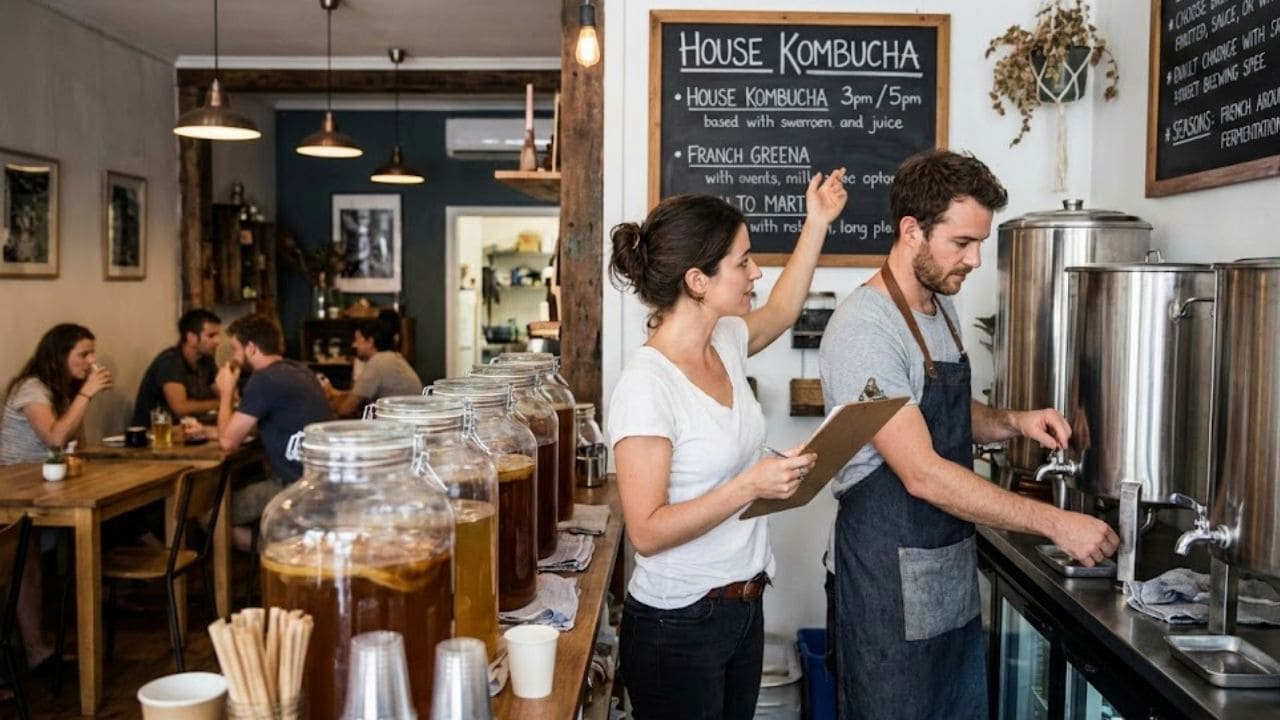
Transitioning from home kombucha brewing to commercial café production demands professional equipment that ensures batch consistency, food safety, and efficient workflows. While gallon jars work for personal consumption, serving customers requires systems that maintain SCOBY health while producing 50-200 bottles weekly in limited kitchen space.
The challenge: maintaining delicate fermentation balance while meeting FDA standards. Generic food service equipment lacks precise temperature control, while full brewery systems exceed budget and space constraints for small operations.
A complete commercial setup requires $2,000-$8,000, including fermentation vessels, SCOBY propagation systems, bottling equipment, pH testing tools, and temperature control. This guide will help you select equipment that meets FDA compliance, scales from 10L to 50L batches, and delivers consistent quality customers expect.
Table of Contents
Navigate directly to the section you need. Click any link below to jump to detailed information about commercial kombucha brewing equipment.
1. Technical Foundation: Kombucha Fermentation Science
Kombucha fermentation involves yeast species (Saccharomyces, Brettanomyces) converting sucrose into ethanol and CO2, while acetic acid bacteria (Acetobacter, Gluconacetobacter) oxidize ethanol into acetic and gluconic acids. This creates kombucha's tangy flavor while producing the cellulose pellicle (SCOBY) at the liquid surface.
Temperature must remain 72-82°F (22-28°C)-below 70°F slows fermentation and increases contamination risk; above 85°F kills beneficial bacteria. pH trajectory: starting at 4.5 (sweetened tea), dropping to 3.5-3.2 during fermentation, finishing at 2.5-3.5 for safe, shelf-stable product. The SCOBY requires surface oxygen for acetic acid production, but excessive agitation disrupts the culture.
Common Failure Modes:
- Mold contamination (green/black fuzzy growth on SCOBY surface)
- Over-acidification (pH below 2.5) creating harsh, vinegar-like flavor
- Inconsistent carbonation from temperature fluctuations during secondary fermentation
- Cross-contamination from inadequate sanitation between batches
- SCOBY death from temperature spikes above 90°F or chlorinated water
At commercial scale, FDA regulations require pH control below 4.6, accurate alcohol labeling, and traceable lot numbers. Temperature fluctuations of 5°F alter fermentation speed by 30-50%.
2. Equipment Comparison: 5 Commercial Systems
System 1: Stainless Steel Brewing Vessels (20-50L)
Food-grade 304 stainless steel fermenters are the gold standard for commercial production. These cylindrical vessels feature welded construction, wide-mouth openings, and bottom-mounted ball valves for sampling without disturbing the culture.
Specifications: 5.3-gallon (20L) to 13-gallon (50L) capacities, 18-gauge stainless with brushed interior, graduated markings, 2-inch tri-clamp openings, 1/2-inch ball valves. Temperature stability ±2°F in climate-controlled spaces.
Cost Breakdown:
- Equipment: $300-$800 per vessel (20L ~$350, 50L ~$650)
- Minimal ongoing costs: replacement gaskets $15/year
- No power consumption
- 20+ year lifespan
Space Requirements: 20L: 12"×16" footprint, 24" height; 50L: 16"×20", 30" height. Top clearance needed for SCOBY access.
Skill Level: Intermediate. Requires sanitation protocols (acid-based cleaners, not bleach), temperature monitoring, proper valve operation.
Pros: Exceptional durability, professional appearance, excellent sanitation, no off-flavors, maintains resale value, ideal for multi-batch rotation.
Cons: High initial cost, heavy when full (50L = 110 lbs), requires lifting for cleaning, no integrated temperature control.
Best For: Cafés producing 100+ bottles weekly, 2-5 year equipment plans, dedicated fermentation space with climate control.
Expected Outcomes: 20L yields 65-70 bottles (12 oz), 50L produces 165-175 bottles. Fermentation 7-14 days. 95%+ batch success rate.
Real-World Example: Blue Ridge Café (Asheville, NC) operates four 50L vessels producing 600 bottles weekly with 99% consistency.
System 2: Food-Grade HDPE Fermentation Buckets
High-density polyethylene buckets offer economical entry into commercial production. White plastic vessels with graduated markings, snap-on lids with airlock holes, and integrated spigots.
Specifications: 5-gallon (19L) to 7-gallon (26L), HDPE #2 resin (FDA-approved), 90-mil wall thickness, molded handles, spigots positioned 2" from bottom.
Cost Breakdown:
- Initial: $25-$45 per bucket with spigot and lid
- Airlocks: $3-$5
- Replace every 18-24 months ($15-$20 annual replacement)
- Three-bucket operation first-year cost: ~$120
Space: 12" diameter, 16" height, 2 lbs empty. Three buckets fit standard 36" counter.
Skill Level: Beginner. Translucent walls aid monitoring. Simple cleaning with hot water and vinegar.
Pros: Minimal investment, lightweight, visual SCOBY monitoring, readily available, disposable if contaminated.
Cons: Scratches easily (contamination risk), no temperature control, spigot threads harbor bacteria, unprofessional appearance, limited lifespan, possible plastic taste.
Best For: Testing market demand before major investment, cottage food operations, backup vessels, seasonal producers.
Expected Outcomes: 5-gallon yields 50-55 bottles. 8-12 days fermentation at 75°F. 10-15% batch variability without climate control.
Real-World Example: Portland's Morning Glory Café started with three HDPE buckets producing 150 bottles monthly, then upgraded to stainless after six months.
System 3: Continuous Brew Systems
Continuous brew maintains perpetual fermentation by harvesting from the bottom while adding sweet tea to the top. Large vessels (10-30 gallons) enable weekly 20-30% harvests without disturbing the SCOBY layer.
Specifications: Porcelain, glass, or stainless construction, 2-4" bottom spigots leaving 70% volume undisturbed. Some include temperature strips and SCOBY guards.
Cost Breakdown:
- Porcelain crocks: $150-$400 (10-gallon ~$200)
- Glass: $180-$350
- Stainless: $400-$900
- Weekly sweet tea: ~$12-$18
- One-time investment amortizes 10+ years
Space: Single large footprint-10-gallon needs 14"×14", 18" height. Requires stable surface supporting 100+ lbs.
Skill Level: Advanced. Demands harvest volume mastery, refill ratios, pH monitoring for fermentation equilibrium. SCOBY hotels necessary for backup.
Pros: Continuous production eliminates downtime, mature kombucha always available, reduced handling, exceptional flavor consistency, minimal footprint.
Cons: Slow startup (4-6 weeks), difficult troubleshooting, total loss risk if contaminated, requires larger initial SCOBY (3-4 lbs), harvest inflexibility.
Best For: Established cafés with consistent daily sales (40+ bottles), single-flavor operations, excellent temperature stability.
Expected Outcomes: 10-gallon CB produces 30-35 bottles weekly at steady state. First harvest week 6-8. Exceptionally stable flavor (±0.1 pH).
Real-World Example: Seattle's Fermentation Station operates 20-gallon porcelain CB producing 175 bottles weekly with 0.05 pH variation over 18 months.
System 4: Jacketed Temperature-Controlled Tanks
Glycol-jacketed or electric-element tanks provide precise temperature control (±1°F) for non-climate-controlled spaces. Double-wall construction with circulating coolant or heating elements.
Specifications: 15-50L, 304 stainless. Glycol models require external chiller ($800-$2,000). Electric models integrate 300-500W elements with digital PID controllers. Include thermowells, PRV ports, CIP spray balls.
Cost Breakdown:
- Jacketed tanks: $1,200-$3,500 (30L ~$1,800)
- Chillers: add $800-$2,000
- Electric models: $900-$2,200
- Operating: glycol $15-$25/month, electric $20-$35/month
- Controllers: $150-$300 replacement every 3-5 years
Space: Tanks 16"×20"×30" for 30L. Chillers add 18"×24"×20". Requires 110V/15A circuit. Total 10-12 sq ft.
Skill Level: Advanced. PID tuning, glycol maintenance, sanitation, troubleshooting temperature failures.
Pros: Eliminates seasonal variation, year-round consistency, accelerates batches to 5-7 days at 82°F, programmable temperature ramping, professional-grade.
Cons: High capital investment, energy costs, maintenance (glycol checks, element descaling), space-intensive, overkill for climate-controlled spaces.
Best For: High-volume cafés (200+ bottles weekly), non-climate-controlled spaces, variable climates, optimizing fermentation speed.
Expected Outcomes: 30L produces 95-100 bottles. 7-9 days fermentation at 78-80°F with <5% variation. ROI in 18-24 months for high-volume.
Real-World Example: Denver's Altitude Kombucha uses three 50L jacketed tanks maintaining 79°F despite warehouse swings of 55-95°F, producing 500+ bottles weekly with 98% consistency.
System 5: Complete Commercial Starter Kits
Turnkey systems bundle fermenters, SCOBY hotels, bottling equipment, and sanitizers in packages for café-scale production, eliminating multi-supplier sourcing.
Specifications: Typical kit includes two 30L stainless/HDPE fermenters, one 10L SCOBY hotel, bottle filler, 50 swing-top bottles, pH meter, hydrometer, thermometer, sanitizer, guides. Premium kits add temperature controllers or cappers.
Cost Breakdown:
- Basic kits (HDPE): $300-$600
- Premium stainless: $1,200-$2,500
- 3-6 months supplies included
- Ongoing: bottles $35-$60/case, sanitizer $20/month, pH calibration $15/quarter
Space: Complete kit occupies 6-8 sq ft counter/shelf space. Bottle storage adds 2-4 sq ft per 100 bottles.
Skill Level: Beginner-Intermediate. Detailed instructions included. Supplier technical support available.
Pros: Single purchase convenience, component compatibility guaranteed, 15-25% bulk pricing savings, reduces decision paralysis, supplier support.
Cons: Limited customization, may include unnecessary items, locked into supplier choices, premium kits approach custom costs, predetermined bottle styles.
Best For: First-time commercial producers, cafés with limited fermentation knowledge, operations valuing convenience, rapid production startup.
Expected Outcomes: Two-vessel rotation enables 60-80 bottles weekly. Startup to first sales in 3-4 weeks. Supports scaling to 150-200 bottles before expansion.
Real-World Example: Chicago's Lakefront Café purchased $1,400 kit, producing first commercial batch within 21 days. After 8 months, expanded to four vessels.
3. Equipment Comparison Table
| System | Capacity | Cost | Skill Level | Best For | Consistency |
|---|---|---|---|---|---|
| Stainless Steel | 20-50L | $300-$800 | Intermediate | High-volume cafés | 95%+ |
| HDPE Buckets | 19-26L | $25-$45 | Beginner | Market testing | 85-90% |
| Continuous Brew | 38-114L | $150-$900 | Advanced | Single-flavor ops | 98%+ |
| Jacketed Tanks | 15-50L | $1,200-$3,500 | Advanced | Variable climates | 98%+ |
| Complete Kits | 30L×2 | $300-$2,500 | Beginner-Int | Turnkey startup | 90-95% |
4. SCOBY Management & Propagation
Commercial production requires SCOBY hotel systems-separate 2-5 gallon containers holding 4-8 backup cultures submerged in mature kombucha. Feed hotels with 1-2 cups sweet tea monthly, maintaining pH 2.5-3.0 to keep cultures dormant but viable.
Propagation involves splitting mature SCOBYs (1"+ thick) into 2-3 layers, allocating one per new 5-gallon batch with 2 cups mature starter. New SCOBYs form within 7-10 days at 75-78°F. For rapid expansion, maintain 80-82°F using heating pads, accelerating formation to 5-7 days.
Quality control: Healthy SCOBYs appear cream to light tan, smooth or bumpy texture. Reject cultures with green/black mold, brown slime (kahm yeast), or foul odors. Replace production SCOBYs every 6-8 batches as yeast sediment reduces efficiency. Hotels eliminate $50-$100 replacement culture costs when batches fail.
5. Complete Production Process
Day 1 - Sweet Tea Preparation
Brew concentrated tea (8-10 bags per gallon) in boiling water for 15 minutes. Add 1 cup white sugar per gallon. Cool to 75-85°F-never add SCOBY above 90°F. Transfer to sanitized fermenter, add SCOBY with 10-20% mature starter (2 cups per gallon minimum). Cover with breathable cloth.
Days 2-7 - Primary Fermentation
Position vessel at stable 72-78°F. Thin pellicle forms within 48-72 hours. Sample pH day 5 (should reach 3.5-4.0) and day 7 (target 3.0-3.5). Avoid moving vessel.
Days 8-10 - Taste Testing
Begin daily taste tests using sanitized straw beneath SCOBY. Optimal harvest: pH 2.8-3.2. Warmer fermentation (78°F+) reaches this by day 8; cooler (72-74°F) may require 12-14 days.
Days 11-14 - Bottling & Secondary
Reserve 20% volume as starter. Bottle remaining kombucha with 1" headspace. For carbonation, add 1-2 teaspoons fruit juice per 16 oz bottle. Cap and store at 72-78°F for 3-7 days, producing 2.5-3.5 volumes CO2. Refrigerate when carbonation reaches desired level.
Troubleshooting
- Mold: Discard batch and SCOBY, sanitize equipment, restart from hotel backup.
- Over-acidification: Reduce fermentation time by 2-3 days.
- Flat kombucha: Increase secondary time, add more priming sugar, verify cap seals.
6. Bottling Equipment & FDA Compliance
Bottling requires bottle filler wands ($15-$30) achieving 30-40 bottles/hour manually. Semi-automatic fillers ($200-$600) double this rate. Swing-top bottles cost $2-$3 each; crown-cap bottles $0.40-$0.80 requiring bench capper ($40-$120).
FDA compliance mandates pH below 4.6, accurate alcohol labeling (test if above 0.5% ABV), and facility registration. Most states require commercial kitchen certification-home production prohibited except under cottage food laws ($15,000-$50,000 annual sales limit).
pH testing demands calibrated meters ($50-$200) verified weekly with buffer solutions. Document pH readings for every batch with date, lot number, operator signature. Many health departments require bi-annual laboratory testing ($150-$300).
Labeling must include: product name, net weight, ingredients (descending order), allergen warnings, nutrition facts, producer name/address, lot code. Contract label printer costs $200-$500 setup, $0.15-$0.40 per label. Insurance requires $1-2 million liability coverage-annual premiums $800-$2,500.
7. Scaling & Production Economics
Equipment investment timeline: Months 1-3 validate with two 20L vessels ($600-$800), months 4-6 add third vessel and upgrade bottling ($400-$600), months 7-12 expand to 50L or continuous brew ($1,200-$2,000).
Cost analysis for 50L batch (165 bottles):
- Ingredients: $18-$25
- Bottles/caps: $65-$130
- Labels: $25-$65
- Total per-bottle: $0.65-$1.35
Pricing strategy: Wholesale $2.50-$3.50 per bottle (40-60% margin), retail $4.50-$6.00 (65-75% margin).
Break-even analysis: $5,000 investment selling 100 bottles weekly at $4.50 retail ($1.00 cost) generates $350 weekly profit, recovering investment in 15 weeks. Most café operations achieve profitability by month 4-6.
Distribution channels: On-premise café sales (highest margin), consignment (60/40 split), farmers markets (premium pricing), wholesale to grocery (lowest margin, highest volume). Successful blend: 40% on-premise, 30% farmers markets, 30% wholesale.
8. Resources & Essential Suppliers
Equipment Vendors
- Homebrewing.org: Fermenters $300-$800, kits $400-$1,200
- MoreBeer.com: Professional equipment, jacketed tanks $1,500-$3,500
- KombuchaKamp.com: CB systems $150-$600, SCOBY cultures $35-$75
- BrewBuilt: Custom stainless, temperature controllers $200-$500
Ingredient Suppliers
- Arbor Teas: Organic bulk tea $25-$45/lb
- Mountain Rose Herbs: $18-$60/lb
- Local restaurant supply: 50-lb sugar bags ~$35-$45
Communities & Education
- Kombucha Brewers International: $200 annual membership
- r/Kombucha: 180k+ members on Reddit
- "The Big Book of Kombucha" by Hannah Crum: $20
9. Conclusion & Next Steps
Begin with two stainless steel 20L vessels ($600-$700) plus SCOBY hotel ($50-$100)-supporting 80-100 bottles weekly while minimizing capital risk. HDPE buckets lack durability for long-term commercial success. Reserve continuous brew and jacketed tanks for expansion once you've validated market demand.
First purchase priority: One 20L stainless fermenter, 5-gallon SCOBY hotel, calibrated pH meter, swing-top bottles (case of 12), sanitizer. Total: $500-$600.
Timeline to proficiency: Weeks 1-2 equipment assembly and first batch, weeks 3-4 first harvest, weeks 5-8 recipe refinement, months 3-4 reliable customer-ready production. Most café producers achieve mastery within 90-120 days.
Ready to launch your kombucha business?
This premium domain is perfect for building a commercial fermentation equipment marketplace, café kombucha guides, or food safety compliance resources.