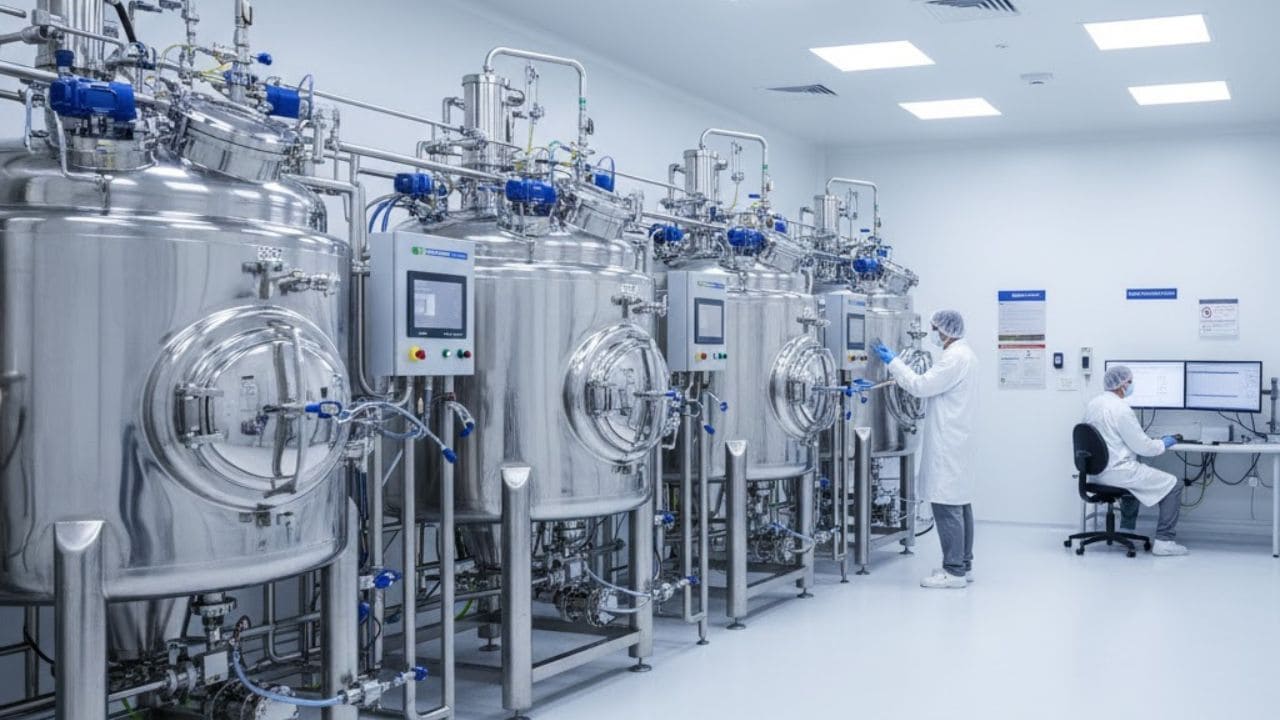
Pharmaceutical startups face a uniquely challenging landscape: develop breakthrough biologics while maintaining regulatory compliance, all within venture capital budgets that demand fiscal discipline. The fermentation equipment decisions made during early development stages ripple through clinical trials, regulatory submissions, and commercial manufacturing. Choose poorly, and costly re-validation delays market entry. Choose wisely, and your cGMP bioreactors for drug manufacturing become competitive advantages rather than compliance burdens.
This comprehensive guide examines the critical equipment selection criteria, validation protocols, and documentation requirements that enable pharmaceutical startups to build compliant manufacturing capabilities without over-capitalizing. Whether you're producing recombinant proteins, monoclonal antibodies, cell therapies, or microbial metabolites, understanding these systems separates successful regulatory submissions from costly delays.
Table of Contents
Navigate directly to the section you need. Click any link below to jump to detailed information about cGMP bioreactors, validation, and pharmaceutical manufacturing.
1. Understanding cGMP Requirements for Bioreactor Systems
Current Good Manufacturing Practice (cGMP) regulations codified in 21 CFR Parts 210 and 211 establish minimum requirements for pharmaceutical manufacturing equipment. Unlike food or industrial fermentation, where quality testing can catch most deviations, pharmaceutical manufacturing demands that quality be built into every system component and process step.
The fundamental principle: equipment must be designed, installed, and operated to prevent contamination, mix-ups, and errors that could affect drug product quality. This means cGMP bioreactors for drug manufacturing incorporate redundant monitoring systems, automated data logging, and design features that facilitate cleaning and sterilization verification.
Equipment qualification represents the regulatory foundation of pharmaceutical manufacturing. Before producing a single batch for clinical trials, your bioreactor system must undergo formal validation demonstrating it consistently performs as intended across specified operating ranges. This validation documentation becomes part of your regulatory submission, subject to FDA inspection.
Cleanroom classifications establish environmental control requirements for manufacturing spaces. ISO 5 (Class 100) environments suit final sterile filling operations, while ISO 7 (Class 10,000) typically accommodates bioreactor operations for sterile products. ISO 8 (Class 100,000) background environments suffice for certain non-sterile intermediate processing. These classifications dictate HVAC systems, personnel gowning, material transfer protocols, and environmental monitoring programs that represent substantial facility investment beyond equipment costs.
Personnel flow and material flow design prevent cross-contamination between products and batches. Pharmaceutical facilities incorporate airlocks, gowning rooms, material pass-throughs, and unidirectional workflows that segregate raw materials from finished products. Your bioreactor placement within this flow pattern affects validation complexity and operational efficiency.
Documentation requirements extend throughout equipment lifecycle from initial design through decommissioning. Every sensor calibration, maintenance activity, cleaning cycle, and process deviation demands contemporaneous documentation following principles of ALCOA+ (Attributable, Legible, Contemporaneous, Original, Accurate, plus Complete, Consistent, Enduring, Available). Electronic systems must comply with 21 CFR Part 11 for electronic records and signatures.
Understanding these foundational requirements informs every subsequent equipment decision, from single-use versus stainless steel to automation platform selection.
2. Single-Use vs Stainless Steel Bioreactors - The Strategic Decision
The choice between single-use and stainless steel bioreactor systems represents the most consequential strategic decision for pharmaceutical startups, affecting capital requirements, operational flexibility, validation complexity, and long-term scalability.
Single-Use Bioreactor Systems
Single-use bioreactors (SUBs) have revolutionized pharmaceutical manufacturing for startups and established companies alike. These systems utilize pre-sterilized, disposable cultivation chambers manufactured from multilayer polymer films, eliminating the cleaning and sterilization requirements that dominate stainless steel operations.
Current single-use technology scales to approximately 2,000L working volume, with 5,000L systems under development by major vendors. For pharmaceutical startups producing specialized biologics with market demands under 500 kg annually, this capacity proves entirely adequate. Manufacturers like Sartorius, Cytiva, and Thermo Fisher offer validated systems across bench scale (2-50L) through clinical/commercial scale (500-2,000L).
Capital investment advantages favor single-use dramatically. A 200-500L single-use bioreactor system configured for cGMP operations costs $50,000-$150,000 including control systems and ancillary equipment. Compare this to $200,000-$500,000 for equivalent stainless steel capacity requiring additional CIP/SIP infrastructure. For venture-backed startups preserving runway, this 3-5x capital reduction proves compelling.
Operational benefits extend beyond capital savings. Batch turnaround time drops from 3-5 days (including cleaning validation) to hours, enabling higher facility throughput. Multi-product facilities avoid expensive campaign segregation and changeover validation. Process development teams test multiple cell lines or process conditions in parallel without cross-contamination concerns.
However, single-use systems introduce extractables and leachables validation requirements. Polymeric materials can release compounds that affect cell growth or contaminate final products. Vendors provide extensive E&L documentation, but startups must validate compatibility with their specific processes and acceptance criteria. This validation adds $10,000-$30,000 to initial implementation costs.
Economic analysis favors single-use for low to moderate production volumes. Annual disposable costs (cultivation chambers, sensors, tubing sets) range from $15,000-$75,000 for 50-200 batch campaigns. For blockbuster drugs requiring thousands of batches annually, stainless steel economics eventually prevail. The crossover point typically occurs around 500-1,000 kg annual production, though specific calculations depend on labor costs, facility constraints, and product pricing.
Stainless Steel Bioreactor Systems
Stainless steel bioreactors remain the gold standard for large-scale pharmaceutical manufacturing and processes requiring extreme conditions. These engineered vessels provide unmatched durability, performing 600+ production batches over 15-20 year lifetimes.
Scale advantages dominate in stainless steel territory. While single-use systems max out around 2,000L, stainless steel bioreactors scale to 20,000L for commercial blockbuster production. Clinical-stage startups planning for eventual commercial scale often invest in oversized stainless systems (1,000-5,000L) that accommodate growth without re-validation.
Capital investment requirements escalate significantly. A cGMP-compliant 1,000L stainless steel bioreactor with automation, CIP/SIP systems, and associated utilities costs $200,000-$500,000. Larger systems (5,000L+) easily exceed $1 million. These investments demand confident market projections and substantial capital reserves.
Clean-in-place (CIP) and steam-in-place (SIP) infrastructure represent mandatory ancillary investments. Automated cleaning cycles utilizing detergents, acids, and bases remove biological residues between batches. Steam sterilization at 121°C for 30-60 minutes ensures sterility before each new campaign. This infrastructure adds $50,000-$150,000 in capital costs plus validation expenses.
Stainless steel excels for microbial fermentation with high oxygen demands. The mass transfer limitations of single-use systems (restricted agitation speeds, gas flow rates) constrain high-density bacterial or yeast cultures. Stainless vessels with Rushton turbines and optimized sparging achieve oxygen transfer rates exceeding 200 mmol/L/h, enabling the 50-100 g/L cell densities common in recombinant protein production.
Long-term economics favor stainless steel for high-volume manufacturing. After amortizing capital investment, operating costs primarily reflect utilities and labor rather than expensive disposables. For established products requiring hundreds of batches annually, cost per batch drops below single-use alternatives.
The strategic decision between single-use and stainless steel ultimately reflects production volume projections, capital availability, facility constraints, and process characteristics. Many pharmaceutical startups adopt hybrid approaches: single-use systems for early clinical development with options for stainless steel scale-up if commercial demand materializes.
3. IQ/OQ/PQ Validation Protocols
Equipment qualification represents the most critical regulatory requirement for cGMP bioreactors for drug manufacturing. The three-phase IQ/OQ/PQ protocol demonstrates that equipment is properly installed, operates according to specifications, and consistently produces acceptable results.
Installation Qualification (IQ)
Installation Qualification verifies that equipment arrives undamaged, includes all specified components, and is installed according to manufacturer requirements and user specifications. This documented evidence provides the foundation for subsequent qualification phases.
IQ protocols document equipment identification including manufacturer, model number, serial number, and firmware versions for all control system components. This traceability becomes critical during change control when vendors release software updates or component replacements require re-qualification assessment.
Utility connections verification ensures electrical supply meets specifications (voltage, phase, amperage), water quality matches requirements (conductivity, bioburden, endotoxin levels for water-for-injection), compressed gases meet purity standards, and HVAC provides specified environmental conditions. Sensor calibration certificates must be current and traceable to NIST standards.
Safety system checks verify emergency stops function correctly, over-temperature alarms trigger at specified set points, pressure relief devices are properly sized and installed, and electrical grounding meets code requirements. These safety verifications protect personnel and facilities during normal operations and failure modes.
IQ documentation requirements include installation drawings showing final equipment placement, utility connection records, component lists with part numbers, calibration certificates for all sensors and instruments, and photographic evidence of installation. This documentation package typically exceeds 100 pages for complex bioreactor systems.
Re-qualification triggers include equipment relocation, major component replacement, software upgrades affecting control algorithms, or extended storage periods. Change control procedures determine re-qualification extent based on change impact assessment.
Operational Qualification (OQ)
Operational Qualification demonstrates that equipment operates according to specifications across entire operating ranges. OQ testing challenges every control system, alarm, interlock, and automated sequence to verify proper function under normal and worst-case conditions.
Critical process parameters receive extensive testing. Temperature control verification includes setpoint achievement testing across the full operating range (typically 20-40°C for mammalian cell culture, 15-45°C for microbial fermentation), accuracy verification (±0.5°C required for most applications), heating and cooling rate characterization, and temperature uniformity mapping throughout vessel volume.
pH control testing demonstrates accurate measurement across relevant ranges (typically pH 6.0-8.0), control loop response to acid and base additions, alarm functionality at high and low set points, and calibration drift over extended runs. Dissolved oxygen (DO) control verification includes sensor accuracy across 0-100% saturation, control response to metabolic oxygen demand, and cascade control integration with agitation and gas flow.
Agitation system characterization documents actual impeller speeds against commanded speeds, power consumption profiles, mechanical vibration analysis, and mixing time determination using tracer studies. Gas flow controllers undergo verification across specified ranges (0.1-3.0 vvm typical), with accuracy verification at multiple flow rates.
Alarm and interlock testing represents critical safety verification. Every alarm must trigger at specified thresholds and generate required notifications. Interlocks that shut down systems during dangerous conditions (over-temperature, over-pressure, agitation failure) undergo failure mode testing to verify proper response.
Automated sequence testing validates recipes, control strategies, and data logging functions. Simulated batches using water or non-GMP media demonstrate that control systems execute complex protocols without operator intervention. Data logging verification ensures all critical parameters are recorded at specified intervals with proper timestamps and audit trails.
Performance Qualification (PQ)
Performance Qualification demonstrates consistent, reproducible performance using actual production processes and materials. PQ represents the final validation phase before routine cGMP manufacturing.
Pharmaceutical regulations typically require three consecutive successful production batches to establish initial PQ. These batches must meet all predetermined acceptance criteria for critical quality attributes including cell viability, product titer, impurity profiles, and final product specifications. Process validation runs utilize approved batch manufacturing records (BMRs) executed by trained production personnel rather than validation specialists.
Statistical analysis of PQ data identifies process capability and establishes normal operating ranges for process parameters. Control charts, capability indices (Cp, Cpk), and trend analysis demonstrate process understanding and consistency. Deviations from expected performance trigger investigations and corrective actions before advancing to routine production.
Acceptance criteria must be scientifically justified based on process development data and product requirements. Temperature excursions beyond ±1°C from setpoint, pH deviations exceeding ±0.3 units, or DO drops below critical thresholds typically constitute deviations requiring investigation even if final product meets specifications.
Ongoing process validation (continued process verification) extends throughout commercial manufacturing. Annual review of batch data identifies trends, equipment drifts, or emerging issues requiring corrective action. Significant process changes or equipment modifications trigger re-qualification to the extent affected by changes.
4. Documentation Systems and Regulatory Compliance
cGMP compliance demands comprehensive documentation systems that track equipment throughout its lifecycle from initial design through routine operation to eventual decommissioning.
The Validation Master Plan (VMP) provides the strategic roadmap for all validation activities. This high-level document defines validation philosophy, identifies systems requiring validation, establishes acceptance criteria, assigns responsibilities, and sets timelines. FDA inspectors typically request the VMP early in facility inspections to understand overall compliance strategy.
User Requirement Specifications (URS) translate scientific and business needs into technical specifications for equipment procurement. Well-written URS documents prevent costly scope gaps and vendor disputes while providing objective criteria for equipment acceptance. URS should address capacity requirements, operating ranges for all parameters, automation capabilities, cleanability requirements, utility specifications, and regulatory expectations.
Standard Operating Procedures (SOPs) govern every aspect of equipment operation, maintenance, cleaning, and troubleshooting. Effective SOPs provide sufficient detail that trained operators achieve consistent results while allowing appropriate flexibility for non-routine situations. The typical bioreactor requires 15-25 SOPs covering setup, operation, cleaning, calibration, preventive maintenance, and deviation handling.
Batch Manufacturing Records (BMRs) document actual execution of each production batch. Pre-printed forms list every required step with spaces for operators to record actual parameters, timestamps, and initials. Electronic batch records (EBRs) increasingly replace paper systems, offering real-time process monitoring, automated data population, and exception-based review workflows that improve efficiency while maintaining compliance.
Change control systems manage all equipment modifications, software updates, and procedural changes. Formal change requests undergo impact assessment determining whether changes require re-validation, updated SOPs, or operator retraining. Changes proceed only after appropriate approvals, with implementation documented and effectiveness verified.
Deviation management and CAPA (Corrective and Preventive Action) systems capture unexpected events, investigate root causes, and implement corrections. Equipment performance deviations trigger investigations determining whether issues stem from equipment malfunction, operator error, or process design gaps. Trending analysis identifies recurring problems requiring systemic corrections.
Electronic records compliance under 21 CFR Part 11 demands that computerized systems incorporate audit trails, electronic signatures, system access controls, and data integrity safeguards. Modern bioreactor control systems include these features, but startups must validate proper configuration and document security policies governing user access and data handling.
Audit readiness requires maintaining document systems that allow rapid retrieval during FDA inspections. Well-organized electronic document management systems with version control, approval workflows, and controlled distribution replace the filing cabinets and binders that previously characterized pharmaceutical documentation.
5. Critical Equipment Specifications for cGMP Compliance
Selecting appropriate cGMP bioreactors for drug manufacturing requires understanding specifications that differentiate pharmaceutical-grade equipment from industrial fermentation systems.
Material construction begins with stainless steel designation. AISI 316L stainless steel represents the pharmaceutical standard, offering superior corrosion resistance compared to 304 stainless. The "L" designation indicates low carbon content (<0.03%) that prevents sensitization during welding, maintaining corrosion resistance at weld joints. All product-contact surfaces must meet these specifications.
Sanitary design principles codified in 3-A Sanitary Standards and ASME BPE (Bioprocessing Equipment) specifications govern equipment geometry. Requirements include smooth surfaces with Ra values below 0.8 μm (32 μin), elimination of dead legs in piping systems, self-draining configurations, and sanitary fittings using tri-clamp, flanged, or other validated connections. These design features ensure complete cleaning and prevent biofilm formation.
Temperature control systems require redundancy and accuracy exceeding standard industrial applications. Dual temperature probes with independent monitoring provide failure detection. Accuracy specifications of ±0.5°C or better with response times under 60 seconds ensure tight control during temperature-sensitive cell culture operations. Over-temperature and under-temperature alarms with user-defined thresholds provide process safeguards.
Automated data logging represents mandatory functionality for pharmaceutical operations. All critical process parameters (temperature, pH, DO, agitation, gas flows) require continuous recording at intervals not exceeding 1 minute. Data systems must incorporate audit trails capturing all user actions, parameter changes, and system events with timestamps and operator identification.
Cleanability and sterilization capability differentiate pharmaceutical bioreactors from research systems. CIP spray balls provide 360-degree coverage of vessel interiors with cleaning solutions. Steam barriers on mechanical seals prevent contamination ingress. Validation studies using biological indicators and chemical markers demonstrate effective cleaning and sterilization across entire systems.
Process Analytical Technology (PAT) integration enables real-time monitoring beyond basic parameters. Raman spectroscopy for glucose and metabolite quantification, near-infrared sensors for biomass estimation, and in-situ microscopy for cell morphology tracking improve process understanding and control. While not required, PAT tools provide competitive advantages in process optimization and regulatory submissions.
Biosafety and containment features become critical for toxic compounds, potent APIs, or pathogenic organisms. Sealed systems with HEPA-filtered exhaust, closed sampling systems, and appropriate pressure controls prevent environmental release and operator exposure. Biosafety level 2 or 3 facilities require specialized bioreactors meeting enhanced containment specifications.
Modular design facilitates validation by allowing discrete validation of subsystems. Rather than validating entire systems as monolithic units, modular approaches validate individual components (control system, agitation system, temperature control) separately. This strategy reduces re-validation scope when modifications affect only specific modules.
6. Budget Planning for Startup Pharmaceutical Operations
Realistic budget planning for cGMP fermentation equipment requires understanding both capital costs and ongoing operational expenses across development stages.
R&D Scale Equipment (10-50L) supports early process development and cell line screening. Benchtop bioreactors from Sartorius, Eppendorf, or Infors achieve $20,000-$80,000 price points depending on automation level and vessel number. These systems rarely require full cGMP validation but should incorporate features (data logging, sanitary design) compatible with later scale-up. Budget 2-4 units for parallel development work.
Pilot Scale Systems (100-500L) enable late-stage process development, tech transfer activities, and Phase I/II clinical manufacturing. Single-use options ($75,000-$150,000) offer capital efficiency, while stainless steel systems ($150,000-$250,000) provide long-term economics if production volumes justify investment. At this scale, full IQ/OQ/PQ validation becomes mandatory, adding $15,000-$35,000 in validation services if not performed in-house.
Clinical Manufacturing Scale (1,000-2,000L) supports Phase III trials and initial commercial launch for specialized biologics. Single-use systems at this scale cost $150,000-$300,000 including control infrastructure. Stainless steel alternatives range from $200,000-$600,000 depending on automation complexity and ancillary systems. Validation expenses escalate to $30,000-$50,000 per system reflecting increased complexity.
Hidden costs frequently surprise pharmaceutical startups. Validation services from specialized consulting firms cost $15,000-$50,000 per bioreactor system depending on complexity and documentation requirements. Annual service contracts ensuring rapid response and preventive maintenance run $5,000-$25,000 based on equipment value and coverage level. Spare parts inventory for critical components (pumps, probes, gaskets) requires $5,000-$15,000 initial stock.
Facility modifications for cGMP compliance often exceed equipment costs. Cleanroom construction costs $200-$500 per square foot depending on classification and geographic location. HVAC systems providing required air changes and pressure cascades represent $100,000-$500,000 investments. Utility upgrades (electrical service, water purification, steam generation) add $50,000-$200,000. Environmental monitoring systems cost $25,000-$75,000.
Leasing vs purchasing analysis merits consideration. Equipment leasing preserves capital while providing operational expense treatment for accounting purposes. Lease rates typically run 7-12% annually with buyout options after 3-5 years. For startups uncertain about long-term facility needs or facing potential acquisition, leasing reduces stranded asset risks.
Total cost of ownership (TCO) calculations should model 5-10 year timelines incorporating capital, validation, maintenance, consumables, and operator labor. Single-use systems show lower initial capital but higher operational costs. Stainless steel systems require larger upfront investment but lower per-batch costs at high volumes. Crossover analysis identifies optimal choices based on production forecasts.
Grant funding and SBIR (Small Business Innovation Research) opportunities can offset equipment costs. NIH and NSF offer SBIR grants up to $1.75 million supporting technology development including equipment acquisition. State economic development programs sometimes provide matching funds or tax credits for biomanufacturing capital investments.
7. Ancillary Systems and Support Equipment
Complete cGMP fermentation capabilities extend beyond bioreactors to supporting systems essential for compliant operations.
Clean-in-place (CIP) systems for stainless steel bioreactors automate cleaning cycles using detergent solutions, acids, bases, and water rinses. Dedicated CIP skids with temperature control, chemical concentration monitoring, and flow verification cost $30,000-$100,000 depending on complexity. Validation of cleaning effectiveness requires residue testing demonstrating removal to acceptable limits (typically <10 ppm for most compounds).
Steam-in-place (SIP) systems provide validated sterilization using pure steam at 121°C. Equipment requirements include clean steam generators, condensate drains, and temperature mapping throughout the sterilization cycle. SIP validation documents achievement of required F₀ values (typically F₀ =12 minutes) at all locations including hard-to-steam areas.
Media preparation and sterilization equipment scales with production volume. Small operations utilize autoclavable carboys and laminar flow hoods ($5,000-$20,000). Larger facilities install jacketed media prep tanks with inline filtration or steam sterilization ($50,000-$200,000). Single-use systems increasingly use pre-mixed, irradiated media reducing in-house preparation requirements.
Process control and automation platforms range from basic PLC systems to sophisticated SCADA interfaces with recipe management and electronic batch records. Entry-level systems cost $15,000-$40,000, while fully integrated platforms with 21 CFR Part 11 compliance exceed $75,000-$150,000. Balance sophistication against operational complexity and validation burden.
Environmental monitoring systems track cleanroom particle counts, viable organisms, temperature, and humidity. Continuous monitoring with automated alerts ensures prompt response to excursions. System costs range from $25,000-$75,000 depending on facility size and classification requirements.
Cold chain equipment including ultra-low freezers (-80°C) for cell banks, refrigerators for media storage, and controlled-rate freezers for product preservation represent $20,000-$75,000 investments. Temperature monitoring and alarm systems prevent costly product loss from equipment failures.
Waste management and disposal systems handle biohazardous waste, chemical waste, and potentially infectious materials. Autoclaves, chemical inactivation systems, and contracted waste disposal services ensure regulatory compliance. Budget $10,000-$30,000 annually for waste management depending on volumes and materials.
8. Vendor Selection and Supplier Qualification
Selecting equipment vendors represents a critical decision affecting not just initial purchase but long-term operational success and regulatory outcomes.
Vendor audit requirements under cGMP mandate that pharmaceutical manufacturers evaluate suppliers' quality systems before equipment purchase. Audit teams assess manufacturing processes, quality control procedures, change control systems, and documentation practices. Virtual audits increasingly supplement on-site visits, reducing costs while maintaining rigor. Document audit findings and vendor responses as part of supplier qualification files.
Quality agreements formalize expectations between manufacturers and vendors. These contracts specify product specifications, change notification requirements, documentation to be provided, technical support commitments, and regulatory support during inspections. Well-negotiated quality agreements prevent disputes and ensure vendors understand pharmaceutical industry requirements.
Technical support and service availability prove critical during validation and routine operations. Evaluate vendor response times for emergency service, availability of applications scientists for troubleshooting, and access to spare parts. Vendors with local service centers provide faster response than those requiring technicians to travel from distant locations. Annual service contracts typically cost 5-10% of equipment value but ensure priority response.
Spare parts availability and lead times impact operational uptime. Critical components (pumps, probes, control system elements) should be available for next-day shipment. For long-lead items (specialized impellers, custom sensors), maintain on-site inventory or negotiate expedited availability. Request recommended spare parts lists during equipment purchase.
Training programs for operators, maintenance personnel, and quality staff ensure competent operation. Comprehensive training includes theory of operation, routine procedures, troubleshooting, and preventive maintenance. Document training completion for all personnel as part of cGMP requirements. Vendors offering ongoing training resources (online modules, refresher courses) provide long-term value.
Regulatory track record and FDA inspection history indicate vendor reliability. Request lists of installations in FDA-regulated facilities and permission to contact reference sites. Vendors with extensive pharmaceutical experience better understand documentation requirements, validation support, and regulatory expectations.
Change notification procedures govern how vendors communicate modifications affecting form, fit, or function. Agreements should require advance notification (typically 90-180 days) of any changes allowing impact assessment and validation planning. Undocumented vendor changes have caused regulatory citations and product recalls.
Long-term partnership considerations extend beyond initial purchase. Evaluate vendor financial stability, commitment to pharmaceutical markets, and investment in next-generation technologies. Equipment lifecycles span 10-20 years; ensure vendors will support systems throughout this period.
9. Conclusion
Pharmaceutical startups navigating cGMP fermentation equipment decisions face unique challenges balancing regulatory compliance with capital efficiency. The choice between single-use and stainless steel bioreactor systems, the rigor of IQ/OQ/PQ validation protocols, and the comprehensiveness of documentation systems collectively determine both regulatory success and operational efficiency.
Strategic equipment selection begins with realistic production volume forecasts, capital availability assessments, and long-term scalability planning. Single-use systems offer compelling advantages for low to moderate volume production, preserving capital while maintaining full cGMP compliance. Stainless steel systems provide economies of scale for high-volume manufacturing and processes with demanding oxygen transfer requirements.
Documentation and validation represent not burdens but competitive advantages for well-prepared startups. Companies that build quality systems from day one avoid costly re-validation, accelerate regulatory approval timelines, and establish operational excellence that scales through commercialization. The upfront investment in proper cGMP bioreactors for drug manufacturing and supporting infrastructure pays dividends throughout product lifecycles.
As pharmaceutical development costs escalate and regulatory scrutiny intensifies, equipment choices made during startup phases increasingly determine market success. Startups that master fermentation technology, invest in appropriate manufacturing capabilities, and establish robust quality systems position themselves for both regulatory approval and commercial viability in competitive biopharmaceutical markets.
Establishing a cGMP manufacturing facility?
This premium domain is perfect for launching your biopharmaceutical company, manufacturing consulting platform, or regulatory compliance resources focused on drug production and quality assurance.