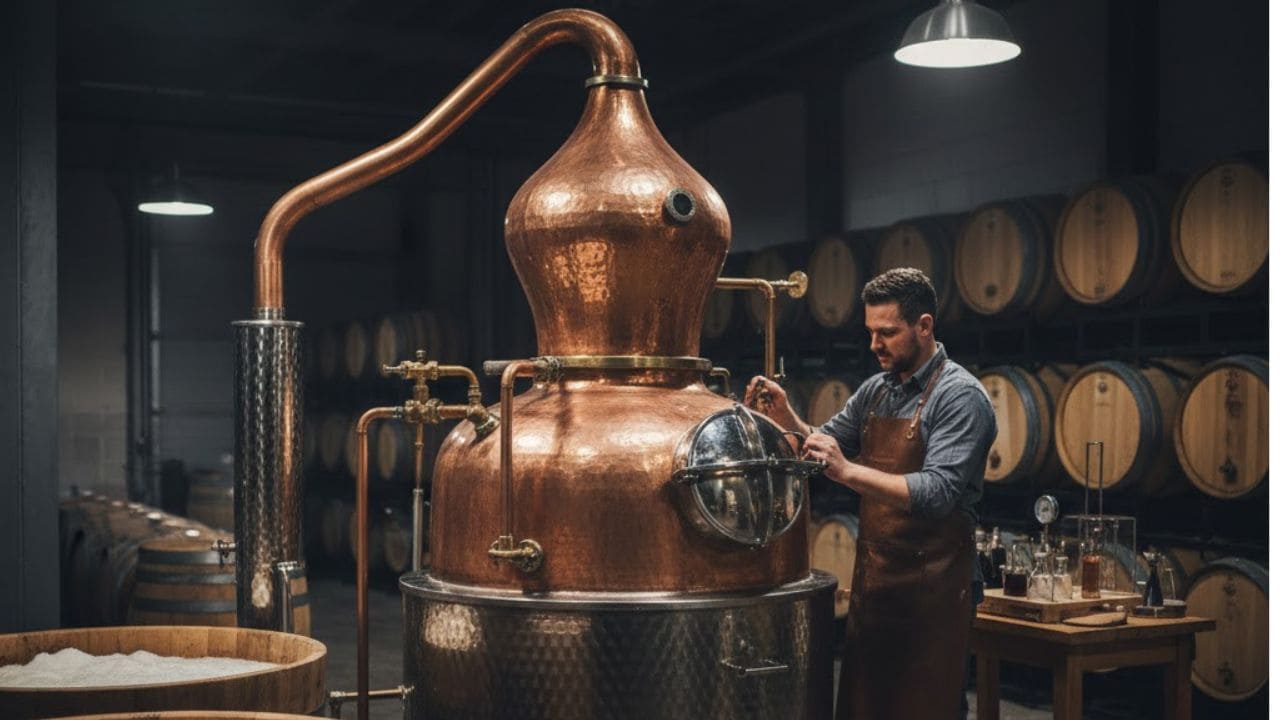
When launching a craft whiskey distillery or scaling from experimental batches to commercial production, selecting the right copper pot still makes the difference between mediocre margins and profitable operations. The 100-500 gallon (380-1900 liter) range represents the sweet spot for nano-distilleries, farm distilleries, and serious craft producers-large enough for legitimate commercial output, small enough to maintain hands-on control and preserve the artisanal character that commands premium pricing.
This guide focuses on three critical decision points: equipment capacity and configuration for your production goals, direct fire versus steam heating for flavor development, and column attachment options that expand versatility without compromising whiskey character. Whether you're investing $15,000 for a bootstrapped startup or $50,000 for a fully-equipped production system, understanding these factors ensures your still purchase aligns with both your whiskey vision and business model.
Table of Contents
Navigate directly to the section you need. Click any link below to jump to detailed information about copper pot stills and craft whiskey distillery equipment.
1. Understanding Copper Pot Stills for Small Batch Whiskey
Copper pot stills operate on batch distillation principles fundamentally different from the continuous column stills used by major whiskey brands. You fill the pot with fermented mash (typically 7-12% ABV beer for whiskey), heat it to vaporize alcohol, collect vapors through the swan neck, condense them back to liquid, and capture the heart cut between undesirable heads and tails. This batch process allows precise control over flavor development-the extended copper contact removes sulfur compounds while preserving esters and congeners that create whiskey's signature character.
The 100-500 gallon capacity range enables production of 15-75 proof gallons per batch after double distillation. A 200-gallon wash still running twice weekly produces approximately 30 proof gallons per week, or 1,560 proof gallons annually-enough to fill roughly 325 standard 750ml bottles weekly or 16,900 bottles annually. These volumes support tasting room sales, regional distribution, and contract distilling arrangements while maintaining craft authenticity.
Copper thickness determines still longevity and heat distribution characteristics. Traditional pot stills use 16-20 gauge copper (1.3-0.8mm thick), with heavier gauge recommended for direct-fired systems. The convex bottom design required for direct firing distributes heat more evenly than flat bottoms, reducing hot spots that cause scorching. Steam-heated stills can use thinner 6-8mm copper since heat distribution is gentler and more uniform.
All quality whiskey stills incorporate several critical features: a substantial pot capacity with 2:1 or 3:1 height-to-diameter ratio for proper vapor separation, a swan neck or lyne arm angled to direct vapors toward the condenser, accessible ports for cleaning and maintenance, temperature gauges at multiple points, and proper union fittings for easy disassembly. The lyne arm angle particularly impacts character-upward angles create more reflux and lighter spirit, while downward angles allow heavier compounds through for fuller-bodied whiskey.
2. Direct Fire vs Steam Heating: Flavor and Operational Trade-offs
Heating method represents perhaps the most consequential decision for whiskey character. This choice affects not only flavor profile but also operational complexity, equipment costs, and production flexibility.
Direct Fire Heating: Traditional Complexity and Flavor Depth
Direct-fired pot stills use gas burners positioned beneath the pot to heat mash directly through the copper bottom. This method produces whiskey with distinctly fuller body and enhanced complexity. The high temperatures achievable-gas flames reach 800-1500°F compared to steam's 240-250°F maximum-promote Maillard reactions that generate furfural, nutty notes, and caramelized flavors. Many craft whiskey producers specifically seek this character, particularly for bourbon, rye, and malt whiskeys where roasted grain flavors complement the distillation profile.
Direct firing requires installation of a rummager-a rotating copper chain assembly that continuously sweeps the pot bottom during distillation. Without this agitation, grain solids settle and burn onto the hot copper, creating unpleasant scorched flavors and potentially ruining batches. The rummager adds $3,000-8,000 to equipment costs depending on still size, plus increases the copper contact surface area which some distillers consider beneficial for sulfur removal.
Operational considerations include significantly shorter equipment lifespan. Direct-fired stills last approximately 10-15 years for wash stills and 8-12 years for spirit stills, compared to 20-25 years and 15-20 years respectively for steam-heated equivalents. The extreme temperatures cause faster copper degradation. Additionally, copper must be 16-20mm thick rather than 6mm, increasing initial material costs by 60-70%. Insurance premiums typically run 15-25% higher due to fire risk, and many jurisdictions impose stricter building code requirements including enhanced ventilation and fire suppression systems.
The operational skill requirement is substantial. Steam heat responds instantly to control inputs-adjust the steam valve and temperature changes within seconds. Gas burners require anticipation and adjustment minutes ahead of desired effects. Turn up the flame too aggressively and you'll overshoot temperatures, potentially causing overflow or scorching. Too conservative and distillation stalls, extending run times and reducing daily throughput. Experienced stillmen develop intuition for managing direct-fired systems, but expect a 6-12 month learning curve.
For craft distilleries positioning whiskey as traditionally-made and premium-priced, direct fire provides authentic storytelling value. Consumers appreciate hearing that their whiskey was "fire-crafted" using methods dating back centuries. This authenticity justifies premium pricing that helps offset higher production costs.
Steam Heating: Precision Control and Consistent Production
Steam-heated stills circulate pressurized steam through internal coils or external jackets surrounding the pot. A remote boiler generates steam, delivering it through insulated piping to the still where it transfers heat to the mash. This indirect heating provides extraordinary control-adjust steam pressure or flow rate and temperatures respond predictably within 30-90 seconds.
The precision enables consistent cut points between distillation runs. You're targeting spirits off the still at specific temperatures and vapor alcohol concentrations. Steam heating's stability makes hitting these targets reliably straightforward, while direct fire's temperature swings require constant adjustment. Consistency matters tremendously for maintaining quality standards batch after batch, particularly important when selling to distributors or building brand recognition.
Steam systems typically require a separate boiler generating 75-150 pounds per hour of steam for 100-300 gallon stills. Boiler costs range from $8,000-25,000 depending on capacity, fuel type (natural gas, propane, electric), and efficiency ratings. Installation includes steam piping, pressure regulators, condensate return systems, and safety valves-budget an additional $5,000-15,000 for complete steam infrastructure. Total installed cost for steam heating generally matches or slightly exceeds direct fire when accounting for all components.
The operational advantages extend beyond temperature control. Steam heating requires no rummager, eliminating a maintenance item and simplifying pot design. Thin-gauge copper reduces material costs and improves heat transfer efficiency, potentially reducing fuel consumption by 20-30% compared to direct fire. The gentler heating prevents scorching even with high-solid grain mashes, giving distillers flexibility to experiment with different mash bills without burning concerns.
From a safety and insurance perspective, steam heating substantially reduces fire risk. While the remote boiler presents some hazard, the distillation area itself has no open flame near alcohol vapors-a significant safety improvement. Insurance companies recognize this lower risk profile with reduced premiums, and building codes impose fewer restrictions on steam-heated facilities.
The flavor profile from steam distillation tends toward cleaner, more refined spirits. Without the high-temperature reactions of direct firing, whiskey emerges with greater grain-forward clarity. This isn't inferior-it's different. Many highly-regarded whiskeys including most Irish whiskeys and the majority of Scotch single malts use steam heating. The character suits grain-forward styles where you want barley, corn, or rye flavors to shine without added complexity from distillation.
For distilleries planning to produce multiple spirit types-vodka, gin, rum alongside whiskey-steam heating's versatility provides clear advantages. The precise control adapts to different spirit requirements, while direct fire's aggressive heating suits whiskey and brandy but challenges vodka and gin production.
3. Column Attachments and Hybrid Still Configurations
Pure pot stills produce spirits at 60-80% ABV after multiple distillations, retaining substantial flavor but requiring multiple runs. Adding column sections transforms a pot still into a hybrid system offering dramatically expanded capabilities while maintaining traditional pot still character.
Understanding Column Still Basics
Column attachments contain plates or perforations that create multiple mini-distillations as vapor rises. Each plate acts as a separation stage-vapor passes upward through the plate, contacts cooler liquid dripping downward, and undergoes partial condensation. The heavier compounds condense and flow back down (reflux), while lighter alcohol molecules continue upward. With sufficient plates (typically 4-20 for craft systems), you can achieve 90-95% ABV in a single pass.
The key parameter is theoretical plates-the number of effective separation stages your column provides. A 4-plate whiskey column offers moderate separation, producing spirits at 70-80% ABV suitable for bourbon or rye. An 8-plate configuration reaches 85-88% ABV, appropriate for lighter whiskeys or white spirits. A 16-20 plate vodka column achieves 92-95% ABV, creating neutral spirits. More plates mean higher proof but less character-you're stripping out the congeners that create flavor.
Bubble cap plates, the most common design, feature raised copper caps with slots allowing vapor to bubble through liquid on each plate. They're robust, easy to clean, and provide good separation efficiency. Perforated plates (sieve plates) use simple hole patterns and cost less but offer slightly lower efficiency and can weep liquid downward during slow operation. For craft whiskey production, bubble cap plates represent the better investment despite 20-30% higher cost.
Modular Column Systems for Whiskey Production
The most versatile approach uses modular column sections that stack onto your pot still. A typical configuration includes a 4-plate whiskey column permanently attached to the pot, with additional 8-12 plate sections that attach when producing vodka or gin. This flexibility allows you to distill bourbon in traditional pot mode or with 4 plates for slightly higher purity, then switch to 16-plate configuration for vodka production using the same base equipment.
Expect to spend $8,000-15,000 for a complete 4-plate copper whiskey column with dephlegmator (reflux management device) suitable for 100-200 gallon stills. Larger 8-12 plate sections for vodka/gin add $12,000-22,000. The columns require 8-12 feet of vertical clearance, so verify your facility ceiling height accommodates the full assembly. Many craft distillers install removable roof sections or locate stills in areas with 15+ foot ceilings specifically to accommodate column extensions.
For bourbon and rye production, limiting your system to 4-6 plates maintains the full-bodied character required by consumer expectations and TTB regulations. Federal standards for bourbon specify distillation to no more than 160 proof (80% ABV), while rye whiskey has the same limit. A 4-plate system typically produces 140-150 proof spirits-well within legal requirements while offering adequate congener reduction for clean flavor development.
Thumpers and Doublers: Simple Secondary Distillation
An alternative to column plates, the thumper (also called a doubler or retort) provides secondary distillation in a simpler, more traditional package. This secondary vessel sits between the pot still and condenser, receiving hot vapor from the first pot. The vapor bubbles through liquid in the thumper, undergoing additional distillation and increasing proof by 20-40%.
Thumpers cost $1,500-4,000 depending on size and construction quality-dramatically less expensive than plate columns while providing meaningful proof increase. They're standard equipment in traditional American whiskey production, particularly for Tennessee whiskey and craft bourbon. The thumper's simpler design means less maintenance and easier operation, though you sacrifice the precise control and higher proof capabilities of plate columns.
For whiskey-focused distilleries without plans to produce neutral spirits, a pot still with thumper represents excellent value. You'll achieve 70-80% ABV spirits in one heating cycle, appropriate for whiskey production, at total equipment costs $5,000-10,000 lower than equivalent column systems. This allows capital allocation toward additional fermentation capacity, barrel inventory, or other business needs.
Hybrid Stills with Integrated Columns
Some manufacturers offer purpose-built hybrid stills combining pot and column elements in optimized configurations. These systems feature a pot still base with an integrated column permanently attached, often with adjustable reflux management allowing variable operation from pure pot mode to high-reflux column mode. Prices for complete hybrid systems in the 100-300 gallon range span $25,000-45,000.
The advantage lies in engineering optimization-the manufacturer designs the pot-to-column transition for ideal vapor flow, incorporates precisely-sized reflux condensers, and balances the system for efficient operation across a range of spirit types. The disadvantage is reduced flexibility; you can't easily reconfigure the column stack or swap components compared to modular systems.
For distilleries planning diverse product portfolios from day one, purpose-built hybrids offer streamlined operation. For producers starting with whiskey and potentially expanding to other spirits later, modular systems provide superior adaptability.
4. Sizing and Capacity Planning for Commercial Production
Matching still capacity to business projections requires understanding the relationships between still size, run frequency, and annual proof gallon output. Undersizing equipment creates immediate production bottlenecks, while oversizing wastes capital and reduces flexibility in smaller batches.
Production Calculations: From Pot Size to Annual Output
A 100-gallon (380L) pot still filled to 75% capacity with 10% ABV mash yields approximately 28 gallons of low wines at 25-30% ABV after first distillation. The second distillation (spirit run) converts those low wines to approximately 10-12 proof gallons of 60-65% ABV hearts after removing heads and tails. Each double-distillation cycle consumes 8-12 hours of active production time plus heating and cooling periods.
Running twice weekly, this 100-gallon system produces 20-24 proof gallons weekly, or 1,040-1,250 proof gallons annually. After dilution to bottling strength (typically 40-50% ABV), this yields 2,000-2,500 finished bottles annually. For tasting room-focused operations with limited distribution, this capacity suffices. For regional distribution requiring 500+ bottles monthly, you'll need larger equipment or additional stills.
A 200-gallon pot still producing 40-48 proof gallons weekly (2,080-2,500 annually) supports regional distribution across 2-3 states with tasting room sales. This capacity aligns with many craft distilleries' growth trajectories in years 2-4 of operation. Initial capital requirements are substantial-$30,000-60,000 for the complete still system-but the production capacity matches realistic business development.
The 300-400 gallon range (60-80 proof gallons weekly, 3,100-4,200 annually) represents serious commercial production. At this scale, you're filling hundreds of barrels yearly, requiring dedicated warehouse space and substantial working capital to fund aging inventory. Equipment costs reach $50,000-100,000 for complete systems, often requiring external financing. This capacity suits established operations expanding from smaller equipment or well-funded startups with aggressive growth projections.
Consider the full production cycle beyond distillation alone. Each 100 gallons of mash requires corresponding fermentation capacity-typically plan for 4-6 fermenters in rotation to maintain consistent still operation. A 200-gallon pot still demands 1,000+ gallons of fermentation capacity, representing $15,000-35,000 in additional equipment. Mash preparation equipment, grain handling, barrel filling systems, and quality control processes all scale with still size.
Multi-Still Strategies vs Single Large Still
An often-overlooked approach installs multiple smaller stills rather than one large unit. Two 150-gallon systems provide equivalent capacity to one 300-gallon still while offering operational advantages: run different mash bills simultaneously, maintain production during maintenance on one unit, and preserve batch-scale control even at higher volumes. The capital investment is 20-30% higher due to duplicated components, but the flexibility often justifies the premium.
This strategy particularly suits distilleries planning multiple whiskey expressions or producing both whiskey and white spirits. Dedicate one still to whiskey production with appropriate column configuration, while the second handles gin, vodka, or experimental batches. The separation prevents flavor cross-contamination and allows optimized configurations for different spirit types.
From a risk management perspective, multiple stills protect against catastrophic equipment failure. Pot still replacement or major repair can take 8-16 weeks-during which production stops completely with a single-still operation. With dual systems, you maintain 50% capacity during repairs, sustaining cash flow and customer commitments.
5. Equipment Manufacturers and Cost Considerations
The craft distilling equipment market offers wide variation in price, quality, and support. Understanding the landscape helps you identify the best value for your specific needs.
Budget Tier: $15,000-25,000 Systems
Several manufacturers target entry-level craft distillers with complete 100-150 gallon systems in this price range. These typically feature stainless steel construction with copper columns, electric heating elements, and basic instrumentation. Quality varies considerably-some represent genuine value while others use thin materials and poor welding that create maintenance headaches.
Olympic Distillers offers complete 100-gallon systems starting around $22,000-25,000, including electric-heated jacketed boilers and copper columns with bubble plates. Their systems serve dozens of operational craft distilleries, demonstrating adequate durability. Affordable Distillery Equipment (based in Missouri) provides 100-gallon jacketed systems starting at approximately $18,000-20,000. Both manufacturers use overseas fabrication, reducing costs but requiring careful inspection upon delivery.
The tradeoffs at this price point include thinner copper (typically 1-1.5mm), potentially under-sized heating elements requiring longer heat-up times, and limited customer support beyond initial installation. Budget an additional 10-15% for improvements like upgraded gaskets, additional temperature probes, and reinforced welds at stress points. Despite limitations, these systems produce quality spirits when operated carefully-several award-winning craft distilleries launched with budget equipment before upgrading as revenues grew.
Crucially, verify that budget equipment meets your jurisdictions' regulatory requirements. TTB approval is essential in the United States, while international operations require appropriate CE marking or local certifications. Cheaper imported equipment sometimes lacks proper documentation, creating permit and insurance complications.
Mid-Range Tier: $30,000-50,000 Systems
This category represents the craft distilling sweet spot-substantially better construction quality and support than budget options, without the premium pricing of top-tier manufacturers. Expect 200-300 gallon capacity, robust copper construction (1.5-2mm thickness), choice of steam or electric heating, comprehensive instrumentation, and solid technical support.
Vendome Copper & Brass Works, the legendary American still manufacturer based in Louisville, Kentucky, offers systems in this range for smaller capacities. Their reputation for quality construction and responsiveness to craft distillers justifies pricing around $35,000-50,000 for 200-gallon complete systems. All-copper construction, precise welds, and decades of whiskey distillation expertise ensure equipment that lasts 20+ years with proper maintenance.
StillDragon, another respected American manufacturer, provides highly modular systems allowing extensive customization. Their 200-gallon base still costs approximately $25,000-35,000, with column sections, condensers, and accessories adding $10,000-20,000 for complete hybrid configurations. The modularity enables starting with basic pot still operation and adding column sections as production requirements evolve.
International options from German manufacturers like Arnold Holstein or Kothe Destillationstechnik deliver exceptional engineering quality in this price range, though shipping costs and lead times (4-6 months typical) require advance planning. German equipment emphasizes precision construction and extensive automation-expect push-button operation versus hands-on American designs.
Mid-range equipment typically includes comprehensive warranties (2-5 years), detailed operational manuals, and responsive technical support. Manufacturers in this tier understand craft distillery business models and design equipment matching typical workflows and space constraints.
Premium Tier: $60,000-100,000+ Systems
Top-tier systems feature full copper construction, advanced automation, superior energy efficiency, and white-glove service. For 300-500 gallon capacity with complete hybrid capabilities, prices reach $60,000-100,000+. This represents significant capital commitment justified only by high-volume operations or distilleries where equipment itself provides marketing value.
Forsyths of Scotland, the world's most prestigious still manufacturer, serves the Scotch whisky industry and selective craft operations. Their handcrafted copper stills represent the ultimate quality with pricing to match-expect $80,000-150,000 for 300-400 gallon systems. The investment buys equipment identical to what produces the world's finest whiskeys, along with unmatched technical consultation.
Carl Artho & Co. in Germany specializes in fruit brandy and whiskey stills incorporating advanced automation including programmable temperature profiles, automatic cut-point determination, and integrated CIP (clean-in-place) systems. Complete 300-gallon systems run $75,000-120,000. The automation reduces labor costs and improves consistency-potentially justifying premium pricing for larger operations.
American manufacturers like Vendome and Independent Stave Company also serve the premium segment with fully customized systems for established craft and regional distilleries. These typically incorporate specific design features requested by the distiller-custom lyne arm angles, specialty condenser configurations, or unique column arrangements-rather than catalog products.
Total System Costs Beyond the Still
Remember that the still purchase represents only 40-60% of total distillation equipment costs. Budget an additional 40-60% for essential auxiliary equipment:
- Condensers and chillers: $3,000-12,000 depending on cooling capacity and efficiency
- Spirit safe and collection vessels: $2,000-8,000 for proper product segregation
- Pumps and transfer systems: $2,000-6,000 for mash handling and spirit transfer
- Heating source (boiler for steam, gas connections for direct fire): $5,000-25,000
- Control systems and instrumentation: $3,000-10,000 for comprehensive monitoring
- Installation, rigging, and commissioning: $5,000-20,000 depending on complexity
- Initial copper cleaning supplies and spare parts: $1,000-3,000
A $30,000 still becomes a $50,000-70,000 complete distillation system once all components are operational. Secure adequate financing for the complete installation rather than buying the still alone and discovering you're short on necessary accessories.
6. Operational Considerations and ROI Planning
Beyond equipment selection, understanding operational economics determines long-term profitability and sustainability.
Labor and Energy Costs
A 200-gallon double-distillation cycle requires approximately 12-16 hours of active operator time: 4-6 hours for the stripping run, 6-8 hours for the spirit run, plus heating and cooling periods. At $20-25/hour labor rates, each production cycle costs $240-400 in direct labor before considering management overhead, quality control, and packaging.
Energy costs vary dramatically by heating method and local utility rates. Electric heating typically consumes 40-60 kWh per production cycle for 200-gallon systems. At $0.12/kWh, this represents $5-7 in electricity costs-negligible compared to labor. Natural gas heating costs approximately $8-15 per cycle, while propane runs $15-25. Steam systems require boiler fuel consumption adding $10-20 per cycle depending on boiler efficiency.
The all-in production cost for converting $50-100 of mash ingredients into 20-25 proof gallons of new-make whiskey ranges from $300-600 including labor, energy, and overhead allocation. This yields a cost per proof gallon of $15-25 before considering barrel aging, inventory carrying costs, and packaging. For whiskey selling at $30-50 per bottle (750ml) at wholesale, gross margins support viable business economics despite the substantial aging period before revenue realization.
Regulatory Compliance and Permitting
Federal DSP (Distilled Spirits Plant) permits through TTB require equipment meeting specific standards. Your still manufacturer should provide documentation confirming compliance, but ultimately you're responsible for ensuring everything meets requirements. State and local permits add additional layers-some jurisdictions restrict still sizes, mandate specific safety equipment, or impose zoning limitations.
Budget 6-18 months for complete permit acquisition before production begins. Legal and consulting fees for this process range from $5,000-25,000 depending on jurisdiction complexity. Many distillers underestimate this timeline and cost, creating cash flow problems when equipment sits idle while awaiting final approvals.
Scaling and Upgrade Paths
Consider your 3-5 year growth trajectory when selecting initial equipment. Purchasing a 150-gallon system knowing you'll need 300-gallon capacity within two years makes little financial sense-the equipment resale market is limited and you'll essentially duplicate capital expenditure. Better to secure adequate financing initially for right-sized equipment than to outgrow equipment prematurely.
Conversely, buying 500-gallon capacity for an unproven product line creates financial risk. The larger equipment demands proportionally larger mash preparation, fermentation, and barrel aging infrastructure-multiplying capital requirements and carrying costs before establishing market demand and sales channels.
A prudent strategy starts with 150-200 gallon capacity for the first 2-3 years while building brand and distribution. Once you're consistently selling 80-90% of production capacity, plan the upgrade to 300-400 gallons. This staged approach matches capital deployment to demonstrated market demand while preserving cash flow during the critical early years.
7. Conclusion
Selecting the right copper pot still for craft whiskey production balances immediate production needs against long-term business vision. The 100-500 gallon range offers sufficient capacity for sustainable commercial operations while maintaining hands-on control and craft authenticity that differentiates your brand.
Direct fire heating provides traditional complexity and fuller flavor profiles ideal for premium positioned whiskeys, while accepting higher operational costs and skill requirements. Steam heating delivers precision control, consistency, and versatility suitable for diverse product portfolios with lower long-term operating costs.
Column attachments expand your still's capabilities from pure pot whiskey to hybrid production including white spirits-maximizing equipment utilization and revenue potential. Whether selecting simple thumpers at $2,000-4,000 or sophisticated modular column systems at $15,000-30,000, match the configuration to your confirmed product roadmap rather than speculative future needs.
Budget $25,000-50,000 for complete entry-level commercial systems in the 150-200 gallon range, or $50,000-100,000 for fully-featured 300-400 gallon production equipment. These investments, while substantial, deliver the production capacity and product quality necessary for profitable craft distillery operations.
Most importantly, select equipment sized for your realistic 18-24 month production requirements rather than aspirational five-year projections. Start with proven capacity, reinvest profits into scaling infrastructure, and maintain the financial flexibility essential for navigating the challenging early years of craft distillery operations. The whiskey market rewards those who produce exceptional products consistently-invest in equipment that enables both exceptional quality and sustainable consistency.
Starting a craft whiskey distillery?
This premium domain is perfect for launching your distillery blog, equipment reviews, or craft spirits education platform focused on small-batch whiskey production and fermentation mastery.