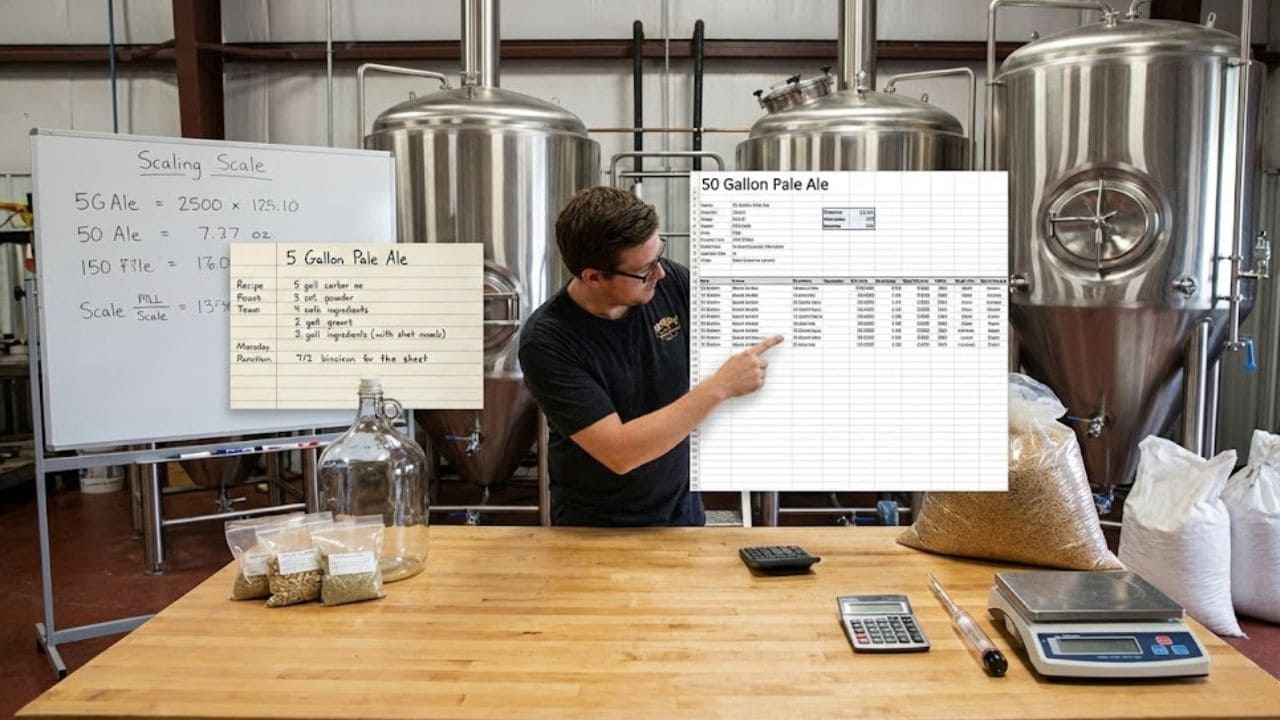
Scaling beer recipes from 5-gallon homebrewing to 50-gallon production batches represents a critical transition point for serious homebrewers eyeing commercial ventures or nano-brewery owners establishing their production systems. This isn't simply multiplying your recipe by ten-volumetric scaling introduces non-linear changes in hop utilization, thermal dynamics, fermentation kinetics, and equipment efficiency that will destroy your carefully crafted beer profile if ignored.
Generic brewing calculators and simple multiplication fail at this scale because they don't account for the physics of larger volumes. A 5-gallon kettle loses heat differently than a 50-gallon system. Hop alpha acid extraction rates change with wort depth and boil vigor. Yeast propagation requirements shift dramatically. Brewhouse efficiency often drops 5-10% when scaling up due to grain bed depth and lautering dynamics.
Expect to invest $5,000-$15,000 for a complete 50-gallon brewing system with proper temperature control, plus $300-500 per batch in ingredients at this scale. This guide will teach you the mathematical formulas, equipment modifications, and process adjustments required to maintain your beer's target IBU, ABV, color, and flavor profile across this critical scale jump.
By the end, you'll master volumetric scaling calculations, understand how to adjust hop schedules for larger boil dynamics, recalculate fermentation timing for increased hydrostatic pressure, and implement quality control protocols that ensure batch-to-batch consistency.
Table of Contents
Navigate directly to the section you need. Click any link below to jump to detailed information about scaling beer recipes from 5 to 50 gallons.
1. Technical Foundation: The Science of Volumetric Scaling
Scaling beer recipes involves understanding the square-cube law: as volume increases linearly, surface area increases at a different rate, fundamentally changing heat transfer, evaporation rates, and extraction efficiency.
Critical Variables That Change Non-Linearly
Heat Transfer Dynamics: A 5-gallon kettle has a surface area to volume ratio of approximately 0.6 ft²/gallon, while a 50-gallon system drops to 0.25 ft²/gallon. This means slower heating and cooling times-what took 20 minutes to reach boiling now requires 60-90 minutes with standard burners. Underpowered heating leads to incomplete hot breaks, poor protein coagulation, and haze issues.
Hop Utilization Rates: Isomerization of alpha acids depends on boil vigor, wort depth, and contact time. In 5-gallon batches with rolling boils, you might achieve 30% utilization for 60-minute additions. In 50-gallon systems with less vigorous boils due to volume, utilization often drops to 22-25%. This requires increasing hop quantities by 15-25% to hit target IBUs, not the linear 10x multiplication.
Fermentation Kinetics: Hydrostatic pressure at the bottom of a 50-gallon fermenter (approximately 2 psi at 4 feet depth) slightly suppresses yeast activity compared to shallow 5-gallon fermenters. Additionally, thermal mass makes temperature swings less dramatic but harder to correct. A 5°F overshoot in a 5-gallon fermenter can be corrected in 30 minutes; the same error in 50 gallons might take 6-8 hours.
Mash Efficiency: Grain bed depth in larger mash tuns reduces flow rates and extraction efficiency. A 5-gallon system might achieve 78% brewhouse efficiency with a 12-inch grain bed, but scaling to 50 gallons with a 24-inch bed often drops to 70-73%. This requires adding 10-15% more grain to hit target gravities.
Common Failure Modes:
- Under-attenuated beer from insufficient yeast pitching
- Excessive bitterness from incorrect IBU scaling calculations
- Stuck fermentations due to inadequate oxygenation
- Oxidation from increased surface area exposure during transfers
- Contamination from inadequate CIP protocols
At 50 gallons per batch, a recipe error costs $500 in ingredients and 40+ hours of labor.
2. Equipment and Systems Comparison for 50-Gallon Brewing
Option 1: Three-Vessel Electric HERMS System
Specifications: 80-gallon stainless hot liquor tank (HLT), 60-gallon mash tun, 65-gallon boil kettle. Dual 5500W heating elements in HLT and kettle. HERMS coil for recirculating mash temperature control. Pumps: March 809 or Chugger (12 GPM capacity). Temperature controllers: PID with 0.5°F accuracy. 240V/50A electrical service required.
Cost Breakdown:
- Equipment: $8,500-12,000 (Blichmann, Spike, or similar)
- Installation: $800-1,500 (electrician for 240V)
- Ongoing per batch: $350-450 (grain, hops, yeast, utilities)
Pros: Precise mash temperature control (±0.5°F), repeatability batch-to-batch, lower labor intensity, professional-grade results.
Cons: High upfront investment, complex troubleshooting when electronics fail, requires dedicated electrical service, not easily portable.
Best For: Serious homebrewers transitioning to commercial or nano-breweries focused on consistency.
Expected Outcomes: 72-75% brewhouse efficiency, 7-8 hour brew days, ±2 IBU consistency, professional-quality beer.
Option 2: Direct-Fire Two-Vessel System
Specifications: 70-gallon mash/lauter tun combo, 65-gallon boil kettle, 200,000 BTU propane burners (one per vessel), gravity feed or single pump system, manual temperature monitoring, stainless steel construction.
Cost Breakdown:
- Equipment: $4,500-6,500
- Propane per batch: $25-35
- Ingredients per batch: $350-450
Pros: Lower initial investment, simple reliable mechanical systems, easier repairs, portable for mobile brewing.
Cons: Less temperature precision (±3-5°F swings), higher labor requirements, weather-dependent if outdoors, propane costs add up.
Best For: Budget-conscious brewers or those brewing outdoors in suitable climates.
Expected Outcomes: 68-72% efficiency, 8-10 hour brew days, ±5 IBU variance, requires experienced brewer for consistency.
Option 3: Single-Vessel Automated Brew System
Specifications: All-in-one 65-gallon vessel (Brewie or PicoBrew industrial), integrated mashing/boiling/whirlpool, automated hop additions and temperature control, recipe software with scaling calculators, 240V/30A electrical.
Cost Breakdown:
- Equipment: $12,000-18,000
- Per batch: $350-450 ingredients
Pros: Minimal labor (4-5 hours hands-off time), consistent automated processes, small footprint, lower skill barrier.
Cons: Highest initial cost, proprietary systems difficult to repair, limited customization, single point of failure.
Best For: Breweries focusing on consistency over variety, operations where labor costs exceed equipment costs.
Expected Outcomes: 74-76% efficiency, 6-7 hour brew days, ±1 IBU consistency, limited recipe flexibility.
3. Equipment Comparison Table
| System Type | Initial Cost | Efficiency | Precision | Skill Level | Best For |
|---|---|---|---|---|---|
| Electric HERMS | $8,500-12,000 | 72-75% | ±0.5°F | Advanced | Commercial-quality consistency |
| Direct-Fire | $4,500-6,500 | 68-72% | ±3-5°F | Intermediate | Budget-conscious outdoor |
| Automated Single-Vessel | $12,000-18,000 | 74-76% | ±0.5°F | Beginner | Labor-saving consistency |
| Hybrid RIMS | $7,000-10,000 | 70-74% | ±1°F | Advanced | Compact precise control |
| Manual 3-Vessel | $3,500-5,000 | 65-70% | ±5-7°F | Expert | Experienced lowest cost |
4. Scaling Calculator Methodology and Formulas
Step 1: Grain Bill Scaling with Efficiency Adjustment
Don't simply multiply grain by 10. Account for efficiency loss:
Scaled Grain (lbs) = [Original Grain × Scale Factor] × (Original Efficiency ÷ Target Efficiency)
Example: 12 lbs pale malt at 78% efficiency (5-gallon batch)
- 50-gallon target: 12 × 10 = 120 lbs baseline
- Efficiency drops to 72%: 120 × (78 ÷ 72) = 130 lbs required
Step 2: Hop Scaling with Utilization Adjustment
Calculate using the Tinseth formula adjusted for volume:
Target IBU = (AAU × Utilization% × 7490) ÷ (Volume × Wort Gravity Adjustment)
Where AAU = Hop Weight (oz) × Alpha Acid %
For larger batches, reduce utilization by 15-20%:
Example: 2 oz Cascade (6% AA) for 60 min in 5 gallons = 35 IBU
- For 50 gallons at reduced utilization:
- New hop weight = 2 × 10 × 1.18 = 23.6 oz (round to 24 oz)
Step 3: Yeast Pitching Rate Calculation
Cells Needed = Volume (mL) × Target Gravity (°P) × 0.75 million cells/mL/°P
For ales: 0.75 million cells/mL/°P
For lagers: 1.5 million cells/mL/°P
Example: 50 gallons (189 L) at 1.055 (13.6°P) ale
- 189,000 mL × 13.6 × 0.75 = 1.93 billion cells
- Requires 2 L starter or 4-5 Wyeast smack packs
5. Step-by-Step Process: 50-Gallon Brew Day
Day 0: Preparation (Evening Before)
The evening before your brew day requires 1-2 hours of preparation. Build your yeast starter (2-3L for 50 gallons), heat 75 gallons strike water to 165-170°F, measure and mill grain (approximately 130 lbs for typical 1.055 OG ale), organize hop additions, sanitize fermenters and transfer equipment, and test pH meter and thermometers for calibration.
Day 1: Brew Day
Hour 1: Mashing In
Heat strike water to calculated temperature: Strike Temp = (0.2 ÷ Grain-to-Water Ratio) × (Target Mash Temp - Grain Temp) + Target Mash Temp. Add grain slowly while stirring to avoid dough balls. Target mash temperature: 150-154°F (65-68°C). Begin recirculation immediately. Check pH: should be 5.2-5.6.
Hours 2-3: Mash Rest and Lautering
Maintain mash temperature within ±2°F for 60 minutes. Perform mashout at 168°F. Recirculate until wort runs clear (15-20 minutes). Begin lautering at 1-2 quarts per minute. Collect 65-68 gallons pre-boil volume. Monitor gravity: targeting 1.042-1.046 for 1.055 final gravity.
Hours 4-5: Boiling
Bring 65 gallons to rolling boil (45-60 minutes). Execute hop schedule:
- 60 min: Bittering hops (target 70% of total IBU)
- 20 min: Flavor hops (20% of total IBU)
- 5 min: Aroma hops
- Flameout: Whirlpool hops (steep 20 min at 180°F)
Target 10-12% boil-off (6-7 gallons evaporation). Post-boil volume: 58-60 gallons at gravity 1.054-1.056.
Hour 6: Chilling and Transfer
Whirlpool 15 minutes, rest 10 minutes for trub settling. Cool to pitching temperature 65-68°F (18-20°C). Plate chiller: 30-40 minutes. Immersion chiller: 60-90 minutes. Transfer to sanitized fermenter, oxygenate during transfer. Sample for gravity reading.
Hour 7: Pitching Yeast
Oxygenate with pure O2: 1 LPM for 60 seconds per 10 gallons (total 6 minutes for 50 gallons). Pitch 400 billion cells (yeast starter or packages). Seal fermenter, set temperature control to 66-68°F (19-20°C).
Days 2-14: Fermentation and Conditioning
Days 2-4: Monitor twice daily. Active fermentation begins 12-18 hours post-pitch. Temperature may rise 2-3°F naturally.
Days 5-10: Peak fermentation. Take gravity readings every 2 days. Maintain 66-68°F. Expected progress: 50-60% attenuation by day 5, 70-80% by day 7, 80-85% by day 10.
Days 11-14: When gravity stable for 2-3 days, raise to 68-70°F for diacetyl rest (2-3 days). Cold crash to 34-38°F for 48 hours.
Day 14+: Packaging
Keg or bottle 58-59 gallons finished beer. Kegging recommended: transfer to three Sanke kegs or ten 5-gallon cornelius kegs. Carbonate at 12-14 PSI for 7-10 days at 38°F. Target carbonation: 2.5 volumes CO2.
6. Scaling Considerations for Commercial Operations
From Pilot to Production Timeline
Year 1: Perfect recipes at 50-gallon scale-target 5-8 core recipes with repeatable results. Log every batch.
Year 2: Increase to weekly batches (1,000 gallons annually). Test market through farmers markets, taproom shares. Calculate true cost: $200 ingredients + $15 utilities + 8 hours labor @ $25/hour = $415 per 20 gallons = $1.04/pint production cost.
Year 3: Decision point-nanobrewery (1-3 barrel system, $50,000-$100,000) or remain advanced homebrewer.
Regulatory Requirements
- TTB (Alcohol and Tobacco Tax and Trade Bureau): Required for commercial production. Brewer's Notice application takes 90-120 days.
- State Licensing: Varies by state-$250-$1,000 for ABC license, facility inspection required.
- Local Health Department: Commercial food production requires inspected facility separate from residential areas.
- Liability Insurance: Product liability insurance $2,000-$5,000 annually.
Commercial Viability Analysis
Economics breakdown:
- Production cost: $1.04/pint
- Retail craft beer: $8-10/pint (bar), $12-16/six-pack (retail)
- Wholesale to taprooms: $6/pint
20-gallon batch = 2,560 oz = 160 pints = $960 revenue - $415 cost = $545 gross profit. The value is recipe development and market testing before larger investment.
7. Resources and Suppliers
Equipment Vendors
- MoreBeer.com: Comprehensive selection, excellent customer service, frequent sales. Free shipping over $59.
- Northern Brewer: Strong community, good starter packages. Retail locations for hands-on inspection.
- SS Brewtech Direct: Purchase directly from manufacturer. Best pricing.
- Homebrew Finds: Daily deals aggregator-save $800+ on system purchases.
Ingredient Suppliers
- Yakima Valley Hops: Direct from farm. 10-lb boxes reduce cost to $8-12/lb vs $18-25/lb retail.
- Malt Source: 55-lb bags ($40-60) vs retail 10-lb bags ($18-30).
- Imperial Yeast: 200 billion cells/package ideal for 20-gallon pitching. $9-11/package.
- Omega Yeast Labs: Large-format, excellent quality, specialty strains.
Educational Resources
- "How to Brew" by John Palmer (4th Edition): Bible of homebrewing, chapters on scaling up. $25.
- "Brewing Better Beer" by Gordon Strong: Competition-focused techniques applicable at all scales.
- "Yeast" by Chris White and Jamil Zainasheff: Comprehensive yeast management for large batches.
Communities and Forums
- Homebrewtalk.com: Largest homebrew forum, 20-gallon brewing subforum, recipe database.
- Reddit r/Homebrewing: Active community, daily Q&A threads, "Advanced Brewers Round Table" weekly.
- American Homebrewers Association (AHA): $48 annual membership, magazine, shop discounts.
8. Your Path Forward: Recommendations and Next Steps
Starting Point Recommendations
If budget-conscious with space constraints: Start with direct-fire two-vessel system. Invest savings in fermentation temperature control-bigger quality impact.
If serious about competition or planning commercial: Electric HERMS system. Temperature precision drives consistency more than any other factor.
If you have outdoor space and enjoy traditional brewing: Three-vessel propane setup. The workflow teaches fundamentals that translate to commercial brewing.
Your First Purchase
Don't buy the complete system first. Purchase fermentation control before brewing equipment. A $200 temperature controller, $150 chest freezer, and 5-gallon batches in controlled fermentation will teach you more about quality than 50-gallon batches in an uncontrolled garage.
Timeline to Proficiency
- Months 1-3: Learn your system-brew simple recipes to understand heating times, efficiency, flow rates.
- Months 4-6: Introduce complexity-step mashes, decoctions, precise hopping. Start logging data.
- Months 6-12: Recipe development-dial in house IPA, enter competitions. By batch 10-12, consistent results.
- Year 2+: You're now the experienced brewer. Consider teaching, commercial exploration, or enjoy abundant house beer.
The difference between 5-gallon hobbyist and 50-gallon serious brewer isn't volume-it's mindset. Process control, systematic troubleshooting, and consistent execution separate good brewing from great brewing. Your first 50-gallon batch will be educational; your tenth will be exceptional. Welcome to serious homebrewing.
Ready to scale your homebrewing operation?
This premium domain is perfect for launching your homebrewing education platform, equipment reviews, or fermentation consulting focused on scaling techniques and commercial transition.