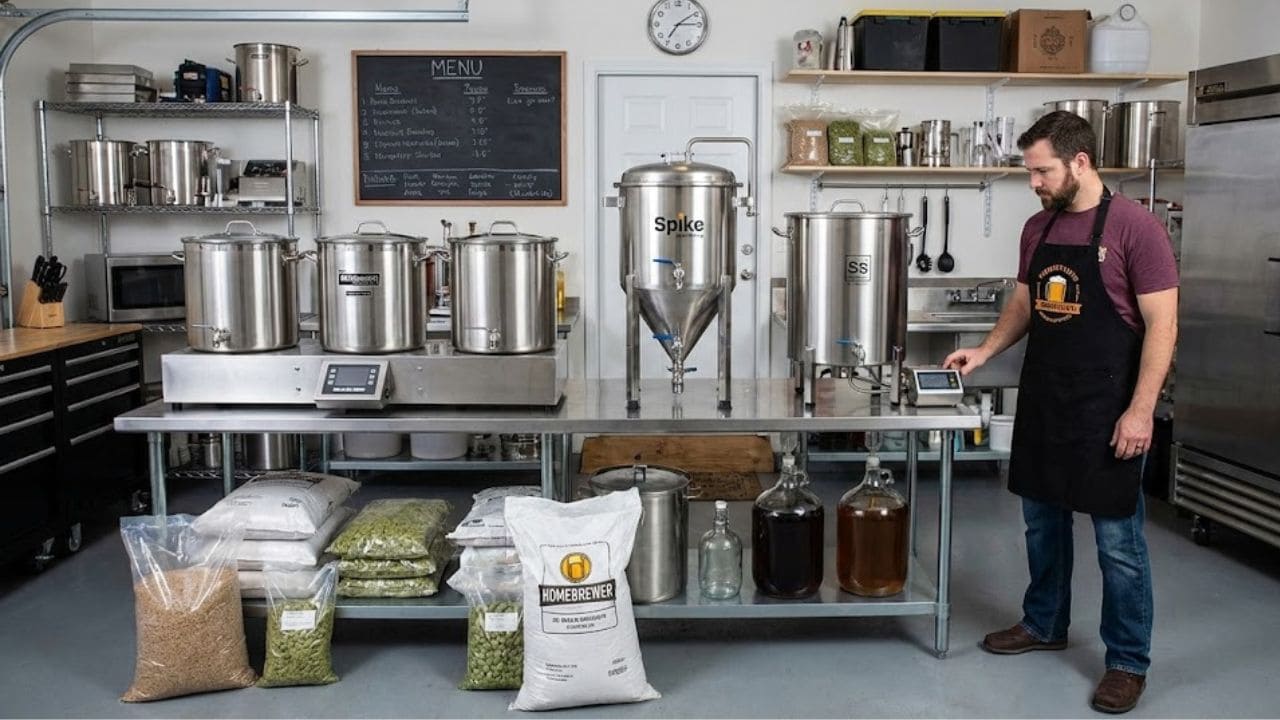
You've outgrown your 5-gallon setup. Your garage fridge is packed with empty kegs, you've mastered recipe formulation, and your friends keep asking when you're "going pro." A 20-gallon brewing system represents the critical transition point between hobbyist and semi-professional brewer-large enough to justify commercial-grade equipment, small enough to refine recipes before significant capital investment, and perfectly sized for supplying a wedding, filling a kegerator for the season, or testing market viability for a future nanobrewery.
But here's the challenge: generic homebrew equipment scales linearly while problems scale exponentially. That propane burner that worked fine for 5 gallons? It'll take 90 minutes to reach strike temperature on 20 gallons, wasting propane and creating oxidation risks. Your plastic bucket fermenter? The headspace-to-volume ratio becomes critical at this scale, and temperature control during active fermentation can swing 15°F (8°C) without proper management, producing fusel alcohols that ruin six weeks of work and $200 in ingredients.
A serious 20-gallon system requires investment between $2,000-$8,000 depending on automation level, plus $150-300 per batch in ingredients. This isn't weekend hobby territory-you're entering the realm where process control, cleaning protocols, and quality assurance separate good beer from dumping 20 gallons down the drain. Commercial breweries don't use fundamentally different techniques; they use better process control, which you'll now need to master.
By the end of this guide, you'll understand the critical differences between system architectures (single-vessel RIMS vs traditional three-vessel vs electric automated), how to calculate true cost-per-pint including labor and utilities, which components justify premium investment versus where to save money, and the specific failure modes that only appear at 20+ gallon scale. Whether you're a competition brewer chasing medals, a homebrewer transitioning to a nanobrewery, or a craft beverage entrepreneur testing kombucha or hard cider formulations, this is your technical roadmap.
Table of Contents
Navigate directly to the section you need. Click any link below to jump to detailed information about 20-gallon brewing systems, equipment comparisons, and scaling considerations.
1. The Science Behind 20-Gallon Batch Brewing
Scaling from 5 to 20 gallons isn't multiplication-it's a phase transition in brewing physics. Your primary challenges shift from "did I follow the recipe" to managing thermal mass, maintaining consistent temperature across larger volumes, and controlling the increased vigor of fermentation that produces 4x the CO2 and heat.
Thermal Dynamics and Energy Requirements
Heating 20 gallons (75.7L) of water from 60°F to 152°F mash temperature requires 153,440 BTUs. A standard propane burner outputs 150,000-200,000 BTU/hour, meaning you'll need 45-60 minutes minimum just for heating, assuming zero heat loss (impossible). Electric systems drawing 5,500 watts (standard 240V/30A circuit) provide only 18,767 BTU/hour-requiring 8+ hours unless you use RIMS (Recirculating Infusion Mash System) or HERMS (Heat Exchange Recirculating Mash System) to maintain rather than achieve temperature.
This isn't academic: every minute of mash temperature deviation from your target affects enzyme activity. Beta-amylase denatures above 158°F (70°C), while alpha-amylase works optimally at 154-162°F (68-72°C). In 5 gallons, you recover quickly from temperature drops. In 20 gallons, thermal inertia means a 5°F drop might take 20 minutes to correct, fundamentally changing your wort fermentability.
Hydrostatic Pressure and Fluid Dynamics
At 20-gallon scale, hydrostatic pressure at the bottom of your mash tun reaches 1.5 PSI-enough to compact grain beds and cause stuck sparges that rarely occurred in smaller batches. This necessitates false bottoms with proper flow dynamics, recirculation pumps rated for high-temperature wort (March pumps or equivalent, not aquarium pumps), and understanding Darcy's Law for fluid flow through porous media. Your sparge water distribution must be uniform; channeling that was annoying in small batches becomes catastrophic when you've invested $250 in grain and hops.
Fermentation Exotherms
Yeast metabolism is exothermic. A 5-gallon batch might generate enough heat to raise temperature 2-3°F during peak fermentation. A 20-gallon batch in active fermentation can spike 10-15°F (5.5-8°C) above ambient in 12 hours without active cooling. For a Belgian tripel fermenting at 75°F (24°C), this means hitting 90°F (32°C)-producing banana and solvent flavors from fusel alcohol production instead of the desired phenolic complexity. You need glycol chilling, fermentation chambers, or at minimum, temperature-controlled space capable of maintaining ±2°F throughout fermentation.
Oxygenation at Scale
Proper yeast health requires 8-10 ppm dissolved oxygen at pitch. Shaking a 5-gallon carboy works. For 20 gallons, you need inline oxygen injection with diffusion stones (0.5-2 micron), pure O2 tanks, and flow rate calculations. Under-oxygenation causes stuck fermentations; over-oxygenation creates oxidative staling. A $40 aquarium pump won't cut it-you need medical-grade oxygen systems ($150-300) or sophisticated aeration equipment.
Common Failure Modes:
- Stuck sparges from compacted grain beds
- Incomplete conversion from poor temperature maintenance
- Oxidation from excessive air exposure during transfers (20 gallons takes longer to move)
- Infection from inadequate cleaning (more surface area to sanitize)
- Yeast stress from poor oxygen management or extreme temperature swings
At this scale, process control isn't perfectionism-it's the difference between success and failure.
2. Detailed System Comparison: 20-Gallon Brewing Equipment
1. Spike Brewing 20-Gallon Solo System ($3,800-$4,500)
Technical Specifications: Single-vessel RIMS system with integrated 5500W heating elements, digital PID temperature controller (±1°F accuracy), stainless steel construction (304SS kettle, 316SS heating elements), integrated sight glass, tri-clamp fittings throughout, March 809-HS high-temperature pump. Complete system includes mash tun/boil kettle (same vessel), hot liquor tank, control panel, and all plumbing.
Cost Breakdown:
- Base system: $3,800
- Optional glycol chiller: $600
- Typical batch ingredients: $180-250
- Electricity per batch: $8-12 (240V/30A circuit required)
Footprint: 4' x 6' brewing area, 30" height clearance. System weight fully loaded: 280 lbs. Requires 240V/30A dedicated circuit (professional electrician installation: $400-800).
Skill Level: Advanced. Requires understanding of PID tuning, pump priming, RIMS flow rates (1-2 GPM optimal), and single-vessel brewing sequence (mash in place, pump out, boil in same vessel).
Pros:
- Fastest brew day (5-6 hours grain-to-fermenter)
- Precise temperature control
- Compact footprint
- Easier cleaning (one vessel for mash/boil)
- Very consistent results
Cons:
- Single-vessel limitation (can't heat sparge water during mash)
- Expensive upfront
- Requires electrical work
- Pump failure stops brewing
- Learning curve for optimal flow rates
Best For: Homebrewers with limited space, those prioritizing consistency over flexibility, brewers making multiple same-recipe batches.
Expected Outcomes: Brewhouse efficiency 82-87%, batch time 5.5 hours average, 19-20 gallons into fermenter (accounting for losses). Competition-quality reproducibility.
2. Blichmann Tower of Power ($4,200-$5,000)
Technical Specifications: Three-tier gravity-fed system, three 20-gallon stainless kettles with etched volume markings, TopTier modular stand (38" top tier height), integrated thermometers, BoilerMaker kettles with tri-clamp ports. Heating via two propane burners (160,000 BTU each) or optional electric elements.
Cost Breakdown:
- Base tower + kettles: $4,200
- Propane burners: Included (or +$800 for electric)
- Batch ingredients: $180-250
- Propane per batch: $12-18 (two 20lb tanks)
Footprint: 4' x 4' floor space, 6'6" height (requires tall ceilings or outdoor space). Empty weight: 180 lbs.
Skill Level: Intermediate to advanced. Gravity-fed systems are intuitive but require strong lifting for grain removal, understanding of flow dynamics, and careful timing between vessels.
Pros:
- Simultaneous heating (heat sparge water during mash, heat boil during sparge)
- Natural circulation
- Impressive appearance
- Traditional three-vessel workflow
- No pumps to fail
- Great for brewing demonstrations
Cons:
- Requires outdoor space or very tall ceilings
- Heavy lifting (lifting 40 lbs of hot spent grain to height)
- Propane logistics
- Weather-dependent if outdoors
- Harder to clean three separate vessels
Best For: Brewers with outdoor space, those who enjoy traditional brewing process, people scaling up to eventual commercial nanobrewery (mimics commercial workflow).
Expected Outcomes: Brewhouse efficiency 78-84%, batch time 6-7 hours, excellent for training future brewery employees on three-vessel process.
3. Anvil Foundry 20-Gallon All-In-One ($800-$950)
Technical Specifications: Single-vessel electric system, 1600W + 1000W heating elements (120V compatible), recirculation pump integrated, digital temperature controller, grain basket with perforated bottom, programmable mash steps, compact design. 304 stainless construction.
Cost Breakdown:
- System: $850
- Batch ingredients: $180-250
- Electricity per batch: $3-5 (120V standard outlet)
- No additional infrastructure needed
Footprint: 2' x 2', 32" tall. Weight loaded: 220 lbs. Works on standard kitchen counter or rolling cart.
Skill Level: Beginner to intermediate. Most user-friendly system, smartphone app control, guided brewing modes.
Pros:
- Budget-friendly entry to 20-gallon brewing
- No electrical work required (120V)
- Extremely compact
- Easy cleanup
- Built-in recirculation prevents stuck sparges
- Programmable for repeatability
Cons:
- Slower heating (3+ hours grain to fermenter ready)
- Limited to 120V power availability
- Smaller boil-off rate (requires longer boils for proper volatilization)
- Some users report pump reliability issues after 30+ batches
Best For: Apartment/condo brewers without outdoor space, beginners scaling up from extract brewing, cost-conscious brewers, those testing 20-gallon scale before bigger investment.
Expected Outcomes: Brewhouse efficiency 74-80% (lower due to grain basket design), batch time 7-8 hours, good beer quality but less professional than high-end systems.
4. SS Brewtech 20-Gallon Brew Bucket + Heat System ($2,400-$3,200)
Technical Specifications: Modular approach-separate mash tun, boil kettle, and advanced fermenter. Brew Bucket features 304SS construction, rotating racking arm, sample port, thermowell, FTSs (Fermentation Temperature Stabilization System) integration. Pair with Kettle + Mash Tun or all-in-one brewing system.
Cost Breakdown:
- Brew Bucket chronical fermenter: $600
- FTSs temperature control: $400
- Mash tun + kettle: $1,400-$2,200 (depending on configuration)
- Batch ingredients: $180-250
Footprint: Variable (4' x 6' for full system), fermenter: 24" x 36" including temperature control.
Skill Level: Intermediate. Requires understanding of closed transfers, fermentation temperature management, and cleaning CIP (clean-in-place) processes.
Pros:
- Professional-grade fermentation control (±0.5°F)
- Closed transfers minimize oxidation
- Sample port for testing without opening
- Modular approach allows upgrading in stages
- Excellent for breweries transitioning to commercial
Cons:
- Expensive for complete system
- Fermentation temperature control adds complexity
- Requires glycol chiller or temperature-controlled space
- Cleaning conical fermenters requires more effort than carboys
Best For: Quality-obsessed homebrewers, competition brewers, those planning commercial transition, lager brewers requiring precise temperature control.
Expected Outcomes: Brewhouse efficiency 80-85%, superior fermentation outcomes (cleaner flavors, better attenuation consistency), produces commercial-quality beer at homebrew scale.
5. Custom-Built 20-Gallon Electric System ($1,800-$2,800)
Technical Specifications: DIY approach using 20-gallon stainless kettles (often repurposed kegs), aftermarket heating elements (5500W ultra-low-watt-density elements), PID controllers (Auber or Inkbird), home-wired control panels, March or Chugger pumps. Requires electrical knowledge and welding/drilling for kettle modifications.
Cost Breakdown:
- Three 20-gallon kettles: $600-900 (new or used)
- Heating elements + PIDs: $400-600
- Pumps and plumbing: $300-500
- Control panel components: $200-400
- Labor: 40-60 hours DIY
Footprint: Variable, typically 4' x 6' for three-vessel configuration.
Skill Level: Advanced to expert. Requires welding, electrical wiring (240V), understanding of control logic, troubleshooting skills.
Pros:
- Lowest cost for high-end capabilities
- Complete customization
- Repairable (you built it)
- Satisfaction of DIY
- Great learning experience
- Can be upgraded incrementally
Cons:
- Time-intensive build
- Requires tools and skills (welder, drill press, electrical knowledge)
- No warranty or support
- Potential safety issues if poorly executed
- May not pass electrical inspection
Best For: Engineers, tinkerers, extreme budget-conscious brewers with skills, those who enjoy building as much as brewing.
Expected Outcomes: Brewhouse efficiency 78-86% (depending on build quality), performance equivalent to commercial systems if properly executed, significant pride of ownership.
6. Bru Gear Direct Fire 20-Gallon System ($2,200-$2,800)
Technical Specifications: Two-vessel system (mash/lauter tun + boil kettle), heavy-gauge stainless construction, stand with propane burners (160,000 BTU), sight glasses, thermometers, ball valves, optional pump add-on. Traditional design optimized for direct fire.
Cost Breakdown:
- Base system (two vessels + stand): $2,200
- Optional pump: $300
- Batch ingredients: $180-250
- Propane per batch: $10-15
Footprint: 3.5' x 5', requires outdoor space or excellent ventilation (propane combustion produces CO and water vapor).
Skill Level: Intermediate. Straightforward workflow, requires manual transfer management and attention to boil-overs.
Pros:
- Mid-range price point
- Fast heating with propane
- Simple mechanical design (less to break)
- Suitable for outdoor brewing clubs
- Good for hop-forward beers (vigorous boil improves hop utilization)
Cons:
- Requires outdoor space
- Propane logistics
- Manual transfers if not adding pump
- Less precise temperature control than electric systems
- Weather-dependent
Best For: Outdoor brewers, clubs doing group brew days, hop-forward beer specialists (IPAs, DIPAs), those preferring traditional methods.
Expected Outcomes: Brewhouse efficiency 76-82%, batch time 6-7 hours, excellent for aggressive hop schedules requiring vigorous boils.
7. Grainfather G70 ($3,200-$3,600)
Technical Specifications: 18.5-gallon capacity all-in-one electric system, 3200W heating, built-in pump and recirculation, connect app for recipe management and brewing guidance, counterflow chiller integrated, delayed start feature, compact footprint. 240V system.
Cost Breakdown:
- G70 system: $3,200
- Batch ingredients: $180-250
- Electricity: $6-9 per batch
- Electrical installation: $400-800 (240V circuit)
Footprint: Smallest in category-18" x 18", 40" height. Weight loaded: 200 lbs.
Skill Level: Beginner to intermediate. App-guided brewing walks through every step, automated temperature management.
Pros:
- Ultra-compact (fits in apartment)
- App connectivity tracks every batch
- Consistent results through automation
- Integrated chiller (no separate equipment)
- Delayed start allows morning mash while sleeping
Cons:
- Smaller actual capacity (18.5 gallons, not 20)
- Expensive for feature set
- Proprietary design limits modifications
- Requires stable WiFi for app features
- Some complexity troubleshooting electronics
Best For: Tech-savvy brewers, space-constrained environments, consistency-focused brewers building recipe database, beginners wanting guided experience.
Expected Outcomes: Brewhouse efficiency 78-83%, batch time 6-7 hours, excellent recipe tracking and reproducibility through app data logging.
3. Comparison Table: 20-Gallon Brewing Systems
| System | Price | Heat Source | Efficiency | Skill Level | Footprint | Best For |
|---|---|---|---|---|---|---|
| Spike Solo | $3,800-$4,500 | Electric (240V) | 82-87% | Advanced | 4'×6' | Consistency, limited space |
| Blichmann Tower | $4,200-$5,000 | Propane | 78-84% | Intermediate+ | 4'×4'×6.5'H | Traditional, outdoor |
| Anvil Foundry | $850-$950 | Electric (120V) | 74-80% | Beginner-Int | 2'×2' | Budget, apartments |
| SS Brewtech | $2,400-$3,200 | Variable | 80-85% | Intermediate | 4'×6' | Competition, quality |
| Custom DIY | $1,800-$2,800 | Electric (240V) | 78-86% | Expert | 4'×6' | Tinkerers, budget |
| Bru Gear | $2,200-$2,800 | Propane | 76-82% | Intermediate | 3.5'×5' | Outdoor, clubs |
| Grainfather G70 | $3,200-$3,600 | Electric (240V) | 78-83% | Beginner-Int | 18"×18" | Tech, ultra-compact |
4. Step-by-Step Process: Brewing 20 Gallons of American IPA
Day 1 - Brew Day (6-8 hours total)
Hour 0-1: Preparation and Heating (Water Chemistry)
Heat 30 gallons total water (15 gallons strike water to 162°F, 15 gallons sparge water to 170°F). For electric systems drawing 5500W, begin heating strike water 90 minutes before mash-in. Add water chemistry: For American IPA profile, target 150ppm sulfate, 50ppm chloride (3:1 ratio emphasizes hop bitterness). Add 1 tsp gypsum and 0.5 tsp calcium chloride per 10 gallons. Verify pH 5.8-6.0 before mash.
Hour 1-2.5: Mashing (Critical Temperature Control)
Mash-in with 55 lbs two-row base malt, 3 lbs crystal 15L, 2 lbs white wheat at 152°F target (actual stabilized temp 150-154°F acceptable). Grain bed depth in 20-gallon tun: 12-14 inches. Begin recirculation immediately at 1-1.5 GPM-slower flow than 5-gallon systems due to grain bed depth. Monitor for stuck sparge: flow should remain constant. Mash 60 minutes. Temperature will drop 2-3°F naturally; add heat at 30-minute mark if using RIMS/HERMS.
Critical Control Point: Check conversion at 45 minutes with iodine test. Incomplete conversion at this scale wastes significant money-if starch present, extend mash 15-30 minutes and raise temperature to 156°F.
Hour 2.5-4: Lautering and Sparging (Patience Required)
Vorlauf (recirculate) until clear runoff-typically 2-3 gallons for 20-gallon batch. Begin fly sparging at 1 GPM maximum-faster rates compact grain bed. Monitor kettle gravity with refractometer: first runnings should be 1.065-1.070. Continue sparging until reaching pre-boil volume of 23 gallons at target gravity 1.052 (adjusts to 1.062 post-boil for OG).
Troubleshooting: Stuck sparge? Stop flow, stir top 2" of grain bed gently with mash paddle, add 2 gallons 180°F water on top, wait 10 minutes, resume slower (0.5 GPM). Prevention: rice hulls (1 lb) in grist for wheat-heavy beers.
Hour 4-5.5: Boiling (Hop Schedule Management)
Bring 23 gallons to rolling boil-propane systems achieve this in 20-30 minutes, electric in 45-60 minutes. Boil-off rate at 20-gallon scale: 2-3 gallons/hour (verify with your system). Total boil 75 minutes for DMS removal from pilsner malt.
Hop Schedule (20 gallons IPA):
- 60 min: 4 oz Magnum pellets (bittering, target 55 IBU)
- 15 min: 2 oz Centennial, 2 oz Simcoe (flavor)
- 5 min: 3 oz Mosaic, 2 oz Citra (aroma)
- Flameout: 4 oz Citra, 3 oz Mosaic (steep 20 min at 180°F)
- Dry hop: 6 oz Citra + 4 oz Mosaic (day 3 of fermentation)
Hour 5.5-6.5: Chilling and Transfer
Using immersion chiller: 23 gallons requires 45-60 minutes to reach 68°F (20°C). Using counterflow chiller: 20-30 minutes. Critical: chill rapidly through 120-80°F range (danger zone for lacto/pedio contamination). Target pitch temperature: 66°F (19°C) for clean American ale fermentation.
During transfer to fermenter, inline oxygenate with pure O2 at 1 LPM for 60 seconds (achieves 8-10ppm DO). Take pre-fermentation sample: measure OG (target 1.062), pH (should be 5.1-5.3 from hop acids), and visual clarity.
Day 1 Evening: Pitching Yeast
Pitch 400 billion cells (two liquid yeast packages or one 200mL starter). For 20 gallons, under-pitching causes slow starts and ester production. Seal fermenter, set temperature control to 66°F (19°C).
Day 2-3: Primary Fermentation Begins
Active fermentation begins 12-18 hours post-pitch. Temperature will spike naturally-your cooling system must counteract. Monitor:
- Day 2: Gravity should drop to 1.050-1.045 (fermentation active)
- Day 3: Add dry hops (10 oz total), gravity 1.030-1.025
Day 4-7: Active Fermentation Management
Peak fermentation day 3-4. Temperature control critical: maintain 66-68°F (19-20°C). Sample daily gravity:
- Day 4: 1.020-1.018
- Day 5: 1.015-1.013
- Day 6: 1.012-1.011
- Day 7: 1.012 (stable, fermentation complete)
Quality Control: If gravity stalls above 1.015 (expected FG 1.012), rouse yeast by gentle swirling, raise temperature to 70°F for diacetyl rest, or check pH (should be 4.2-4.5).
Day 8-10: Conditioning
Raise temperature to 70°F for 48-hour diacetyl rest, then cold crash to 34°F (1°C) for 48 hours. Dry hops will drop, beer clarifies naturally.
Day 11: Packaging
Keg or bottle 19 gallons finished beer (1 gallon loss to trub/dry hops). Target carbonation: 2.5 volumes CO2. Kegging: force carbonate at 12 PSI for 7 days at 38°F. Bottling: prime with 4.5 oz dextrose for entire batch.
Safety Considerations: At 20-gallon scale, CO2 production during active fermentation can displace oxygen in small rooms-ensure ventilation. Handling 200+ lb boil kettles requires caution. Pressure transfers require understanding of PSI limits for vessels.
5. Scaling Considerations: From Homebrew to Commercial
Pilot Batch to Production Timeline
Year 1: Perfect recipes at 20-gallon scale-target 5-8 core recipes with repeatable results. Log every batch: gravity, pH, temperature deviations, taste notes. Your 20-gallon system is recipe development before capital investment.
Year 2: Increase frequency to weekly 20-gallon batches (1,000 gallons annually). Test market through farmers markets, taproom shares, friends/family feedback. Calculate true cost: $200 ingredients + $15 utilities + 8 hours labor @ $25/hour = $415 per 20 gallons = $1.04/pint production cost.
Year 3: Decision point-nanobrewery (1-3 barrel system, $50,000-$100,000) or remain advanced homebrewer. Your 20-gallon system becomes pilot brewery for new recipes while 3-barrel produces flagship beers.
Regulatory Requirements
- TTB (Alcohol and Tobacco Tax and Trade Bureau): Required for commercial alcohol production. Brewer's Notice application takes 90-120 days, requires bonding, extensive paperwork. Your 20-gallon system falls under "homebrew exemption" (under 200 gallons annually per household).
- State Licensing: Varies dramatically-California requires ABC license ($250-$1,000), inspection of facility. Some states allow "cottage brewery" licenses for very small production.
- Local Health Department: Commercial food production requires inspected facility, separate from residential areas. Your 20-gallon homebrew setup likely doesn't qualify for commercial licensing without facility upgrades.
- Liability Insurance: Commercial brewers need product liability insurance ($2,000-$5,000 annually).
Commercial Viability Analysis
Can you make money at 20-gallon scale? Not really-but you can offset costs.
Economics breakdown:
- Production cost: $1.04/pint
- Retail craft beer: $8-10/pint (bar), $12-16/six-pack (retail)
- Your cost per six-pack equivalent: $12.48
If selling legally through local brewery alternating proprietorship or as homebrew club, you might achieve $6/pint wholesale to taprooms. 20-gallon batch = 2,560 oz = 160 pints = $960 revenue - $415 cost = $545 gross profit. Minus your labor? Break-even at best. The value is recipe development and market testing before larger investment.
Distribution and Packaging Options
- Kegging: Most practical for 20-gallon batches. Four 5-gallon kegs, distributed to local bars through alternating proprietorship arrangements.
- Bottling: Hand-bottling 20 gallons (≈200 bottles) takes 3-4 hours. Invest in bottle filler ($80), capper ($40), bottles ($100 for 200).
- Crowlers/Cans: Mobile canning services will can batches as small as 30 gallons-combine two 20-gallon batches. Cost: $0.50-$0.75/can including can, packaging, labor.
Equipment Investment Timeline
- Months 1-6: Basic 20-gallon system ($2,000-$4,000)
- Months 6-12: Fermentation control ($800), kegging system ($600)
- Year 2: Additional fermenters for pipeline (3x $600 = $1,800)
- Year 3: Decision-commercial leap ($50,000+) or remain pro-sumer
6. Resources and Supplies for 20-Gallon Brewing
Equipment Vendors
- MoreBeer.com: Comprehensive selection, excellent customer service, frequent sales. Spike Brewing authorized dealer. Expect 10-15% off during Black Friday sales. Free shipping over $59.
- Northern Brewer: Strong community, good starter packages. Anvil Foundry available here. Retail locations in many cities for hands-on inspection.
- SS Brewtech Direct: Purchase chronicals and fermentation systems directly from manufacturer. Best pricing, but no third-party retailer discounts.
- Homebrew Finds (website): Daily deals aggregator-can save $800+ on system purchases by catching flash sales.
- Local Homebrew Shops: Support local, get immediate advice, often price-match online. Denver's Hop Project, Portland's F.H. Steinbart, Austin's Austin Homebrew Supply are standouts.
Ingredient Suppliers (Quality vs. Cost)
- Yakima Valley Hops: Direct from farm, bulk pricing. 10-lb hop boxes reduce cost to $8-12/lb vs $18-25/lb retail. Critical for hop-forward beers at 20-gallon scale.
- Malt Source: Central malt distributor, 55-lb bags ($40-60) vs retail 10-lb bags ($18-30). One 20-gallon batch uses 60 lbs malt-bulk purchasing mandatory.
- Imperial Yeast: Larger format yeast (200 billion cells/package) ideal for 20-gallon pitching rates. $9-11/package vs propagating starters.
- Omega Yeast Labs: Similar large-format, excellent quality, specialty strains for experimental beers.
Communities and Forums
- Homebrewtalk.com: Largest homebrew forum, extensive equipment reviews, 20-gallon brewing subforum, recipe database. Electric brewery thread is legendary resource for DIY builds.
- Reddit r/Homebrewing: Active community, daily Q&A threads, quick responses. "Advanced Brewers Round Table" weekly thread covers 20+ gallon scale issues.
- American Homebrewers Association (AHA): $48 annual membership includes magazine, discounts at shops (saves $100+ annually), competition entry discounts, community forums.
- Local Homebrew Clubs: Find via AHA club finder. Monthly meetings, group buys (split 55-lb malt bags), shared equipment, competition practice. Critical for scaling up-learn from others' mistakes.
Books and Courses
- "How to Brew" by John Palmer (4th Edition): Bible of homebrewing, chapters on scaling up, extensive technical detail. $25, worth 100x that.
- "Brewing Better Beer" by Gordon Strong: Competition-focused techniques, applicable at all scales. Strong is BJCP Grandmaster, multiple Ninkasi Award winner.
- "Yeast" by Chris White and Jamil Zainasheff: Comprehensive yeast management-critical at 20-gallon scale where pitching rates matter.
- Online Courses: Craft Beer & Brewing's "Advanced All-Grain Brewing" ($79), covers 10-30 gallon techniques. Brewing Science Institute offers professional-level courses ($300-500) if considering commercial transition.
Professional Associations
- Brewers Association: If planning commercial transition, professional membership ($395/year) provides resources, conferences, regulatory guidance.
- Master Brewers Association: Technical focus, scientific brewing resources, valuable if you're engineering-minded.
- BJCP (Beer Judge Certification Program): Study and certify as beer judge-improves your own brewing immensely by training palate. Free to study, $25 exam fee.
7. Your Path Forward: Recommendations and Next Steps
Starting Point Recommendations by Situation
If you're budget-conscious with space constraints: Begin with Anvil Foundry ($850). It'll produce good beer, teach you 20-gallon scale challenges, and you can upgrade later. Invest savings in fermentation temperature control-bigger quality impact than equipment.
If you're serious about competition or planning commercial: SS Brewtech fermentation system paired with mid-range brew setup. Fermentation control drives quality more than brewing equipment precision. A $600 Brew Bucket with FTSs will make better beer than a $4,000 brew system with a plastic bucket fermenter.
If you have space and enjoy traditional brewing: Blichmann Tower or Bru Gear direct-fire systems. The workflow teaches you fundamentals that translate to commercial brewing, and the equipment will last decades.
If you're technical and enjoy building: Custom electric build. Join Homebrewtalk electric brewery thread, order components over 3 months, spend winter weekends building. You'll understand every component intimately-invaluable for troubleshooting.
Your First Purchase
Don't buy the complete system first. Purchase fermentation control before brewing equipment. A $200 Inkbird temperature controller, a $150 chest freezer, and 5-gallon batches in controlled fermentation will teach you more about quality than 20-gallon batches in an uncontrolled garage. Once you've mastered fermentation management at small scale, invest in the 20-gallon system-you'll know what quality tastes like.
Timeline to Proficiency
Mastering 20-gallon brewing is a journey, not a destination. Here's a realistic timeline for developing the skills and consistency that separate good homebrewers from exceptional ones:
- Months 1-3: Learn your system's quirks-brew simple recipes (pale ales, blondes) to understand heating times, efficiency, flow rates. Expect first batch to hit 74-76% efficiency; by batch 3 you'll reach 80%+.
- Months 4-6: Introduce complexity-step mashes, decoctions, precise hopping schedules. Start logging data systematically.
- Months 6-12: Recipe development-dial in house IPA, create seasonal variations, enter competitions. By batch 10-12 you'll achieve consistent results.
- Year 2+: You're now the experienced brewer helping others. Consider teaching, commercial exploration, or simply enjoying abundant house beer.
The difference between 5-gallon hobbyist and 20-gallon serious brewer isn't volume-it's mindset. You're entering a realm where process control, systematic troubleshooting, and consistent execution separate good brewing from great brewing. Your first 20-gallon batch will be educational; your tenth will be exceptional. Welcome to serious homebrewing.
Ready to scale your homebrewing operation?
This premium domain is perfect for launching your homebrewing blog, equipment reviews, or fermentation education platform focused on advanced brewing techniques and 20-gallon systems.